

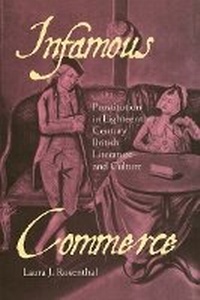
Infamous Commerce
Prostitution in Eighteenth-Century British Literature and Culture
Published on 19. March 2015
Book
Paperback/Softback
288 pages
978-0-8014-5681-7 (ISBN)
Description
In Infamous Commerce, Laura J. Rosenthal uses literature to explore the meaning of prostitution from the Restoration through the eighteenth century, showing how both reformers and libertines constructed the modern meaning of sex work during this period. From Grub Street's lurid "whore biographies" to the period's most acclaimed novels, the prostitute was depicted as facing a choice between abject poverty and some form of sex work. Prostitution, in Rosenthal's view, confronted the core controversies of eighteenth-century capitalism: luxury, desire, global trade, commodification, social mobility, gender identity, imperialism, self-ownership, alienation, and even the nature of work itself.
In the context of extensive research into printed accounts of both male and female prostitution-among them sermons, popular prostitute biographies, satire, pornography, brothel guides, reformist writing, and travel narratives-Rosenthal offers in-depth readings of Samuel Richardson's Clarissa and Pamela and the responses to the latter novel (including Eliza Haywood's Anti-Pamela), Bernard Mandeville's defenses of prostitution, Daniel Defoe's Roxana, Henry Fielding's Tom Jones, and travel journals about the voyages of Captain Cook to the South Seas. Throughout, Rosenthal considers representations of the prostitute's own sexuality (desire, revulsion, etc.) to be key parts of the changing meaning of "the oldest profession."
In the context of extensive research into printed accounts of both male and female prostitution-among them sermons, popular prostitute biographies, satire, pornography, brothel guides, reformist writing, and travel narratives-Rosenthal offers in-depth readings of Samuel Richardson's Clarissa and Pamela and the responses to the latter novel (including Eliza Haywood's Anti-Pamela), Bernard Mandeville's defenses of prostitution, Daniel Defoe's Roxana, Henry Fielding's Tom Jones, and travel journals about the voyages of Captain Cook to the South Seas. Throughout, Rosenthal considers representations of the prostitute's own sexuality (desire, revulsion, etc.) to be key parts of the changing meaning of "the oldest profession."
Reviews / Votes
Rosenthal offers an intriguing account of the changing figure of the prostitute in Restoration and 18th-century British culture. Tracing the transition from 'prostitution as the embrace of pleasure' to 'prostitution as the sacrifice of pleasure to business,' she argues that early in the period prostitutes were represented as 'desiring women,' longing for sexual fulfillment and receiving payment only incidentally, but that over time they came to be depicted as enterprising capitalists who engaged in sex only incidentally, in the process becoming alienated from their labor. The author pursues this thesis through a satisfying mix of texts, some firmly canonical (Clarissa, Tom Jones), some quasi-canonical (Roxana, Fanny Hill), and some obscure (prostitute biographies, South Sea narratives). Rosenthal discovers new points of contact between gender studies and labor history, and along the way touches on industrialization, contractual relations, consumerism, societies for the reformation of manners, Jewish identity, and the history of the novel. Her close readings are sensitive and well informed; the book is also pleasingly readable and therefore accessible even to nonspecialists.(Choice) What is most surprising about Laura Rosenthal's wonderfully textured cultural history of prostitution in eighteenth-century Britain is that it was not written earlier. Given the predominance of the whore's story in the period and 'the copious, even obsessive, writing about prostitution in the eighteenth century,' as Rosenthal rightly attests, the fact that no comprehensive survey of this literature had been published to date seems like a critical aberration that Infamous Commerce finally corrects.... Her book overflows with convincing and persuasive readings of individual texts because of the analytical simplicity and critical complexity of its historical thesis.... Infamous Commerce opens a flood of so many new possibilities (new texts, new readings, new histories) that it has immediately become an ur-text in the field. Every future scholar of eighteenth-century prostitution and prostitute narratives will cite this work.
(Tulsa Studies in Women's Literature)
More details
Language
English
Place of publication
Ithaca
United States
Target group
College/higher education
Professional and scholarly
Product notice
Paperback (trade)
Illustrations
1 halftone - 1 Halftones, black and white
Dimensions
Height: 229 mm
Width: 152 mm
Thickness: 19 mm
Weight
454 gr
ISBN-13
978-0-8014-5681-7 (9780801456817)
Copyright in bibliographic data and cover images is held by Nielsen Book Services Limited or by the publishers or by their respective licensors: all rights reserved.
Schweitzer Classification
Other editions
Additional editions
Laura J. Rosenthal
Infamous Commerce
Prostitution in Eighteenth-Century British Literature and Culture
E-Book
03/2015
Cornell University Press
€28.49
Available for download
Person
Laura J. Rosenthal is Professor of English at the University of Maryland. She is the author of Playwrights and Plagiarists in Early Modern England: Gender, Authorship, Literary Property and coeditor of Monstrous Dreams of Reason: Body, Self, and Other in the Enlightenment.
Content
Introduction1. A "Cool State of Indifference": Mother Creswell's Academy2. The "Deluge of Depravity": Bernard Mandeville and the Reform Societies3. Whore, Turk, and Jew: Defoe's Roxana4. Fanny's Sisters: The Prostitute Narrative5. Clarissa among the Whores6. Tom Jones and the "New Vice"7. Risky Business in the South Seas and BackConclusion: Usury of the HeartNotes
Bibliography
Index
Bibliography
Index