

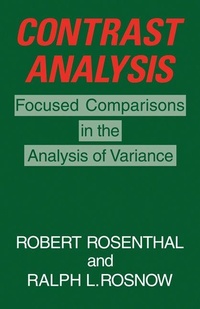
Contrast Analysis
Focused Comparisons in the Analysis of Variance
Published on 26. April 1985
Book
Paperback/Softback
120 pages
978-0-521-31796-2 (ISBN)
Description
This book, first published in 1985, is for those seeking appropriate statistical approaches to research data that is devoted entirely to the topic of contrasts. Contrast analysis permits us to ask more focused questions of our data. In return for a small amount of simple computation, we get greater statistical power, and can make clearer substantive interpretations of the research results. Contrast analysis should be employed in the context of the analysis of variance whenever the numerator degrees of freedom are greater than one (which is probably most of the time). Unfortunately, it is employed relatively rarely by behavioural and social scientists. This book makes it possible for non-mathematical data analysts to avail themselves of contrasts, and thereby simply and efficiently to address the focused questions posed by their theories, hypotheses, and hunches. A wide range of researchers in the behavioural and social sciences, education and business will find this book an invaluable resource.
More details
Language
English
Place of publication
Cambridge
United Kingdom
Target group
College/higher education
Product notice
Paperback (trade)
Illustrations
Worked examples or Exercises
Dimensions
Height: 216 mm
Width: 140 mm
Thickness: 7 mm
Weight
162 gr
ISBN-13
978-0-521-31796-2 (9780521317962)
Copyright in bibliographic data and cover images is held by Nielsen Book Services Limited or by the publishers or by their respective licensors: all rights reserved.
Schweitzer Classification
Content
Preface; 1. Why contrasts?; 2. One-way analysis; 3. Two-factor studies; 4. Wired-in, pre-analyses, multiples and proportions; 5. Repeated-measures designs; 6. Mixed sources of variance; 7. Practical issues of computations; 8. Measuring the benefits of contrasts; 9. Conclusion: Abelson's perspective; Appendices; References; Index.