

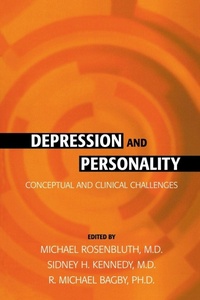
Depression and Personality
Conceptual and Clinical Challenges
Published on 22. August 2005
Book
Paperback/Softback
338 pages
978-1-58562-154-5 (ISBN)
Description
Depression and Personality: Conceptual and Clinical
Challenges offers an intriguing new look at where we are in
understanding the relationship between personality dimensions, disorders,
and mood disorder. It is both a cogent update of conceptual models and a
clearly written, practical guide to the challenges faced every day by
clinicians as they treat patients with depression and bipolar
disorder.
Laying the groundwork for subsequent chapters, the editors
emphasize the value of not only robust pharmacotherapy augmented by
psychosocial interventions (with a focus on the assets rather than the
liabilities of a patient's temperament), but also of a detailed review of
where we are today.
An introductory overview provides valuable
historical perspective on the evolution of personality from "humors" to body
constitution and temperament. In 10 informative chapters, 22 contributors discuss
* The neurobiological dimensions of personality, focusing on
affect-related traits as they review the evidence for serotonin and
norepinephrine disturbance based on challenge paradigms, and the range of
models to understand the interrelationship between personality and
depression.
* The justification for depressive personality in both
categorical terms, i.e., adding to the diagnostic armamentarium of DSM-V,
and dimensional terms, focusing on the Five Factor Model to provide a link
between several facets of neuroticism and depressive personality disorder.
* The impact of personality on various aspects of treatment, filling in
a gap in the pharmacotherapy literature by asserting that personality
pathology can affect the patient's capacity to seek, be engaged in, or be
compliant with treatment.
* Key assessment and treatment issues,
recommending a multimodal phased treatment approach that involves targeted
pharmacotherapy and integrated individual psychotherapy.
* The role of
personality disorder in the assessment and treatment of chronic depression,
with a concise, practical overview of medication and psychotherapy issues
regarding the role of Axis II disorders, and the complex relationship
between bipolar disorder and personality factors.
* The complexity
involved in adolescent depression with personality disorder, providing a
conceptual framework for understanding what factors of personality
contribute to vulnerability for depression in adolescents, and depression in
later life, including particularly relevant issues such as the role of
physical illness and organic factors on the clinical presentation of
personality and affective disorder
Invaluable reading for clinicians
and researchers alike, Depression and Personality: Conceptual and
Clinical Challenges offers fascinating perspectives on the
historical antecedents, neurobiological dimensions, and conceptual models
regarding the relationship between personality and depression.
Challenges offers an intriguing new look at where we are in
understanding the relationship between personality dimensions, disorders,
and mood disorder. It is both a cogent update of conceptual models and a
clearly written, practical guide to the challenges faced every day by
clinicians as they treat patients with depression and bipolar
disorder.
Laying the groundwork for subsequent chapters, the editors
emphasize the value of not only robust pharmacotherapy augmented by
psychosocial interventions (with a focus on the assets rather than the
liabilities of a patient's temperament), but also of a detailed review of
where we are today.
An introductory overview provides valuable
historical perspective on the evolution of personality from "humors" to body
constitution and temperament. In 10 informative chapters, 22 contributors discuss
* The neurobiological dimensions of personality, focusing on
affect-related traits as they review the evidence for serotonin and
norepinephrine disturbance based on challenge paradigms, and the range of
models to understand the interrelationship between personality and
depression.
* The justification for depressive personality in both
categorical terms, i.e., adding to the diagnostic armamentarium of DSM-V,
and dimensional terms, focusing on the Five Factor Model to provide a link
between several facets of neuroticism and depressive personality disorder.
* The impact of personality on various aspects of treatment, filling in
a gap in the pharmacotherapy literature by asserting that personality
pathology can affect the patient's capacity to seek, be engaged in, or be
compliant with treatment.
* Key assessment and treatment issues,
recommending a multimodal phased treatment approach that involves targeted
pharmacotherapy and integrated individual psychotherapy.
* The role of
personality disorder in the assessment and treatment of chronic depression,
with a concise, practical overview of medication and psychotherapy issues
regarding the role of Axis II disorders, and the complex relationship
between bipolar disorder and personality factors.
* The complexity
involved in adolescent depression with personality disorder, providing a
conceptual framework for understanding what factors of personality
contribute to vulnerability for depression in adolescents, and depression in
later life, including particularly relevant issues such as the role of
physical illness and organic factors on the clinical presentation of
personality and affective disorder
Invaluable reading for clinicians
and researchers alike, Depression and Personality: Conceptual and
Clinical Challenges offers fascinating perspectives on the
historical antecedents, neurobiological dimensions, and conceptual models
regarding the relationship between personality and depression.
Reviews / Votes
To my knowledge, this is the most concise presentation ofthe genetic, biological, environmental, interpersonal, and psychosocial
factors that impinge on persons who might not respond well to treatment for
depression because of underlying personality structures. This is a very
important contribution that offers new hope in work with these people. The
busy clinician will find the content in this well-organized book easily
accessible. * Doody's Book Review Service * As a clinician, I found the conceptual chapters and
clinical literature reviews stimulating, thought provoking, and clarifying.
. . . I solidly recommend the volume for the professional who is interested
in gaining a better understanding of current conceptual models of depression
and personality as well as timely literature reviews of the same, and it
should be valuable for both the researcher and the clinician. I also
recommend it for adoption by clinical psychology graduate programs as an
adjunct text in courses focusing on either affective disorders or
personality disorders. * PsycCritiques * Overall, [Depression and Personality] tackles a wide
set of findings. The chapters are clearly written. All of the conclusions
and discussions are solidly grounded by empirical studies. The authors of
each chapter are experts in their area, which is shown by the depth with
which topics are presented. * The Journal of Nervous and Mental Disease *
More details
Language
English
Place of publication
VA
United States
Target group
Professional and scholarly
US School Grade: College Graduate Student and over
Product notice
Paperback (trade)
Illustrations
33 Tables, unspecified; 3 Line drawings, black and white
Dimensions
Height: 229 mm
Width: 152 mm
Thickness: 18 mm
Weight
457 gr
ISBN-13
978-1-58562-154-5 (9781585621545)
Copyright in bibliographic data and cover images is held by Nielsen Book Services Limited or by the publishers or by their respective licensors: all rights reserved.
Schweitzer Classification
Other editions
Additional editions
E-Book
12/2005
1st Edition
American Psychiatric Publishing
€51.99
Available for download
Persons
Michael Rosenbluth, M.D., is Assistant Professor of
Psychiatry at the University of Toronto and Director of the Psychiatric
Rehabilitation Treatment Program at Toronto East General Hospital in
Toronto, Ontario.
Sidney H. Kennedy, M.D., is Professor of
Psychiatry at the University of Toronto and Psychiatrist-in-Chief of the
University Health Network in Toronto, Ontario.
R. Michael Bagby,
Ph.D., is Professor of Psychiatry at the University of Toronto and
Director of Clinical Research at the Centre for Addiction & Mental
Health in Toronto, Ontario.
Psychiatry at the University of Toronto and Director of the Psychiatric
Rehabilitation Treatment Program at Toronto East General Hospital in
Toronto, Ontario.
Sidney H. Kennedy, M.D., is Professor of
Psychiatry at the University of Toronto and Psychiatrist-in-Chief of the
University Health Network in Toronto, Ontario.
R. Michael Bagby,
Ph.D., is Professor of Psychiatry at the University of Toronto and
Director of Clinical Research at the Centre for Addiction & Mental
Health in Toronto, Ontario.
Content
CONTRIBUTORS
PREFACE
INTRODUCTION
PART I:
CONCEPTUAL ISSUES
Chapter 1. PERSONALITY AND TEMPERAMENT: HISTORICAL
PERSPECTIVES
Chapter 2. THE PSYCHOBIOLOGY OF PERSONALITY
DISORDERS
Chapter 3. PERSONALITY TRAITS/DISORDERS AND DEPRESSION: A
SUMMARY OF CONCEPTUAL AND EMPIRICAL FINDINGS
Chapter 4. THE DEPRESSIVE
PERSONALITY: PSYCHOPATHOLOGY, ASSESSMENT, AND TREATMENT
PART II:
TREATMENT IMPLICATIONS
Chapter 5. THE IMPACT OF PERSONALITY ON THE
PHARMACOLOGICAL TREATMENT OF DEPRESSION
Chapter 6. CLINICAL STRATEGIES
FOR EFFICIENT TREATMENT OF MAJOR DEPRESSIVE DISORDER COMPLICATED BY
PERSONALITY DISORDER
Chapter 7. REFRACTORY AND CHRONIC DEPRESSION: THE
ROLE OF AXIS II DISORDERS IN ASSESSMENT AND TREATMENT
Chapter 8. BIPOLAR
DISORDER AND PERSONALITY: CONSTRUCTS, FINDINGS, AND CHALLENGES
Chapter
9. EVALUATING THE CONTRIBUTION OF PERSONALITY FACTORS TO DEPRESSED MOOD IN
ADOLESCENTS: CONCEPTUAL AND CLINICAL ISSUES
Chapter 10. THE IMPACT OF
PERSONALITY DISORDERS ON LATE-LIFE DEPRESSION
INDEX
PREFACE
INTRODUCTION
PART I:
CONCEPTUAL ISSUES
Chapter 1. PERSONALITY AND TEMPERAMENT: HISTORICAL
PERSPECTIVES
Chapter 2. THE PSYCHOBIOLOGY OF PERSONALITY
DISORDERS
Chapter 3. PERSONALITY TRAITS/DISORDERS AND DEPRESSION: A
SUMMARY OF CONCEPTUAL AND EMPIRICAL FINDINGS
Chapter 4. THE DEPRESSIVE
PERSONALITY: PSYCHOPATHOLOGY, ASSESSMENT, AND TREATMENT
PART II:
TREATMENT IMPLICATIONS
Chapter 5. THE IMPACT OF PERSONALITY ON THE
PHARMACOLOGICAL TREATMENT OF DEPRESSION
Chapter 6. CLINICAL STRATEGIES
FOR EFFICIENT TREATMENT OF MAJOR DEPRESSIVE DISORDER COMPLICATED BY
PERSONALITY DISORDER
Chapter 7. REFRACTORY AND CHRONIC DEPRESSION: THE
ROLE OF AXIS II DISORDERS IN ASSESSMENT AND TREATMENT
Chapter 8. BIPOLAR
DISORDER AND PERSONALITY: CONSTRUCTS, FINDINGS, AND CHALLENGES
Chapter
9. EVALUATING THE CONTRIBUTION OF PERSONALITY FACTORS TO DEPRESSED MOOD IN
ADOLESCENTS: CONCEPTUAL AND CLINICAL ISSUES
Chapter 10. THE IMPACT OF
PERSONALITY DISORDERS ON LATE-LIFE DEPRESSION
INDEX