

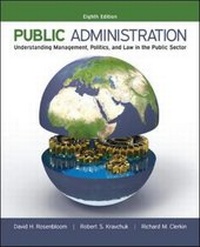
Public Administration: Understanding Management, Politics, and Law in the Public Sector
8th Edition
Published on 16. May 2014
Book
Paperback/Softback
624 pages
978-0-07-337915-9 (ISBN)
Description
The eighth edition of Public Administration: Understanding Management, Politics, and Law in the Public Sector grounds students in the fundamentals of public administration while embracing its complexity. It describes, explains, and analyses public administration through the lenses of three well-established perspectives: management, politics, and law. This edition retains its strong U.S. focus while broadening the discussion and themes in recognition of its adoption in about twenty countries abroad and to enhance its global utility as a "world text."
Instructors and students can now access their course content through the Connect digital learning platform by purchasing either standalone Connect access or a bundle of print and Connect access. McGraw-Hill Connect (R) is a subscription-based learning service accessible online through your personal computer or tablet. Choose this option if your instructor will require Connect to be used in the course. Your subscription to Connect includes the following:
* SmartBook (R) - an adaptive digital version of the course textbook that personalizes your reading experience based on how well you are learning the content.
* Access to your instructor's homework assignments, quizzes, syllabus, notes, reminders, and other important files for the course.
* Progress dashboards that quickly show how you are performing on your assignments and tips for improvement.
* The option to purchase (for a small fee) a print version of the book. This binder-ready, loose-leaf version includes free shipping.
Complete system requirements to use Connect can be found here: http://www.mheducation.com/highered/platforms/connect/training-support-students.html
Instructors and students can now access their course content through the Connect digital learning platform by purchasing either standalone Connect access or a bundle of print and Connect access. McGraw-Hill Connect (R) is a subscription-based learning service accessible online through your personal computer or tablet. Choose this option if your instructor will require Connect to be used in the course. Your subscription to Connect includes the following:
* SmartBook (R) - an adaptive digital version of the course textbook that personalizes your reading experience based on how well you are learning the content.
* Access to your instructor's homework assignments, quizzes, syllabus, notes, reminders, and other important files for the course.
* Progress dashboards that quickly show how you are performing on your assignments and tips for improvement.
* The option to purchase (for a small fee) a print version of the book. This binder-ready, loose-leaf version includes free shipping.
Complete system requirements to use Connect can be found here: http://www.mheducation.com/highered/platforms/connect/training-support-students.html
More details
Edition
8th edition
Language
English
Place of publication
United States
Publishing group
McGraw-Hill Education - Europe
Target group
College/higher education
US School Grade: College Freshman
Illustrations
28 Illustrations
Dimensions
Height: 234 mm
Width: 198 mm
Thickness: 23 mm
Weight
916 gr
ISBN-13
978-0-07-337915-9 (9780073379159)
Copyright in bibliographic data and cover images is held by Nielsen Book Services Limited or by the publishers or by their respective licensors: all rights reserved.
Schweitzer Classification
Persons
David H. Rosenbloom is Distinguished Professor of Public Administration in the School of Public Affairs at American University in Washington, DC. He holds a Ph.D. in political science from the University of Chicago. He is the 2001 recipient of the American Political Science Associations John Gaus Award for exemplary scholarship in the joint tradition of political science and public administration. In 1999, he received the American Society for Public Administration's Dwight Waldo Award for his outstanding contributions to the field. He is a member of the National Academy of Public Administration, from which he received the 2001 Louis Brownlow Award for his book on Building a Legislative-Centered Public Administration. Professor Rosenbloom serves on the editorial boards of about a dozen leading public administration journals and is a member of the Marietta College Board of Trustees. He frequently guest lectures at universities and public service organizations in the U.S. and abroad.
Robert S. Kravchuk is Professor and Chair of the Department of Political Science at the University of North Carolina-Charlotte. His teaching and research focus on public budgeting and finance, administrative theory and the political economy of former socialist countries in transition, with a special emphasis on Ukraine and Russia. His current research projects include an exploration of the root concepts of American administrative theory, and a comprehensive history of Russian public administration from Ivan the Terrible to Vladimir Putin. His administrative experience includes service as Under Secretary in the Connecticut State budget office, U.S. Treasury Department Resident Budget Advisor to the Minister of Finance of Ukraine, and appointment by the U.S. Secretaries of State and the Treasury as the Financial Advisor to the President of Bosnia-Herzegovina. A frequent writer and lecturer on public budgeting and administrative reform and capacity building, Professor Kravchuk has taught at the Indiana University School of Public and Environmental Affairs, the University of Connecticut, the University of Hartford, and Le Moyne College. He lives in Charlotte, North Carolina.
Richard M. Clerkin is an Assistant Professor in the Public Administration Department in the School of Public and International Affairs at North Carolina Sate University. He received his Ph.D. in Public Affairs from Indiana University-Bloomington, where he was a Chancellor's Fellow. The main focus of his research focuses on the interplay of government and nonprofit organizations. In particularl, he studies the role nonprofits play in advocating and lobbying in the policy process and how nonprofits are accountable to their multiple stakeholders. In a new research project, he is examining state level regulation of charitable solicitation. Additional areas of research include examining the institutional pressures that shape organizational structures and procedures in nonprofits, applying the concept of public service motivation to volunteering and donating behavior, as well as using charitable gaming to explore the paradoxes and tensions nonprofits face as they try to achieve their mission. His research has been published in Public Administration Review, Nonprofit and Voluntary Sector Quarterly, and Nonprofit Management and Leadership. He lives in Raleigh, North Carolina with his wife and children.
Robert S. Kravchuk is Professor and Chair of the Department of Political Science at the University of North Carolina-Charlotte. His teaching and research focus on public budgeting and finance, administrative theory and the political economy of former socialist countries in transition, with a special emphasis on Ukraine and Russia. His current research projects include an exploration of the root concepts of American administrative theory, and a comprehensive history of Russian public administration from Ivan the Terrible to Vladimir Putin. His administrative experience includes service as Under Secretary in the Connecticut State budget office, U.S. Treasury Department Resident Budget Advisor to the Minister of Finance of Ukraine, and appointment by the U.S. Secretaries of State and the Treasury as the Financial Advisor to the President of Bosnia-Herzegovina. A frequent writer and lecturer on public budgeting and administrative reform and capacity building, Professor Kravchuk has taught at the Indiana University School of Public and Environmental Affairs, the University of Connecticut, the University of Hartford, and Le Moyne College. He lives in Charlotte, North Carolina.
Richard M. Clerkin is an Assistant Professor in the Public Administration Department in the School of Public and International Affairs at North Carolina Sate University. He received his Ph.D. in Public Affairs from Indiana University-Bloomington, where he was a Chancellor's Fellow. The main focus of his research focuses on the interplay of government and nonprofit organizations. In particularl, he studies the role nonprofits play in advocating and lobbying in the policy process and how nonprofits are accountable to their multiple stakeholders. In a new research project, he is examining state level regulation of charitable solicitation. Additional areas of research include examining the institutional pressures that shape organizational structures and procedures in nonprofits, applying the concept of public service motivation to volunteering and donating behavior, as well as using charitable gaming to explore the paradoxes and tensions nonprofits face as they try to achieve their mission. His research has been published in Public Administration Review, Nonprofit and Voluntary Sector Quarterly, and Nonprofit Management and Leadership. He lives in Raleigh, North Carolina with his wife and children.
Content
About the AuthorsContents in BriefContentsPrefacePart I. Introduction: Definitions, Concepts, and SettingChapter 1: The Practice and Discipline of Public Administration: Competing ConcernsChapter 2: The American Administrative State: Development and Political EnvironmentChapter 3: Federalism and Intergovernmental Relations: The Structure of the American Administrative StatePart II. Core FunctionsChapter 4: Organization: Structure and ProcessChapter 5: Public Personnel Administration and Collective BargainingChapter 6: Budgeting and the Public FinancesChapter 7: Decision MakingPart III. The Convergence of Management, Politics and Law in the Public SectorChapter 8: Policy Analysis and Implementation EvaluationChapter 9: Regulatory Administration: An Illustration of Management, Politics, and Law in the Public SectorPart IV. Public Administration and the PublicChapter 10: Public Administration and the PublicChapter 11: Public Administration and Democratic ConstitutionalismChapter 12: Accountability and EthicsChapter 13: The FutureGlossaryCreditsIndex