

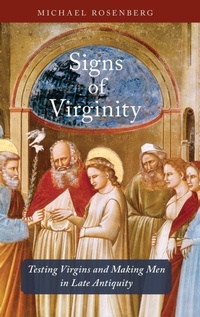
Signs of Virginity
Testing Virgins and Making Men in Late Antiquity
Published on 22. March 2018
Book
Hardback
328 pages
978-0-19-084589-6 (ISBN)
Description
Although the theme of bloodied nuptial sheets seems pervasive in western culture, its association with female virginity is uniquely tied to a brief passage in the book of Deuteronomy detailing the procedure for verifying a young woman's purity and seldom, if ever, appears outside of non-Abrahamic traditions. In Signs of Virginity, Michael Rosenberg examines the history of virginity testing in Judaism and early Christianity, and the relationship of these tests to a culture that encourages male sexual violence.
Deuteronomy's violent vision of virginity has held sway in Jewish and Christian circles more or less ever since, but Rosenberg points to two authors--the rabbinic collective that produced the Babylonian Talmud and Augustine of Hippo--who, even as they perpetuate patriarchal assumptions about female virginity, nonetheless attempt to subvert the emphasis on sexual dominance bequeathed to them by Deuteronomy. Unlike the authors of earlier Rabbinic and Christian texts, who modified but fundamentally maintained and even extended the Deuteronomic ideal, the Babylonian Talmud and Augustine both construct alternative models of female virginity that, if taken seriously, would utterly reverse cultural ideals of masculinity. Indeed this vision of masculinity as fundamentally gentle, rather than characterized by brutal and violent sexual behavior, fits into a broader idealization of masculinity propagated by both authors, who reject what Augustine called a "lust for dominance" as a masculine ideal.
Deuteronomy's violent vision of virginity has held sway in Jewish and Christian circles more or less ever since, but Rosenberg points to two authors--the rabbinic collective that produced the Babylonian Talmud and Augustine of Hippo--who, even as they perpetuate patriarchal assumptions about female virginity, nonetheless attempt to subvert the emphasis on sexual dominance bequeathed to them by Deuteronomy. Unlike the authors of earlier Rabbinic and Christian texts, who modified but fundamentally maintained and even extended the Deuteronomic ideal, the Babylonian Talmud and Augustine both construct alternative models of female virginity that, if taken seriously, would utterly reverse cultural ideals of masculinity. Indeed this vision of masculinity as fundamentally gentle, rather than characterized by brutal and violent sexual behavior, fits into a broader idealization of masculinity propagated by both authors, who reject what Augustine called a "lust for dominance" as a masculine ideal.
Reviews / Votes
This book will prove a valuable resource and conversation partner for students and scholars of classical and antique expressions of Judaism, Christianity, gender, and sexuality. * Michael R. Whitenton, Baylor University, Review of Biblical Literature * Signs of Virginity is a beautifully in depth and complex work that in the hands of another writer could have been impossible to follow. Michael Rosenberg does an excellent job of leading readers through a variety of texts with ease, without ever oversimplifying the complexity of each. The sheer diversity of texts he brings to the table is admirable... Rosenberg's study will soon be indispensable for those interested in late antique masculinity... Along with earning a spot in the ranks of masculinity studies, Signs of Virginity also belongs to a burgeoning field of scholarship that treats rabbinic Judaism and Christianity together. Rosenberg's comparison of the Babylonian Talmud with Christian sources places him in a similar vein as scholars like Michal Bar-Asher Siegal, Seth Schwartz, and Jeffrey Rubenstein. * Jeannie Sellick, Reading Religion *More details
Language
English
Place of publication
New York
United States
Target group
Professional and scholarly
Dimensions
Height: 240 mm
Width: 161 mm
Thickness: 22 mm
Weight
658 gr
ISBN-13
978-0-19-084589-6 (9780190845896)
Copyright in bibliographic data and cover images is held by Nielsen Book Services Limited or by the publishers or by their respective licensors: all rights reserved.
Schweitzer Classification
Other editions
Additional editions
E-Book
01/2018
1st Edition
OUP eBook
€79.49
Available for download
E-Book
01/2018
1st Edition
OUP eBook
€79.49
Available for download
Person
Michael Rosenberg is assistant professor of rabbinics at Hebrew College.
Content
Introduction - Defining Virginity, Making Men
Part One: Testing Virginity in the Body
Chapter One - Testing Virginity in the Body
Chapter Two - Bloodied Sheets: The Biblical Nuptial Bed as Rape Scene
Chapter Three - "Trustworthy Women" and Other Witnesses: Tweaking Deuteronomy in Pre-Rabbinic and Early Rabbinic Judaism
Part Two: Testing Virginity through Faith
Chapter Four - Doubts and Faith: Possible Alternatives in Three First-Century Jewish Authors
Chapter Five - Struck by Wood, Struck by God: Virginity Beyond/Despite Anatomy
Part Three: Subjecting Virginity
Chapter Six - Open Doors and Accused Brides: Subjectivity and a New Standard for Virginity Testing in Rabbinic Babylonia
Chapter Seven - Impure Nuptials and Sex as Work: The Bavli's Attempted Divorce of Virginity from Violence
Chapter Eight - (De)Mythologizing the Hymen: Augustine, the Bavli, and the Rejection of Force
Epilogue
Bibliography
Part One: Testing Virginity in the Body
Chapter One - Testing Virginity in the Body
Chapter Two - Bloodied Sheets: The Biblical Nuptial Bed as Rape Scene
Chapter Three - "Trustworthy Women" and Other Witnesses: Tweaking Deuteronomy in Pre-Rabbinic and Early Rabbinic Judaism
Part Two: Testing Virginity through Faith
Chapter Four - Doubts and Faith: Possible Alternatives in Three First-Century Jewish Authors
Chapter Five - Struck by Wood, Struck by God: Virginity Beyond/Despite Anatomy
Part Three: Subjecting Virginity
Chapter Six - Open Doors and Accused Brides: Subjectivity and a New Standard for Virginity Testing in Rabbinic Babylonia
Chapter Seven - Impure Nuptials and Sex as Work: The Bavli's Attempted Divorce of Virginity from Violence
Chapter Eight - (De)Mythologizing the Hymen: Augustine, the Bavli, and the Rejection of Force
Epilogue
Bibliography