

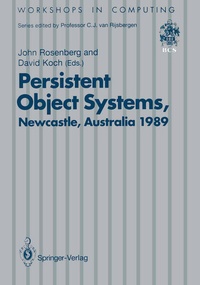
Persistent Object Systems
Proceedings of the Third International Workshop 10-13 January 1989, Newcastle, Australia
1st Edition
Published on 31. August 1990
Book
Paperback/Softback
XVII, 408 pages
978-3-540-19626-6 (ISBN)
Description
Persistent object systems are systems which support the creation and manipulation of objects in a uniform manner, regardless of how long they persist. This is in direct contrast with conventional systems where temporary objects are created and manipulated using one mechanism (typically programming language data structures) and permanent objects are maintained using a different mechanism (usually a filestore). The unification of temporary and permanent objects yields systems which are smaller and more efficient than conventional systems and which provide a powerful and flexible platform for the development of large, data intensive applications. This volume presents the proceedings of a workshop at which latest research in this area was discussed. The papers are grouped into sections on the following topics: type systems and persistence, persistent programming languages, implementing persistence, object stores, measurement of persistent systems, transactions and persistence, and persistent machines.
More details
Series
Language
English
Place of publication
London
United Kingdom
Publishing group
Springer Berlin
Target group
Professional and scholarly
Research
Illustrations
XVII, 408 p.
Dimensions
Height: 242 mm
Width: 170 mm
Thickness: 24 mm
Weight
728 gr
ISBN-13
978-3-540-19626-6 (9783540196266)
DOI
10.1007/978-1-4471-3173-1
Schweitzer Classification
Other editions
Additional editions
John Rosenberg | David Koch
Persistent Object Systems
Proceedings of the Third International Workshop 10-13 January 1989, Newcastle, Australia
E-Book
12/2012
Springer
€53.49
Available for download
Content
I: Type Systems and Persistence.- The Napier Type System.- Grammars and Implementation Independent Structure Representation.- A Program Development Environment Based on Persistence and Abstract Data Types.- Exploiting the Potential of Persistent Object Stores.- Browsing, Grazing and Nibbling Persistent Data Structures.- II: Persistent Programming Languages.- Persistent System Architectures.- Issues in the Implementation of a Persistent Prolog.- A Capability Based Language for Persistent Programming: Implementation Issues.- Distributed PS-algol.- The Implementation of an Object-Oriented Language in PS-algol.- III: Implementing Persistence.- Aggregation, Persistence, and Identity in Worlds.- Implementing Persistence in E.- Addressing in a Persistent Environment.- Name-Based Mapping: Addressing Support for Persistent Objects.- IV: Object Stores.- Generating and Manipulating Identifiers for Heterogeneous, Distributed Objects.- The Evolution of the SSE Data Storage System into a Persistent Object System.- Persistence in a Distributed Object Server.- A Simple Object Storage System.- V: Measurement of Persistent Systems.- Monitoring Execution of PS-algol Programs.- Performance Evaluation in a Persistent Object System.- VI: Transactions and Persistence.- Transactions on Persistent Objects.- Commutativity-Based Locking for Nested Transactions.- Transaction Groups: A Model for Controlling Cooperative Transactions.- VII: Persistent Machines.- The Persistent Abstract Machine.- Design of POMP - A Persistent Object Management Processor.- A Capability-Based Massive Memory Computer.- Support for Objects in the MONADS Architecture.- Author Index.