

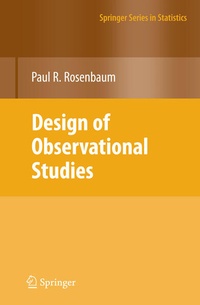
Design of Observational Studies
Published on 25. February 2012
Book
Paperback/Softback
404 pages
978-1-4614-2486-4 (ISBN)
Description
An observational study is an empiric investigation of effects caused by treatments when randomized experimentation is unethical or infeasible. Observational studies are common in most fields that study the effects of treatments on people, including medicine, economics, epidemiology, education, psychology, political science and sociology. The quality and strength of evidence provided by an observational study is determined largely by its design. Design of Observational Studies is both an introduction to statistical inference in observational studies and a detailed discussion of the principles that guide the design of observational studies.
Design of Observational Studies is divided into four parts. Chapters 2, 3, and 5 of Part I cover concisely, in about one hundred pages, many of the ideas discussed in Rosenbaum's Observational Studies (also published by Springer) but in a less technical fashion. Part II discusses the practical aspects of using propensity scores and other tools to create a matched comparison that balances many covariates. Part II includes a chapter on matching in R. In Part III, the concept of design sensitivity is used to appraise the relative ability of competing designs to distinguish treatment effects from biases due to unmeasured covariates. Part IV discusses planning the analysis of an observational study, with particular reference to Sir Ronald Fisher's striking advice for observational studies, "make your theories elaborate."
The second edition of his book, Observational Studies, was published by Springer in 2002.
Design of Observational Studies is divided into four parts. Chapters 2, 3, and 5 of Part I cover concisely, in about one hundred pages, many of the ideas discussed in Rosenbaum's Observational Studies (also published by Springer) but in a less technical fashion. Part II discusses the practical aspects of using propensity scores and other tools to create a matched comparison that balances many covariates. Part II includes a chapter on matching in R. In Part III, the concept of design sensitivity is used to appraise the relative ability of competing designs to distinguish treatment effects from biases due to unmeasured covariates. Part IV discusses planning the analysis of an observational study, with particular reference to Sir Ronald Fisher's striking advice for observational studies, "make your theories elaborate."
The second edition of his book, Observational Studies, was published by Springer in 2002.
Reviews / Votes
From the reviews: "I should begin by noting that the first time I read the book's title I thought that it would address the topic of classical epidemiological designs like case-control studies, cohort studies, etc. However, I was wrong. Rosenbaum's book addresses the crucial topic of designing and analyzing empiric non-randomized investigations to prove causal relationships between treatments and outcomes. These types of studies, the observational ones, are prone to present two well-known selection biases: overt biases, i.e., differences in outcomes between treatments may reflect measured pre-treatment differences between groups rather than effects of treatments, and hidden biases, i.e., the same situation but with pre-treatment differences that were not recorded in the study. To overcome overt biases, applied statisticians usually advocate the use of model-based adjustments and to overcome hidden biases they usually recommend designing a randomized experiment. However, Rosenbaum's book addresses these two biases with an alternative approach: propensity score matching for overt biases and sensitivity analysis for hidden biases. Practitioners may think that sensitivity analysis means performing several analyses of the same data set; however, this is not the Rosenbaum's approach. Overall, the book is written in a clear and concise way, merging theoretical and practical aspects. Small examples are provided to develop the understanding of key issues in parallel with real examples of practical size from both the economics and the biomedicine areas. Moreover, although the book is not intended as a statistical software oriented book, the text includes some code in R and SAS. For example, Chapter 13 is devoted to matching in R. Finally, the book covers all the relevant issues in designing and analyzing treatment effects in observational studies, with the exception of observer bias, i.e., the bias present when the assessment of the outcomes are not valid; see Haro et al. (2006) for further details. Nowadays, it is yet unusual to address hidden biases in observational studies and, therefore, this book is an essential reading for statisticians who want to go a step beyond from the likely naive sentence: 'We assume no unmeasured confounding in the study'." (Journal of Biopharmaceutical Statistics , 2011, Issue 1) "Graduate students and researchers in statistics, biostatistics, econometrics, or academic researchers in statistically oriented fields of psychology and social sciences. ... 'Design of Observational Studies' talks about statistics. ... The book will be suitable for a seminar course for graduate students with previous knowledge of the subject area, or practicing statisticians seeking guidance in design of observational research and a language to discuss the issues. 'Design of Observational Studies' is an important book." (Erkki P. Liski, International Statistical Review, Vol. 78 (1), 2010) "This is for those who want to improve whatever their basic design is-for those people, this is a very good book. ... have several quick, but useful, guides: key elements in a design, solutions to common problems (very useful), a symbol glossary, a listing of acronyms, a glossary of statistical terms, suggested readings for a course on the design of observational studies, and an index. ... anyone who is not an expert on the varieties of matching will profit from reading this." (Richard Goldstein, Technometrics, Vol. 53 (2), May, 2011)More details
Product info
Paperback
Series
Edition
2010
Language
English
Place of publication
NY
United States
Target group
Professional and scholarly
Research
Illustrations
XVIII, 384 p.
Dimensions
Height: 235 mm
Width: 155 mm
Thickness: 22 mm
Weight
610 gr
ISBN-13
978-1-4614-2486-4 (9781461424864)
DOI
10.1007/978-1-4419-1213-8
Schweitzer Classification
Other editions
New editions
Paul R. Rosenbaum
Design of Observational Studies
Book
07/2020
2nd Edition
Springer
€171.19
Shipment within 7-9 days
Additional editions
Paul R. Rosenbaum
Design of Observational Studies
Book
11/2009
Springer
€117.69
Article exhausted; check for reprint

Paul R. Rosenbaum
Design of Observational Studies
E-Book
10/2009
1st Edition
Springer
€117.69
Available for download
Content
Beginnings.- Dilemmas and Craftsmanship.- Causal Inference in Randomized Experiments.- Two Simple Models for Observational Studies.- Competing Theories Structure Design.- Opportunities, Devices, and Instruments.- Transparency.- Matching.- A Matched Observational Study.- Basic Tools of Multivariate Matching.- Various Practical Issues in Matching.- Fine Balance.- Matching Without Groups.- Risk-Set Matching.- Matching in R.- Design Sensitivity.- The Power of a Sensitivity Analysis and Its Limit.- Heterogeneity and Causality.- Uncommon but Dramatic Responses to Treatment.- Anticipated Patterns of Response.- Planning Analysis.- After Matching, Before Analysis.- Planning the Analysis.