

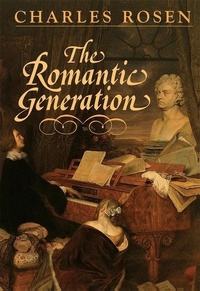
The Romantic Generation
Will be published approx. on 15. September 1998
Book
Paperback/Softback
744 pages
978-0-674-77934-1 (ISBN)
Description
"A magnum opus."-George Steiner, New Yorker
"Grippingly, even excitingly, readable."-Edward Said, London Review of Books
What Charles Rosen's National Book Award-winning The Classical Style did for the music of the Classical period, this volume brilliantly does for the Romantic Era. An exhilarating exploration of the musical language, forms, and styles of the Romantic period, it captures the spirit that enlivened a generation of composers and musicians, and in doing so it conveys the very sense of Romantic music. In readings uniquely informed by his performing experience, Rosen offers consistently acute and thoroughly engaging analyses of works by Schubert, Schumann, Mendelssohn, Bellini, Liszt, and Berlioz, and he presents a new view of Chopin as a master of polyphony and large-scale form. He adeptly integrates his observations on the music with reflections on the art, literature, drama, and philosophy of the time, and thus shows us the major figures of Romantic music within their intellectual and cultural context.
Rosen covers a remarkably broad range of music history and considers the importance to nineteenth-century music of other cultural developments: the art of landscape, a changed approach to the sacred, the literary fragment as a Romantic art form. He sheds new light on the musical sensibilities of each composer, studies the important genres from nocturnes and songs to symphonies and operas, explains musical principles such as the relation between a musical idea and its realization in sound and the interplay between music and text, and traces the origins of musical ideas prevalent in the Romantic period. Rich with striking descriptions and telling analogies, Rosen's overview of Romantic music is an accomplishment without parallel in the literature, a consummate performance by a master pianist and music historian.
"Grippingly, even excitingly, readable."-Edward Said, London Review of Books
What Charles Rosen's National Book Award-winning The Classical Style did for the music of the Classical period, this volume brilliantly does for the Romantic Era. An exhilarating exploration of the musical language, forms, and styles of the Romantic period, it captures the spirit that enlivened a generation of composers and musicians, and in doing so it conveys the very sense of Romantic music. In readings uniquely informed by his performing experience, Rosen offers consistently acute and thoroughly engaging analyses of works by Schubert, Schumann, Mendelssohn, Bellini, Liszt, and Berlioz, and he presents a new view of Chopin as a master of polyphony and large-scale form. He adeptly integrates his observations on the music with reflections on the art, literature, drama, and philosophy of the time, and thus shows us the major figures of Romantic music within their intellectual and cultural context.
Rosen covers a remarkably broad range of music history and considers the importance to nineteenth-century music of other cultural developments: the art of landscape, a changed approach to the sacred, the literary fragment as a Romantic art form. He sheds new light on the musical sensibilities of each composer, studies the important genres from nocturnes and songs to symphonies and operas, explains musical principles such as the relation between a musical idea and its realization in sound and the interplay between music and text, and traces the origins of musical ideas prevalent in the Romantic period. Rich with striking descriptions and telling analogies, Rosen's overview of Romantic music is an accomplishment without parallel in the literature, a consummate performance by a master pianist and music historian.
Reviews / Votes
Consistently brilliant...[Rosen's] analytical genius extends to both music and language, so that again and again he finds just the right words to describe a musical effect simply, clearly, and to perfection. -- Joseph Kerman * New York Review of Books * Rosen is a fluent writer, having at his command both informality and rhetorical force. He is a musicologist and theoretician whose authority extends from Bach to Boulez. The rigor of his technical demonstration is, to a singular degree, grounded in a vivid knowledge of cultural history, of the social and intellectual background to Western music; it is this rich sense of background that made Rosen's The Classical Style a masterpiece. But, first and foremost, he is a pianist of penetrating originality...A magnum opus. -- George Steiner * New Yorker * What must be said immediately is how well, how enviably well, Rosen knows this music, its secrets, its astonishing harmonic and structural innovations, and the problems and pleasures of its performance...the book...is often grippingly, even excitingly, readable. -- Edward Said * London Review of Books * Charles Rosen's new book is that rarity: a work of detailed musical analysis that combines profound scholarship with artistic intuition...it leads one to want to hear the music: to listen anew to the well-known works and to acquaint oneself with the lesser known. -- David Blum * New York Times Book Review * The Romantic Generation will certainly be recognized as one of the decade's most important books about music...Rosen is a master. -- Joseph McLellan * Washington Post * Although no pianist can afford to be without the book, musicians of every kind should partake of both its wisdom and its practical lessons...Among non-musicians, anyone interested in the cultural and literary history of the period can feast on Rosen's introductory and incidental essays about the Romantic movement as a whole. -- Robert Craft * Chicago Tribune * Startling, brilliant, infuriating, revelatory...Rosen is able to see music in a fluid way, as a subtle play of processes that cannot always be precisely pinned down. -- Mark Swed * Wall Street Journal * The book underscores that Romantic composers elevated, as did Romantic poets, once trivial genres to the level of the sublime and, in so doing, defined a revolutionary approach to culture. -- Michael Kimmelman * New York Times * Author/teacher/concert pianist Rosen delivers a monumental follow-up to his award-winning The Classical Style, here concentrating on the generation of European composers who 'came of age' in the 1820s and 1830s: Liszt, Schumann, Berlioz, Mendelssohn, Bellini, and, first and foremost, Chopin...The thrust of [these] discussions is to illuminate some of the more startling and masterful changes in musical form that occurred as 'Classical' gave way to 'Romantic'...A valuable and important book. * Kirkus Reviews * A fresh, challenging, and stimulating view of the society in which Chopin, Liszt, Berlioz, and Schumann flourished. Highly recommended. * Library Journal * Pianist and professor Rosen helps us understand the harmonic and rhythmic variety and the virtuosity required of performers that make romantic music appeal to so many...Long on analysis of significant musical examples (728 accompany the text) and short on summary comments on the nature of romantic music, this is a worthy fellow to Rosen's prizewinning The Classical Style (1980). -- Alan Hirsch * Booklist * Charles Rosen's latest book deserves attention from anyone who is drawn to music written in the years 1825-50 and who, more especially, wishes to explore the inner workings of masterpieces by Chopin, Schumann, and Liszt. -- Christopher Hatch * Opera Quarterly * [This is a book of] many riches, which treats a complex, seemingly unmanageable topic in a consistently provocative, engaging, and stimulating manner. There is probably no one other than Rosen who could bring to this task such a range and depth of musical and cultural knowledge. -- Robert P. Morgan * Journal of Modern History * Historically informed, intellectually brilliant, profoundly intuitive and thoroughly practical-every pianist who wants to play Chopin, Schumann and Liszt will need to read it. -- Richard Dyer * Boston Sunday Globe * Rosen opens the reader's ears and mind with his brilliant insights, his enthusiasm for the music, and his elegance and wit. -- Rufus Hallmark * Washington Times * The Romantic Generation is a work that answers resonantly to the definition of Romantic style proposed by one of Rosen's touchstones, the boy-genius Novalis: It 'makes the familiar strange, and the strange familiar.' -- Jonathan Bate * Wall Street Journal *More details
Series
Language
English
Place of publication
Cambridge, Mass
United States
Target group
College/higher education
Professional and scholarly
Product notice
Paperback (trade)
Unsewn / adhesive bound
Illustrations
728 musical examples
Dimensions
Height: 235 mm
Width: 167 mm
Thickness: 37 mm
Weight
969 gr
ISBN-13
978-0-674-77934-1 (9780674779341)
Copyright in bibliographic data and cover images is held by Nielsen Book Services Limited or by the publishers or by their respective licensors: all rights reserved.
Schweitzer Classification
Other editions
Additional editions
Charles Rosen
Romantic Generation
E-Book
09/1998
1st Edition
Harvard University Press
€75.99
Available for download
Person
Charles Rosen (1927-2012) was an American concert pianist and the author of more than a dozen books, including the National Book Award-winning The Classical Style. The recipient of a National Humanities Medal, he was Professor of Music and Social Thought at the University of Chicago.
Content
Preface Music and Sound Imagining the sound Romantic paradoxes: the absent melody Classical and Romantic pedal Conception and realization Tone color and structure Fragments Renewal The Fragment as Romantic form Open and closed Words and music The emancipation of musical language Experimental endings and cyclical forms Ruins Disorders Quotations and memories Absence: the melody suppressed Mountains and Song Cycles Horn calls Landscape and music Landscape and the double time scale Mountains as ruins Landscape and memory Music and memory Landscape and death: Schubert The unfinished workings of the past Song cycles without words Formal Interlude Mediants Four-bar phrases Chopin: Counterpoint and the Narrative Forms Poetic inspiration and craft Counterpoint and the single line Narrative form: the ballade Changes of mode Italian opera and J. S. Bach Chopin: Virtuosity Transformed Keyboard exercises Virtuosity and decoration (salon music?) Morbid intensity Chopin: From the Miniature Genre to the Sublime Style Folk music? Rubato Modal harmony? Mazurka as Romantic form The late mazurkas Freedom and tradition Liszt: On Creation as Performance Disreputable greatness Die Lorelei: the distraction of influence The Sonata: the distraction of respectability The invention of Romantic piano sound: the Etudes Conception and realization The masks of Liszt Recomposing: Sonnet no. 104 Self-Portrait as Don Juan Berlioz: Liberation from the Central European Tradition Blind idolaters and perfidious critics Tradition and eccentricity: the idee fixe Chord color and counterpoint Long-range harmony and contrapuntal rhythm: the "Scene d'amour" Mendelssohn and the Invention of Religious Kitsch Mastering Beethoven Transforming Classicism Classical form and modern sensibility Religion in the concert hall Romantic Opera: Politics, Trash, and High Art Politics and melodrama Popular art Bellini Meyerbeer Schumann: Triumph and Failure of the Romantic Ideal The irrational The inspiration of Beethoven and Clara Wieck The inspiration of E.T.A. Hoffmann Out of phase Lyric intensity Failure and triumph Index of Names and Works