


Mill
Published on 31. January 2013
Book
Hardback
330 pages
978-0-19-927105-4 (ISBN)
Description
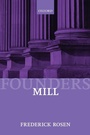
Frederick Rosen presents an original study of John Stuart Mill's moral and political philosophy, which explores the main themes of his writings--particularly those that emerge from the two major works, System of Logic (1843) and Principles of Political Economy (1848). From these, Mill developed the more widely-read later essays, On Liberty (1859), Utilitarianism (1861), Considerations on Representative Government (1861), and The Subjection of Women (1869). He was one of the greatest thinkers of the nineteenth century, and attempted to understand the political as well as intellectual struggles of his time, including those between capitalism and socialism, liberty and despotism, and Christianity and secular forces (particularly the sciences) that seemed to undermine religious belief. Rosen examines Mill's complex relationships with other contemporary thinkers (such as Jeremy Bentham, James Mill, Auguste Comte, George Grote, and Harriet Taylor Mill), and his philosophical sources, including Socrates, Plato, Aristotle, Hobbes, Locke, and Hume; and goes on to illustrate Mill's influence on subsequent philosophers, logicians, and economists. Rosen considers Mill's approaches to the study of active character and happiness in his work on logic and in the study of political economy, from which new interpretations of his ideas of liberty, justice, equality, and utility follow. Many of the debates with which Mill was engaged remain part of contemporary life, and Rosen's book is a guide for exploring and resolving them. Mill's ideas, his arguments, and the versions of utilitarianism and liberalism that he developed have created a humane, civilising philosophy for our times.
Reviews / Votes
Rosen's Mill is a valuable and distinctive contribution. It will be required reading for all serious students of Mill. * Dale E. Miller, Mind * Rosen's book reflects not only many years of work on Mill, but also decades of hard labor on the Bentham Project. One benefit of this from the reader's point of view is that Mill is firmly located in his intellectual context, along with not only his father and Bentham, but with John Austin and George Grote as well ... The other feature of Mill that sets it apart from previous discussions is the claim that the key to Mill's thought is to be found in his long correspondence with Auguste Comte ... a very good guide to Mill's politics, to his idiosyncratic socialism, and he is properly insistent on the centrality of Mill's feminism to his anxieties about social despotism. * Alan Ryan, Victorian Studies * This is a valuable study of Mill's social and political thought. Frederick Rosen brings a lifetime of study of utilitarian thought, especially of Jeremy Bentham, so he can put Mill's thought into a historical context. He also brings a fresh interpretation to Mill's writings. * Henry R. West, Notre Dame Philosophical Reviews *More details
Series
Language
English
Place of publication
Oxford
United Kingdom
Target group
College/higher education
Professional and scholarly
Dimensions
Height: 240 mm
Width: 161 mm
Thickness: 22 mm
Weight
661 gr
ISBN-13
978-0-19-927105-4 (9780199271054)
Copyright in bibliographic data and cover images is held by Nielsen Book Services Limited or by the publishers or by their respective licensors: all rights reserved.
Schweitzer Classification
Other editions
Additional editions
Person
Frederick Rosen is Professor Emeritus of the History of Political Thought and Honorary Senior Research Fellow at the Bentham Project, University College London. In 1983 he became General Editor of The Collected Works of Jeremy Bentham and Director of the Bentham Project at University College London, a post he held for several decades. He has published numerous books and articles, including Jeremy Bentham and Representative Democracy: A Study of the Constitutional Code (OUP, 1983), Bentham, Byron, and Greece: Constitutionalism, Nationalism, and Early Liberal Political Thought (OUP, 1992), and Classical Utilitarianism from Hume to Mill (Routledge, 2003). He is the founder of the journal Utilitas, co-editor with J. H. Burns of Jeremy Bentham's Constitutional Code, Volume I (OUP, 1983), and as General Editor and Joint General Editor (with P. Schofield) published fourteen volumes in The Collected Works of Jeremy Bentham (OUP, 1984-2003).
Content
PART I: SYSTEM OF LOGIC; PART II: THE SPELL OF COMTE; PART III: PRINCIPLES OF POLITICAL ECONOMY