

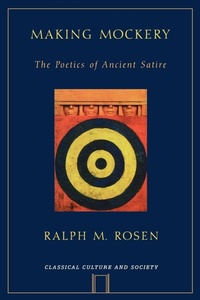
Making Mockery
The Poetics of Ancient Satire
Published on 3. March 2016
Book
Paperback/Softback
312 pages
978-0-19-538595-3 (ISBN)
Description
Making Mockery explores the dynamics of comic mockery and satire in Greek and Roman poetry, and argues that poets working with such material composed in accordance with shared generic principles and literary protocols. It encourages a synoptic, synchronic view of such poetry, from archaic iambus through Roman satire, and argues that if we can appreciate the abstract poetics of mockery that governs individual poets in such genres, we can we better understand how such poetry functioned in its own historical moment.
Rosen examines in particular the various strategies deployed by ancient satirical poets to enlist the sympathies of a putative audience, convince them of the justice of their indignation and the legitimacy of their personal attacks. The mocking satirist at the height of his power remains elusive and paradoxical--a figure of self-constructed abjection, yet arrogant and sarcastic at the same time; a figure whose speech can be self-righteous one moment, but scandalous the next; who will insist on the "reality" of his poetry, but make it clear that this reality is always mediated by an inescapable movement towards fictionality. While scholars have often, in principle, acknowledged the force of irony, persona-construction and other such devices by which satirists destabilize their claims, very often in practice--especially when considering individual satirists in isolation from others--they too succumb to the satirist's invitation to take what he says at face value. Despite the sophisticated critical tools they may bring to bear on satirical texts, therefore, classicists still tend to treat such poets ultimately as monochromatically indignant, vindictive individuals on a genuine self-righteous mission. This study, however, argues that that a far subtler analysis of the aggressive, poeticized subject in Classical antiquity--its target, and its audience--is called for.
Rosen examines in particular the various strategies deployed by ancient satirical poets to enlist the sympathies of a putative audience, convince them of the justice of their indignation and the legitimacy of their personal attacks. The mocking satirist at the height of his power remains elusive and paradoxical--a figure of self-constructed abjection, yet arrogant and sarcastic at the same time; a figure whose speech can be self-righteous one moment, but scandalous the next; who will insist on the "reality" of his poetry, but make it clear that this reality is always mediated by an inescapable movement towards fictionality. While scholars have often, in principle, acknowledged the force of irony, persona-construction and other such devices by which satirists destabilize their claims, very often in practice--especially when considering individual satirists in isolation from others--they too succumb to the satirist's invitation to take what he says at face value. Despite the sophisticated critical tools they may bring to bear on satirical texts, therefore, classicists still tend to treat such poets ultimately as monochromatically indignant, vindictive individuals on a genuine self-righteous mission. This study, however, argues that that a far subtler analysis of the aggressive, poeticized subject in Classical antiquity--its target, and its audience--is called for.
More details
Series
Language
English
Place of publication
New York
United States
Target group
College/higher education
Professional and scholarly
Dimensions
Height: 234 mm
Width: 156 mm
Thickness: 17 mm
Weight
477 gr
ISBN-13
978-0-19-538595-3 (9780195385953)
Copyright in bibliographic data and cover images is held by Nielsen Book Services Limited or by the publishers or by their respective licensors: all rights reserved.
Schweitzer Classification
Other editions
Additional editions
Book
05/2007
Oxford University Press Inc
€79.60
Shipment within 15-20 days
E-Book
05/2007
OUP eBook
€19.99
Available for download
Person
Ralph Rosen is Professor in the Department of Classical Studies at the University of Pennsylvania.
Content
1: Dynamics of Ancient Satirical Poetry
2: Two Paradigms of Mockery in Greek Myth: Iambe and Demeter; Heracles and the Cercopes
3: Where the Blame Lies: The Question of Thersites
4: Shifting Perspectives of Comic Abjection: Odysseus and Polyphemus as Figures of Satire
5: Satiric Authenticity in Callimachus' Iambi
6: Mockery, Self-mockery, and the Didactic Ruse: Juvenal Satires Nine and Five
7: Archilochus, Critias, and the Poetics of Abjection
2: Two Paradigms of Mockery in Greek Myth: Iambe and Demeter; Heracles and the Cercopes
3: Where the Blame Lies: The Question of Thersites
4: Shifting Perspectives of Comic Abjection: Odysseus and Polyphemus as Figures of Satire
5: Satiric Authenticity in Callimachus' Iambi
6: Mockery, Self-mockery, and the Didactic Ruse: Juvenal Satires Nine and Five
7: Archilochus, Critias, and the Poetics of Abjection