

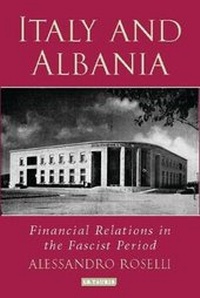
Italy and Albania
Financial Relations in the Fascist Period
Published on 30. June 2006
Book
Hardback
240 pages
978-1-84511-254-7 (ISBN)
Description
The first full and comprehensive examination of the turbulent financial and economic relationship between Italy and Albania in the twentieth century, which throws new light on Italian Fascist imperialism. "Italy and Albania" retraces the complicated foreign and economic strategy that led in 1939 to the "union of the two crowns" of Italy and Albania. Drawing on original research, Roselli shows how Italy's strategy towards Albania veered between the extremes of a minimum of economic penetration and a maximum of political interference. He shows how, from an Albanian perspective, King Zog's policy was an impossible balancing act between the conflicting interests of foreign powers. Often presented as a trophy of Fascist foreign policy, the Italian experience in Albania in the interwar period can be regarded as a major economic failure. The huge inflow of Italian capital to Albania - consisting almost entirely of government money - failed not only to set in motion a stable expansion of the Albanian economy but also to produce a return for Italy in terms of the exploitation of the country's natural resources or its trade with Albania.
Contemporary observers were impressed by the strength of Albania's currency, its monetary regime based on the gold standard, and its strong balance of payments. But this was largely window dressing, behind which there was an extremely backward economy that siphoned resources out of Italy, without that country gaining any appreciable advantage. Seen in this light, the events of 1939 -the Italian occupation of Albania and the Union between the two countries - become the inevitable consequence of a state of economic affairs that was unacceptable to Fascist Italy. Italy's involvement in Albania did not end with the defeat of Fascism, as the long international controversy surrounding the gold of the Albanian Central Bank demonstrates. This book makes a major contribution to our understanding of the history of both countries and the make up of Europe today.
Contemporary observers were impressed by the strength of Albania's currency, its monetary regime based on the gold standard, and its strong balance of payments. But this was largely window dressing, behind which there was an extremely backward economy that siphoned resources out of Italy, without that country gaining any appreciable advantage. Seen in this light, the events of 1939 -the Italian occupation of Albania and the Union between the two countries - become the inevitable consequence of a state of economic affairs that was unacceptable to Fascist Italy. Italy's involvement in Albania did not end with the defeat of Fascism, as the long international controversy surrounding the gold of the Albanian Central Bank demonstrates. This book makes a major contribution to our understanding of the history of both countries and the make up of Europe today.
Reviews / Votes
'Roselli devotes his closing chapter to the Bank of England's custodianship of the gold reserve of the National Bank of Albania. This must be seen as the definitive academic analysis, previous detailed documentation having all been governmental...Roselli's research furnishes the authoritative history of the 'international debates which lasted for the entire Cold War period'. To the study of what was arguably the longest-running 'incident' of the Cold War, the book is an invaluable contribution.' Michael Kaser, Emeritus Fellow of St Antony's College, University of Oxford; Honorary Professor, University of BirminghamMore details
Series
Language
English
Place of publication
United Kingdom
Publishing group
Bloomsbury Publishing PLC
Target group
Professional and scholarly
Illustrations
Illustrations
Dimensions
Height: 234 mm
Width: 156 mm
ISBN-13
978-1-84511-254-7 (9781845112547)
Copyright in bibliographic data and cover images is held by Nielsen Book Services Limited or by the publishers or by their respective licensors: all rights reserved.
Schweitzer Classification
Other editions
Additional editions
E-Book
06/2006
1st Edition
I.B. Tauris
€120.99
Available for download
Person
Alessandro Roselli is the Chief Representative in the United Kingdom of the central Bank of Italy, where he has spent his whole career. His most recent book, Il Governatore Vincenzo Azzolini, 1931-1944, was published by Laterza in 2000.