

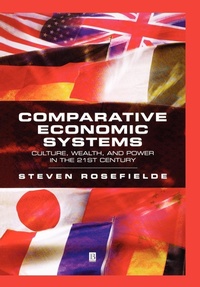
Comparative Economic Systems
Culture, Wealth, and Power in the 21st Century
1st Edition
Published on 19. March 2002
Book
Paperback/Softback
304 pages
978-0-631-22962-9 (ISBN)
Description
Comparative Economic Systems: Culture, Wealth and Power in the 21st Century explains how culture, in various guises, modifies the standard rules of economic engagement, creating systems that differ markedly from those predicted by the theory of general market competition. This analysis is grounded in established principles, but also assumes that individual utility seeking may be culturally determined, that political goals may take precedence over public well being, and that business misconduct may be socially detrimental.
Reviews / Votes
"Now that the transition is over, Professor Steven Rosefielde is bringing back a new and improved version of comparative economic systems, one that treats culture, politics, and business misconduct explicitly in a market context. Rosefielde's approach is original and sophisticated, producing a theoretically rigorous text still accessible to the advanced undergraduate student. Students will learn a large amount of economic theory and come to appreciate the variety of economic systems and the sources of that variety. This is a signal accomplishment by a serious scholar and student of comparative economics." James Millar, George Washington University"This book is an outstanding text to acquaint students with the differences among the world's major economic systems. Its author is one of the best-informed and most careful scholars in the field." Quinn Mills, Harvard Business School
"Thisis an ambitious and innovative work that rigorously and successfully addresses a question that economists often and mistakenly ignore: namely, how do ethics, culture, and politics affect the operation of core economic principles and the relative performance of the major economic systems in the global economy?"Charles Wolf, RAND
"Rosefielde provides a forward-looking text that is firmly grounded in the fundamentals of comparative economics but that seizes fully the opportunities offered to the field by the end of the cold war. This is a text that can make comparative economic systems a "must-take" course for every undergraduate and a "must-offer" course for every economics department." Josef C. Brada, Arizona State University
More details
Language
English
Place of publication
Hoboken
United Kingdom
Publishing group
John Wiley and Sons Ltd
Target group
Professional and scholarly
Product notice
Paperback (trade)
Unsewn / adhesive bound
Dimensions
Height: 244 mm
Width: 170 mm
Thickness: 16 mm
Weight
528 gr
ISBN-13
978-0-631-22962-9 (9780631229629)
Copyright in bibliographic data and cover images is held by Nielsen Book Services Limited or by the publishers or by their respective licensors: all rights reserved.
Schweitzer Classification
Other editions
Additional editions
E-Book
04/2015
Wiley-Blackwell
€57.99
Available for download
E-Book
05/2008
Wiley-Blackwell
€57.99
Available for download
Book
03/2002
1st Edition
Wiley
€151.50
Shipment within 15-20 days
Person
Steven Rosefielde is Professor of Economics at the University of North Carolina and a member of the Russian Academy of Natural Sciences. He is actively involved in economic systems and global security research with the American, Russian, Swedish, and Japanese governments. He is the author of five books, and over 150 articles published in periodicals such as the Wall Street Journal, Slavic Review, Journal of Comparative Economics, Europe-Asia Studies, European Economic Review, and the American Economic Review.
Content
Preface. Glossary.
Introduction.
Part I: Systems.
1. Comparative Economic Systems.
2. Classification and Principles.
3. Culture, Politics and Ethics.
4. Power.
Part II: Perfect Economic Mechanisms.
5. Perfect Competition.
6. Perfect Governance.
Part III: Great Powers.
7. America.
8. Continental Europe.
9. Japan.
10. China.
11. Russia.
12. Transition.
13. Comparative Potential.
Part IV: Performance.
14. Measurement.
15. Global Performance.
Part V: International Relations.
16. Security.
17. Military Balance.
18. Interplay.
Introduction.
Part I: Systems.
1. Comparative Economic Systems.
2. Classification and Principles.
3. Culture, Politics and Ethics.
4. Power.
Part II: Perfect Economic Mechanisms.
5. Perfect Competition.
6. Perfect Governance.
Part III: Great Powers.
7. America.
8. Continental Europe.
9. Japan.
10. China.
11. Russia.
12. Transition.
13. Comparative Potential.
Part IV: Performance.
14. Measurement.
15. Global Performance.
Part V: International Relations.
16. Security.
17. Military Balance.
18. Interplay.