

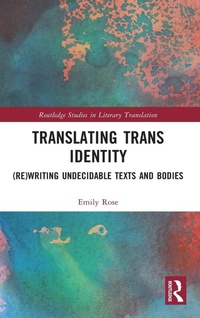
Translating Trans Identity
(Re)Writing Undecidable Texts and Bodies
1st Edition
Published on 25. March 2021
Book
Hardback
200 pages
978-0-367-36996-5 (ISBN)
Description
This book explores the ways in which translation deals with sexual and textual undecidability, adopting an interdisciplinary approach bridging translation, transgender studies, and queer studies in analyzing the translations of six texts in English, French, and Spanish labelled as 'trans.'
Rose draws on experimental translation methods, such as the use of the palimpsest, and builds on theory from areas such as philosophy, linguistics, queer studies, and transgender studies and the work of such thinkers as Derrida and Deleuze to encourage critical thinking around how all texts and trans texts specifically work to be queer and how queerness in translation might be celebrated. These texts illustrate the ways in which their authors play language games and how these can be translated between languages that use gender in different ways and the subsequent implications for our understanding of the act of translation and how we present our gender identity or identities.
In showing what translation and transgender identity can learn from one another, Rose lays the foundation for future directions for research into the translation of trans identity, making this book key reading for scholars in translation studies, transgender studies, and queer studies.
For a video recording of the book's BCLT launch, visit: https://www.youtube.com/watch?v=z-KVzQ8I2PI
Rose draws on experimental translation methods, such as the use of the palimpsest, and builds on theory from areas such as philosophy, linguistics, queer studies, and transgender studies and the work of such thinkers as Derrida and Deleuze to encourage critical thinking around how all texts and trans texts specifically work to be queer and how queerness in translation might be celebrated. These texts illustrate the ways in which their authors play language games and how these can be translated between languages that use gender in different ways and the subsequent implications for our understanding of the act of translation and how we present our gender identity or identities.
In showing what translation and transgender identity can learn from one another, Rose lays the foundation for future directions for research into the translation of trans identity, making this book key reading for scholars in translation studies, transgender studies, and queer studies.
For a video recording of the book's BCLT launch, visit: https://www.youtube.com/watch?v=z-KVzQ8I2PI
More details
Series
Language
English
Place of publication
London
United Kingdom
Publishing group
Taylor & Francis Ltd
Target group
College/higher education
Illustrations
26 s/w Abbildungen, 20 s/w Photographien bzw. Rasterbilder, 6 s/w Zeichnungen, 3 s/w Tabellen
3 Tables, black and white; 6 Line drawings, black and white; 20 Halftones, black and white; 26 Illustrations, black and white
Dimensions
Height: 235 mm
Width: 157 mm
Thickness: 16 mm
Weight
468 gr
ISBN-13
978-0-367-36996-5 (9780367369965)
Copyright in bibliographic data and cover images is held by Nielsen Book Services Limited or by the publishers or by their respective licensors: all rights reserved.
Schweitzer Classification
Other editions
Additional editions
Book
01/2023
1st Edition
Routledge
€63.40
Shipment within 15-20 days
E-Book
03/2021
1st Edition
Routledge
€55.49
Available for download
E-Book
03/2021
1st Edition
Routledge
€55.49
Available for download
Person
Emily Rose finished her PhD on Translating Trans Identity at the University of East Anglia in 2018. Her work has been published in Transgender Studies Quarterly (volume 3 (3-4) and volume 6 (3)), Queer in Translatio and Untranslatability: an Interdisciplinary Perspective, a volume she also co-edited. She currently teaches MFL at a preparatory school in Norfolk.
Content
List of illustrations
Preface
Acknowledgements
Introduction
Chapter One: The History of (Trans)gender
Chapter Two: Close Readings of Transgender texts
Chapter Three: The Palimpsest
Chapter Four: The History of Intersex
Chapter Five: Close Readings of Intersex Texts
Chapter Six: The Hypertext
Chapter Seven: The History of Agender
Chapter Eight: Close Readings of Agender Texts
Chapter Nine: The Lipogram and the Cut-Out Technique
Conclusion: An Open Ending
Appendix
Bibliography
Index
Preface
Acknowledgements
Introduction
Chapter One: The History of (Trans)gender
Chapter Two: Close Readings of Transgender texts
Chapter Three: The Palimpsest
Chapter Four: The History of Intersex
Chapter Five: Close Readings of Intersex Texts
Chapter Six: The Hypertext
Chapter Seven: The History of Agender
Chapter Eight: Close Readings of Agender Texts
Chapter Nine: The Lipogram and the Cut-Out Technique
Conclusion: An Open Ending
Appendix
Bibliography
Index