

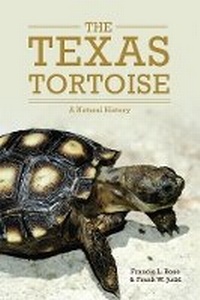
The Texas Tortoise
A Natural History
Will be published approx. on 30. June 2014
Book
Hardback
210 pages
978-0-8061-4451-1 (ISBN)
Description
Remnants of an ancient lineage, tortoises date back to the Eocene. Among the five species remaining in North America, Texas tortoises are the smallest in size and inhabit some of the harshest arid environments known. They are also the most neglected by wildlife personnel. In The Texas Tortoise, biologists Francis L. Rose and Frank W. Judd draw on decades of research to offer the first comprehensive account of this fascinating but threatened species.
The authors begin by explaining the relationship of the Texas tortoise to other species, fossil as well as extant. They delineate the Texas tortoise's environment and describe what it eats, how the animal grows and reproduces, and how it behaves. Throughout, Rose and Judd write eloquently about the threats to the species' survival, reflecting deep concern about its future protection.
The authors also discuss Texas tortoises' significance in supporting other species in their environment - southern Texas and northeastern Mexico - where their survival is threatened by habitat reduction and increasing road traffic. ""If you see a tortoise on the roadway,"" Rose and Judd admonish the reader, ""move it to safety, and drive away as quickly as legally allowed."" It is in fact illegal to collect or possess a Texas tortoise. But for those who do, this book advises how to care for the animal.
Tortoises have enjoyed a splendid and diverse history. That they did so well for so long is perplexing, the authors note, as the animals are slow and do not actively defend themselves against predators. The Texas Parks and Wildlife Department lists Texas tortoises as ""threatened,"" and Rose and Judd call on the federal government to do the same. Biologists, conservationists, and turtle enthusiasts alike will find this guide to Texas and other tortoises invaluable.
The authors begin by explaining the relationship of the Texas tortoise to other species, fossil as well as extant. They delineate the Texas tortoise's environment and describe what it eats, how the animal grows and reproduces, and how it behaves. Throughout, Rose and Judd write eloquently about the threats to the species' survival, reflecting deep concern about its future protection.
The authors also discuss Texas tortoises' significance in supporting other species in their environment - southern Texas and northeastern Mexico - where their survival is threatened by habitat reduction and increasing road traffic. ""If you see a tortoise on the roadway,"" Rose and Judd admonish the reader, ""move it to safety, and drive away as quickly as legally allowed."" It is in fact illegal to collect or possess a Texas tortoise. But for those who do, this book advises how to care for the animal.
Tortoises have enjoyed a splendid and diverse history. That they did so well for so long is perplexing, the authors note, as the animals are slow and do not actively defend themselves against predators. The Texas Parks and Wildlife Department lists Texas tortoises as ""threatened,"" and Rose and Judd call on the federal government to do the same. Biologists, conservationists, and turtle enthusiasts alike will find this guide to Texas and other tortoises invaluable.
More details
Series
Language
English
Place of publication
Oklahoma
United States
Target group
Professional and scholarly
Illustrations
34 black & white and 34 colour illustrations
Dimensions
Height: 235 mm
Width: 156 mm
Thickness: 17 mm
Weight
522 gr
ISBN-13
978-0-8061-4451-1 (9780806144511)
Copyright in bibliographic data and cover images is held by Nielsen Book Services Limited or by the publishers or by their respective licensors: all rights reserved.
Schweitzer Classification
Persons
Francis L. Rose is co-author of Wildflowers of the Llano Estacado.
Frank W. Judd is co-editor of The Laguna Madre of Texas and Tamaulipas. Both are authors of numerous scholarly articles on turtles.
Frank W. Judd is co-editor of The Laguna Madre of Texas and Tamaulipas. Both are authors of numerous scholarly articles on turtles.