

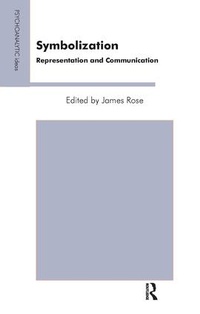
Symbolization
Representation and Communication
Published on 31. December 2007
Book
Paperback/Softback
160 pages
978-1-85575-590-1 (ISBN)
Description
'Because psychoanalysis is a science of subjectivity, it is no surprise that symbolism has been of central interest from its inception and early development. There are few phenomena more obviously subjective than symbols. They conjure a particular fascination because of their enigmatic quality. For this reason, they manage to communicate something in an obscure manner. Thus, they partly hide. This duality and ambiguity approaches the fl eeting and evanescent quality of subjectivity itself: at its most subjective.'Thinking in this descriptive way is not the most immediately helpful approach to understanding symbols as phenomena because it omits immediate consideration of how symbols are formed and how they are used by the individual and the groups that seem to form around them. Initially, the promise of symbols to the pioneers of psychoanalysis was based on their offering an access to the unconscious. Like dreams - and manifest in dreams - they promised to be part of the royal road to the unconscious.'This book is therefore assembled in such a way that the reader can trace the development of the understanding of symbols and their formation and use in its historical context and to try to look at their clinical signifi cance. This is in the hope that the book will be of relevance and use in the practical sense as well as the theoretical.'- James Rose, from the Introduction
Reviews / Votes
The author approached this task by thinking about two issues. The first concerns what might force an individual subject to use symbols as means of communication. He is interested in the possibility that symbols are developed as part of the means of managing the inevitable and unavoidable anxiety of change. Change-or its prospect-is itself equally unavoidable because we cannot know the future. The author then looks at the development of symbols as a means of communication through the use of the setting. This concerns thinking about experience that is initially unrepresentable and to observe how that experience becomes represented in the psychoanalytic setting. The particular experience he chose was a sense of nothingness because it is by definition both subjective and unrepresentable. Contents1 Introduction: symbols - on their formation and use2 A connection between a symbol and a symptom by Freud S. 3 Triangulation, one's own mind and objectivity by Cavell M.4 Symbols and their function in managing the anxiety of change by Rose J. S.5 A Psychoanalytic view of perception by Botella C. and Botella S. 6 A clinical paradox of absence in the transference: how some patients create a virtual object to communicate an experience by Rose J.S. 7 Observing patients' use of the psychoanalytic setting to communicate an experience of absence: the work of progressive triangulation by Rose J.S. 8 Some conclusionsMore details
Series
Language
English
Place of publication
London
United Kingdom
Publishing group
Taylor & Francis Ltd
Target group
College/higher education
Professional and scholarly
Professional Practice & Development
Dimensions
Height: 229 mm
Width: 152 mm
Weight
240 gr
ISBN-13
978-1-85575-590-1 (9781855755901)
Copyright in bibliographic data and cover images is held by Nielsen Book Services Limited or by the publishers or by their respective licensors: all rights reserved.
Schweitzer Classification
Other editions
Additional editions
Book
07/2019
1st Edition
Routledge
€185.50
Shipment within 15-20 days
E-Book
05/2018
1st Edition
Routledge
€40.99
Available for download
E-Book
05/2018
1st Edition
Routledge
€40.99
Available for download
Person
James Rose, PhD, is a Fellow of the Institute of Psychoanalysis and a member of the British Psychoanalytical Society. He has a private psychoanalytic practice in London. Since 1987 he has worked as a psychoanalytic psychotherapist at the Brandon Centre for Counselling and Psychotherapy for Young People, an inner city charity specializing in the psychotherapeutic treatment of adolescents and young adults, situated in Kentish Town, London.
Content
Contents1 Introduction: symbols - on their formation and use2 A connection between a symbol and a symptom by Freud S. 3 Triangulation, one's own mind and objectivity by Cavell M.4 Symbols and their function in managing the anxiety of change by Rose J. S.5 A Psychoanalytic view of perception by Botella C. and Botella S. 6 A clinical paradox of absence in the transference: how some patients create a virtual object to communicate an experience by Rose J.S. 7 Observing patients' use of the psychoanalytic setting to communicate an experience of absence: the work of progressive triangulation by Rose J.S. 8 Some conclusions