

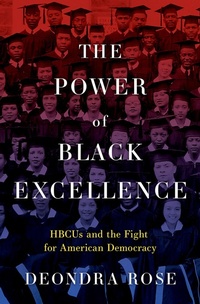
The Power of Black Excellence
HBCUs and the Fight for American Democracy
Published on 3. December 2024
Book
Hardback
344 pages
978-0-19-777659-9 (ISBN)
Description
A powerful and revealing history of Historically Black Colleges and Universities (HBCUs), which have been essential for empowering Black citizens and for the ongoing fight for democracy in the US.
From their founding, Historically Black Colleges and Universities (HBCUs) educated as many as 90 percent of Black college students in the United States. Although many are aware of the significance of HBCUs in expanding Black Americans' educational opportunities, much less attention has been paid to the vital role that they have played in enhancing American democracy.
In The Power of Black Excellence, Deondra Rose provides an authoritative history of HBCUs and the unique role they have played in shaping American democracy since 1837. Drawing on over six years of deep research, Rose brings into view the historic impact that government support for HBCUs has had on the American political landscape, arguing that they have been essential for not only empowering Black citizens but also reshaping the distribution of political power in the United States. Rose challenges the conventional wisdom that, prior to the late twentieth century, the federal government took a laissez-faire approach to education. Instead, governmental action was crucial in aiding the expansion of HBCUs in an era plagued by racist policies and laws. Today, HBCUs remain extremely important, as evidenced by the outsized number of black political leaders--including Kamala Harris--who attended them. Rose stresses that policymakers promote democracy itself when they support HBCUs and their unique approach to postsecondary education, which includes a commitment to helping students develop politically empowering skills, promoting political leadership, and fostering a commitment to service.
A fresh look into the relationship between education and democracy, The Power of Black Excellence is essential reading for anyone interested not just in HBCUs, but the broader trajectory of Black citizenship in American history.
From their founding, Historically Black Colleges and Universities (HBCUs) educated as many as 90 percent of Black college students in the United States. Although many are aware of the significance of HBCUs in expanding Black Americans' educational opportunities, much less attention has been paid to the vital role that they have played in enhancing American democracy.
In The Power of Black Excellence, Deondra Rose provides an authoritative history of HBCUs and the unique role they have played in shaping American democracy since 1837. Drawing on over six years of deep research, Rose brings into view the historic impact that government support for HBCUs has had on the American political landscape, arguing that they have been essential for not only empowering Black citizens but also reshaping the distribution of political power in the United States. Rose challenges the conventional wisdom that, prior to the late twentieth century, the federal government took a laissez-faire approach to education. Instead, governmental action was crucial in aiding the expansion of HBCUs in an era plagued by racist policies and laws. Today, HBCUs remain extremely important, as evidenced by the outsized number of black political leaders--including Kamala Harris--who attended them. Rose stresses that policymakers promote democracy itself when they support HBCUs and their unique approach to postsecondary education, which includes a commitment to helping students develop politically empowering skills, promoting political leadership, and fostering a commitment to service.
A fresh look into the relationship between education and democracy, The Power of Black Excellence is essential reading for anyone interested not just in HBCUs, but the broader trajectory of Black citizenship in American history.
Reviews / Votes
Rose (Duke Univ.) offers a compelling and timely exploration of Historically Black Colleges and Universities (HBCUs) and their role in shaping American democracy. * C. R. Hilburger, Choice *More details
Series
Language
English
Place of publication
New York
United States
Target group
Professional and scholarly
Product notice
sewn/stitched
Cloth over boards
Illustrations
21 b/w figures; 15 tables
Dimensions
Height: 243 mm
Width: 164 mm
Thickness: 32 mm
Weight
662 gr
ISBN-13
978-0-19-777659-9 (9780197776599)
Copyright in bibliographic data and cover images is held by Nielsen Book Services Limited or by the publishers or by their respective licensors: all rights reserved.
Schweitzer Classification
Other editions
Additional editions
E-Book
08/2024
OUP eBook
€21.99
Available for download
E-Book
08/2024
OUP eBook
€21.99
Available for download
Person
Deondra Rose is the Kevin D. Gorter Associate Professor of Public Policy at Duke University's Sanford School of Public Policy with secondary appointments in the departments of Political Science and History. Her research focuses on US higher education policy, political behavior, American political development, and the politics of inequality, particularly in relation to gender, race, and socioeconomic status. A summa cum laude, Phi Beta Kappa graduate of the University of Georgia, Rose received her M.A. and Ph.D. in Government from Cornell University, with a specialization in American Politics and public policy.
Content
Acknowledgments
Introduction
Chapter 1: An Act of Empowerment: Race, Democratic Citizenship, and the Creation of Black Educational Institutions in the Nineteenth Century
Chapter 2: Setting a Foundation for Change: The Political Mission of Black Colleges (1870s-1964)
Chapter 3: Higher Education as a Movement: HBCUs and the Fight for Civil Rights
Chapter 4: "A Different World": Why the Unique HBCU Experience Matters
Chapter 5: Investing in Black Excellence: HBCU Faculty and the Importance of Politically Empowering Academic Experiences
Chapter 6: Building Citizens, Shaping Democracy: The Political and Civic Value of the HBCU Educational Experience
Chapter 7: Foundations for Leadership: HBCUs and the Cultivation of Black Political Elites
Chapter 8: The Power of Black Excellence and the Future of Democracy
Appendices
References
Index
Introduction
Chapter 1: An Act of Empowerment: Race, Democratic Citizenship, and the Creation of Black Educational Institutions in the Nineteenth Century
Chapter 2: Setting a Foundation for Change: The Political Mission of Black Colleges (1870s-1964)
Chapter 3: Higher Education as a Movement: HBCUs and the Fight for Civil Rights
Chapter 4: "A Different World": Why the Unique HBCU Experience Matters
Chapter 5: Investing in Black Excellence: HBCU Faculty and the Importance of Politically Empowering Academic Experiences
Chapter 6: Building Citizens, Shaping Democracy: The Political and Civic Value of the HBCU Educational Experience
Chapter 7: Foundations for Leadership: HBCUs and the Cultivation of Black Political Elites
Chapter 8: The Power of Black Excellence and the Future of Democracy
Appendices
References
Index