

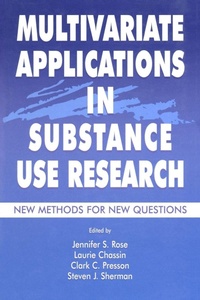
Multivariate Applications in Substance Use Research
New Methods for New Questions
1st Edition
Published on 8. June 2015
Book
Paperback/Softback
360 pages
978-1-138-01250-9 (ISBN)
Description
This edited volume introduces the latest advances in quantitative methods and illustrates ways to apply these methods to important questions in substance use research. The goal is to provide a forum for dialogue between methodologists developing innovative multivariate statistical methods and substance use researchers who have produced rich data sets.
Reflecting current research trends, the book examines the use of longitudinal techniques to measure processes of change over time. Researchers faced with the task of studying the causes, course, treatment, and prevention of substance use and abuse will find this volume helpful for applying these techniques to make optimal use of their data.
This innovative volume:
introduces the use of latent curve methods for describing individual trajectories of adolescent substance use over time;
explores methods for analyzing longitudinal data for individuals nested within groups, such as families, classrooms, and treatment groups;
demonstrates how different patterns of missing data influence the interpretation of results;
reports on some recent advances in longitudinal growth modeling;
illustrates methods to assess mediation when there are multiple mediating pathways underlying an intervention effect;
describes methods to identify moderating relations in structural equation models;
demonstrates the use of structural equation models to evaluate a preventive intervention;
applies epidemic modeling techniques to understand the spread of substance use in society;
illustrates the use of latent transition analysis to model substance use as a series of stages; and
applies logistic regression to prospectively predict smoking cessation.
Reflecting current research trends, the book examines the use of longitudinal techniques to measure processes of change over time. Researchers faced with the task of studying the causes, course, treatment, and prevention of substance use and abuse will find this volume helpful for applying these techniques to make optimal use of their data.
This innovative volume:
introduces the use of latent curve methods for describing individual trajectories of adolescent substance use over time;
explores methods for analyzing longitudinal data for individuals nested within groups, such as families, classrooms, and treatment groups;
demonstrates how different patterns of missing data influence the interpretation of results;
reports on some recent advances in longitudinal growth modeling;
illustrates methods to assess mediation when there are multiple mediating pathways underlying an intervention effect;
describes methods to identify moderating relations in structural equation models;
demonstrates the use of structural equation models to evaluate a preventive intervention;
applies epidemic modeling techniques to understand the spread of substance use in society;
illustrates the use of latent transition analysis to model substance use as a series of stages; and
applies logistic regression to prospectively predict smoking cessation.
Reviews / Votes
"The chapters in this edited volume cover an impressive array of innovative statistical techniques, with many of the contributors being acknowledged experts in the development and application of these techniques....This book provides a valuable introduction to the principles underlying their use as well as the substantive issues that can be addressed using these techniques, and will hopefully serve as an impetus towards their more widespread application."-Addiction Biology
More details
Series
Language
English
Place of publication
Hove
United Kingdom
Publishing group
Taylor & Francis Ltd
Target group
Professional and scholarly
Dimensions
Height: 229 mm
Width: 152 mm
Thickness: 19 mm
Weight
522 gr
ISBN-13
978-1-138-01250-9 (9781138012509)
Copyright in bibliographic data and cover images is held by Nielsen Book Services Limited or by the publishers or by their respective licensors: all rights reserved.
Schweitzer Classification
Other editions
Additional editions
Jennifer S. Rose | Laurie Chassin | Clark C. Presson
Multivariate Applications in Substance Use Research
New Methods for New Questions
Book
01/2000
Psychology Press
€134.00
Shipment within 10-20 days
Jennifer S. Rose | Laurie Chassin | Clark C. Presson
Multivariate Applications in Substance Use Research
New Methods for New Questions
E-Book
01/2000
Psychology Press Ltd
€49.99
Available for download
Jennifer S. Rose | Laurie Chassin | Clark C. Presson
Multivariate Applications in Substance Use Research
New Methods for New Questions
E-Book
01/2000
1st Edition
Psychology Press Ltd
€49.99
Available for download
Persons
Jennifer S. Rose, Laurie Chassin, Clark C. Presson, Steven J. Sherman
Content
Contents: Preface. P.J. Curran, A Latent Curve Framework for the Study of Developmental Trajectories in Adolescent Substance Use. S.T. Khoo, B.O. Muthen, Longitudinal Data on Families: Growth Modeling Alternatives. D. Hedeker, J.S. Rose, The Natural History of Smoking: A Pattern-Mixture Random-Effects Regression Model. B.O. Muthen, Methodological Issues in Random Coefficient Growth Modeling Using a Latent Variable Framework: Applications to the Development of Heavy Drinking Ages 18 Through 37. D.P. MacKinnon, Contrasts in Multiple Mediator Models. P.K. Wood, Estimation and Equivalent Models for Quadratic and Interactive Latent Variable Models. J.B. Ullman, J.A. Stein, R.L. Dukes, Evaluation of D.A.R.E. (Drug Abuse Resistance Education) With Latent Variables in the Context of a Solomon Four Group Design. D.C. Rowe, J.L. Rodgers, M. Gilson, Epidemics of Smoking: Modeling Tobacco Use Among Adolescents. S.L. Hyatt, L.M. Collins, Using Latent Transition Analysis to Examine the Relationship Between Perceived Parental Permissiveness and the Onset of Substance Use. J.S. Rose, L. Chassin, C.C. Presson, S.J. Sherman, Prospective Predictors of Smoking Cessation: A Logistic Regression Application. C.C. Presson, L. Chassin, S.J. Sherman, J.S. Rose, Summary and Future Directions.