

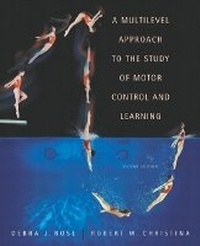
Multilevel Approach to the Study of Motor Control and Learning, A
2nd Edition
Published on 9. June 2005
Book
Paperback/Softback
464 pages
978-0-8053-6031-8 (ISBN)
Description
This textbook provides a comprehensive introduction to the principles of motor control and motor learning. The authors integrate knowledge from the fields of cognitive psychology and neuroscience to provide students with a more complete understanding of the multilevel processes that contribute to the acquisition and control of movement skills. Each section of the book introduces the most important theoretical models in each particular area, followed by theoretical principles and then illustrated with practical examples drawn from movement, skill, and clinical settings. The breadth of the practical applications will appeal to students preparing to enter a variety of professions that require a strong knowledge of motor control and learning principles.
The strong contemporary and multilevel review of the literature in both motor control and learning will provide the student with the most comprehensive and user-friendly introduction to two highly integrated areas of study in movement science today.
The strong contemporary and multilevel review of the literature in both motor control and learning will provide the student with the most comprehensive and user-friendly introduction to two highly integrated areas of study in movement science today.
More details
Other editions
Previous edition
Book
09/1997
Pearson
€69.51
Article exhausted; check for reprint
Content
I. MOTOR CONTROL.
1. Introduction to Motor Control.
2. How Motor Control Is Studied.
3. Sensory Contributions to Action.
4. Vision and Vestibular Contributions to Action.
5. Developing and Executing a Plan of Action.
II. MOTOR LEARNING.
6. Introduction to Motor Learning.
7. How Motor Learning Is Studied.
8. Setting the Stage for Motor Learning.
9. Organizing the Practice Environment.
10. Augmented Feedback and Motor Learning.
11. Memory and Forgetting.
12. Transfer of Motor Learning
1. Introduction to Motor Control.
2. How Motor Control Is Studied.
3. Sensory Contributions to Action.
4. Vision and Vestibular Contributions to Action.
5. Developing and Executing a Plan of Action.
II. MOTOR LEARNING.
6. Introduction to Motor Learning.
7. How Motor Learning Is Studied.
8. Setting the Stage for Motor Learning.
9. Organizing the Practice Environment.
10. Augmented Feedback and Motor Learning.
11. Memory and Forgetting.
12. Transfer of Motor Learning