

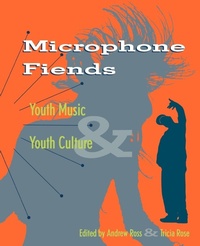
Microphone Fiends
Youth Music and Youth Culture
Published on 14. April 1994
Book
Paperback/Softback
286 pages
978-0-415-90908-2 (ISBN)
Description
Microphone Fiends, a collection of original essays and interviews, brings together some of the best known scholars, critics, journalists and performers to focus on the contemporary scene. It includes theoretical discussions of musical history along with social commentaries about genres like disco, metal and rap music, and case histories of specific movements like the Riot Grrls, funk clubbing in Rio de Janeiro, and the British rave scene.
Reviews / Votes
"...[This book] is the screaming child demanding attention not only from scholars but from mainstream music journalists as well. The strength of this collection, which is primarily cultural criticism, lies in its various and often conflicting approaches and perspectives." -- American Music, Fall 1996"...everyone who contributes is bright, excited, and big with fruitful thoughts." -- Puncture
"A huge, multilayered cacphonus conversation, involving styles of popular music ranging from hardcore rap to college rock to rave to Brazilian funk, represented by participants from all avenues of musical culture. The radical decision to include artists and members of the popular press alongside academics means that the voices included within Microphone Fiends don't conform to one language, they argue with each other and with themselves, unafraid of the rebel stance that has characterized youth culture from its rowdy, world-changing birth. Listening to each other, artists, culture workers, and scholars can uncover insights about the pop-cult ground they cultuivate that otherwise would have eluded them." -- Ann Powers, The Village Voice
"Expression is what youth music and youth culture are all about, a mode of expression that has been lacking in a social perspective. The diversity of the book reflects the "multiculturalism" within, giving a precise sub-cultural analysis. The book's dedication to youth musical culture only makes Microphone Fiends better. Fortunately, it has matured to a point where it can report on itself competently. Microphone Fiends definitely represents the music behind its cultures."
"I bet Microphone Fiends becomes required reading in musical history classes everywhere. This exhaustive dissertation of popular (and not so popular) music forms is basically a collection of articles, commentaries and discussions on everything from raves to riot grrls." -- Thrust,#23
". . .strike[s] a welcome balance between self-aware and self-concious pronouncements on the next generation." -- Publisher's Weekly
"...[This book] is the screaming child demanding attention not only from scholars but from mainstream music journalists as well. The strength of this collection, which is primarily cultural criticism, lies in its various and often conflicting approaches and perspectives." -- American Music, Fall 1996
More details
Language
English
Place of publication
London
United Kingdom
Publishing group
Taylor & Francis Ltd
Target group
College/higher education
Professional and scholarly
Dimensions
Height: 235 mm
Width: 191 mm
Thickness: 16 mm
Weight
543 gr
ISBN-13
978-0-415-90908-2 (9780415909082)
Copyright in bibliographic data and cover images is held by Nielsen Book Services Limited or by the publishers or by their respective licensors: all rights reserved.
Schweitzer Classification
Other editions
Additional editions
E-Book
06/2014
1st Edition
Routledge
€53.99
Available for download
E-Book
06/2014
1st Edition
Routledge
€53.99
Available for download
Book
06/1994
Routledge
€133.92
Article exhausted; check different version
Persons
Tricia Rose is Assistant Professor of History and Africana Studies at New York University. Andrew Ross is Director of the American Studies Program and Professor of Comparative Literature at New York University.
Content
Introduction, Andrew Ross; Part 1 Histories & Futures; Chapter 1 We Know What Time It Is, George Lipsitz; Chapter 2 Same As It Ever Was, Susan McClary; Chapter 3 Is Anybody Listening? Does Anybody Care?, Lawrence Grossberg; Chapter 4 Excerpt from Altered Spade: Readings in Race-Mutation Theory, Greg Tate; Part 2 Locating Hip Hop; Chapter 5 A Style Nobody Can Deal With, Tricia Rose; Chapter 6 Puerto Rican And Proud, Boyee!, Juan Flores; Chapter 7 The State of Rap, Jeffrey Louis Decker; Chapter 8 Contracting Rap, Tricia Rose; Part 3 The Dance Continuum; Chapter 9 In the Empire of the Beat, Walter Hughes; Chapter 10 Hello, Lady Kier Kirby; Chapter 11 Not a Mutant Turtle, Willi Ninja; Chapter 12 Nobody Wants a Part -Time Mother, Tricia Rose; Chapter 13 Moral Panic, the Media and British Rave Culture, Sarah Thornton; Chapter 14 The Funkification of Rio, George Yudice, Hermano ViannaJr.; Part 4 Rock, Rituals & Rights; Chapter 15 Rah, Rah, Sis-Boom-Bah, Robert Christgau; Chapter 16 Border Crossing in the U.S.A., Donna Gaines; Chapter 17 Highbrow, Lowbrow, Voodoo Aesthetics, Robert Walser; Chapter 18 Smells Like Teen Spirit, Joanne Gottlieb, Gayle Wald;