

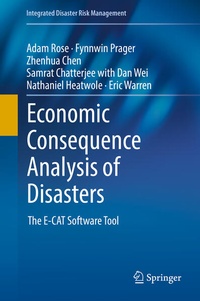
Economic Consequence Analysis of Disasters
The E-CAT Software Tool
Published on 25. April 2017
Book
Hardback
XLV, 137 pages
978-981-10-2566-2 (ISBN)
Description
This study develops a methodology for rapidly obtaining approximate estimates of the economic consequences from numerous natural, man-made and technological threats. This software tool is intended for use by various decision makers and analysts to obtain estimates rapidly. It is programmed in Excel and Visual Basic for Applications (VBA) to facilitate its use. This tool is called E-CAT (Economic Consequence Analysis Tool) and accounts for the cumulative direct and indirect impacts (including resilience and behavioral factors that significantly affect base estimates) on the U.S. economy. E-CAT is intended to be a major step toward advancing the current state of economic consequence analysis (ECA) and also contributing to and developing interest in further research into complex but rapid turnaround approaches.
The essence of the methodology involves running numerous simulations in a computable general equilibrium (CGE) model for each threat, yielding synthetic data for the estimation of a single regression equation based on the identification of key explanatory variables (threat characteristics and background conditions). This transforms the results of a complex model, which is beyond the reach of most users, into a "reduced form" model that is readily comprehensible. Functionality has been built into E-CAT so that its users can switch various consequence categories on and off in order to create customized profiles of economic consequences of numerous risk events. E-CAT incorporates uncertainty on both the input and output side in the course of the analysis.
The essence of the methodology involves running numerous simulations in a computable general equilibrium (CGE) model for each threat, yielding synthetic data for the estimation of a single regression equation based on the identification of key explanatory variables (threat characteristics and background conditions). This transforms the results of a complex model, which is beyond the reach of most users, into a "reduced form" model that is readily comprehensible. Functionality has been built into E-CAT so that its users can switch various consequence categories on and off in order to create customized profiles of economic consequences of numerous risk events. E-CAT incorporates uncertainty on both the input and output side in the course of the analysis.
More details
Series
Edition
1st ed. 2017
Language
English
Place of publication
Singapore
Singapore
Target group
Professional and scholarly
Illustrations
14 farbige Abbildungen, 14 s/w Abbildungen
XLV, 137 p. 28 illus., 14 illus. in color.
Dimensions
Height: 241 mm
Width: 160 mm
Thickness: 16 mm
Weight
481 gr
ISBN-13
978-981-10-2566-2 (9789811025662)
DOI
10.1007/978-981-10-2567-9
Schweitzer Classification
Other editions
Additional editions
Adam Rose | Fynnwin Prager | Zhenhua Chen
Economic Consequence Analysis of Disasters
The E-CAT Software Tool
Book
05/2018
Springer
€64.19
Shipment within 15-20 days
Adam Rose | Fynnwin Prager | Zhenhua Chen
Economic Consequence Analysis of Disasters
The E-CAT Software Tool
E-Book
04/2017
Springer
€64.19
Available for download
Persons
Adam Rose: Price School of Public Policy and Center for Risk and Economic Analysis of Terrorism Events (CREATE), University of Southern California
Fynnwin Prager: College of Business Administration and Public Policy, California State University, Dominguez Hills
Zhenhua Chen: Center for Risk and Economic Analysis of Terrorism Events (CREATE), University of Southern California
Samrat Chatterjee: Applied Statistics and Computational Modeling, Pacific Northwest National Laboratory
Dan Wei: Price School of Public Policy and Center for Risk and Economic Analysis of Terrorism Events (CREATE), University of Southern California
Nathaniel Heatwole: Acumen, LLC
Eric Warren: Center for Risk and Economic Analysis of Terrorism Events (CREATE), University of Southern California
Fynnwin Prager: College of Business Administration and Public Policy, California State University, Dominguez Hills
Zhenhua Chen: Center for Risk and Economic Analysis of Terrorism Events (CREATE), University of Southern California
Samrat Chatterjee: Applied Statistics and Computational Modeling, Pacific Northwest National Laboratory
Dan Wei: Price School of Public Policy and Center for Risk and Economic Analysis of Terrorism Events (CREATE), University of Southern California
Nathaniel Heatwole: Acumen, LLC
Eric Warren: Center for Risk and Economic Analysis of Terrorism Events (CREATE), University of Southern California
Content
Introduction.- Enumeration of Categories of Economic Consequences.- Threat Scenarios and Direct Impacts.- Computable General Equilibrium Modeling and Its Application.- User Interface Variable.- Estimation of the Reduced Form Coefficients for the E-CAT User Interface.- Uncertainty Analysis.- Validation of Computable General Equilibrium Based Models.- E-CAT User Interface Tool.