

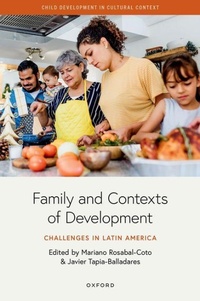
Family and Contexts of Development
Challenges in Latin America
Published on 9. October 2025
Book
Hardback
216 pages
978-0-19-767514-4 (ISBN)
Description
Within developmental psychology, it has been proven that families are a significant context for development. It is also well known that in Latin America, families represent a deeply rooted societal value, yet the continent has often been overlooked within the research base.
Family and Contexts of Development offers an eco-cultural and contextualized contribution focusing on how the family functions as a context for development in Latin American throughout the life span. Editors Mariano Rosabal-Coto and Javier Tapia-Balladares bring together leading researchers in the field to present evidence of how both family and culture are prominent dimensions that help us understand development across different life stages. The family unit concentrates dynamics and roles as a core structure, shaped by culture and transmitting culture, through everyday occurrences and specific events. The volume features quantitative, qualitative, and experimental methodologies and draws on cases from Mexico, Colombia, Costa Rica, Argentina, and Brazil. Each chapter illustrates that families can play a double role, either as a risk, or a protective factor in development. With the rapid changes to society that are unique to Latin America, new forms and types of families are constantly constructed and challenged. Regardless, this book will highlight that these types of families, in their continuity and in their disruptions, remain as a distinct platform for human development.
Family and Contexts of Development offers an eco-cultural and contextualized contribution focusing on how the family functions as a context for development in Latin American throughout the life span. Editors Mariano Rosabal-Coto and Javier Tapia-Balladares bring together leading researchers in the field to present evidence of how both family and culture are prominent dimensions that help us understand development across different life stages. The family unit concentrates dynamics and roles as a core structure, shaped by culture and transmitting culture, through everyday occurrences and specific events. The volume features quantitative, qualitative, and experimental methodologies and draws on cases from Mexico, Colombia, Costa Rica, Argentina, and Brazil. Each chapter illustrates that families can play a double role, either as a risk, or a protective factor in development. With the rapid changes to society that are unique to Latin America, new forms and types of families are constantly constructed and challenged. Regardless, this book will highlight that these types of families, in their continuity and in their disruptions, remain as a distinct platform for human development.
More details
Series
Language
English
Place of publication
New York
United States
Target group
College/higher education
Product notice
sewn/stitched
Cloth over boards
Dimensions
Height: 236 mm
Width: 165 mm
Thickness: 33 mm
Weight
408 gr
ISBN-13
978-0-19-767514-4 (9780197675144)
Copyright in bibliographic data and cover images is held by Nielsen Book Services Limited or by the publishers or by their respective licensors: all rights reserved.
Schweitzer Classification
Other editions
Additional editions
Mariano Rosabal-Coto | Javier Tapia-Balladares
Family and Contexts of Development
Challenges in Latin America
E-Book
07/2025
OUP eBook
€45.99
Available for download
Mariano Rosabal-Coto | Javier Tapia-Balladares
Family and Contexts of Development
Challenges in Latin America
E-Book
07/2025
OUP eBook
€45.99
Available for download
Persons
Mariano Rosabal-Coto is a retired Researcher in the Institute of Psychological Research and Department of Pscyhology at the University of Costa Rica. He completed his graduate studies at the University of Costa Rica and his doctoral studies at the University of Osnabrueck, Germany. Rosabal-Coto's research areas have been cultural psychology and cross-cultural developmental psychology, and his main research topics are parenting and culture, divorce and parenthood, familism, culturally sensitive developmental psychology and recently the cultural conceptions of attachment. For more than 30 years, he has also been active as a practitioner for children, adolescents, and adults.
Javier Tapia-Balladares is Professor and Researcher of Developmental Psychology at the University of Costa Rica, where he has worked since 1993. He obtained a degree in psychology at this University (1985-1993) and an academic doctorate in developmental psychology and psychology of religion at the Universite Catholique
de Louvain, a Louvain-la-Neuve, in Belgium (1996-2000). He is the author of Biopoetics of Adolescence: Identities, Beliefs, Bonds" (2019), which was awarded the "National Cultural Research Award 2019" by the Ministry of Culture of Costa Rica. He was previously the Director of the Institute of Psychological Research (2019-2023), where he founded the seminar on developmental psychology and was director of the journal Actualidades en Psicologia. For over twenty years he has taught developmental psychology, research methodologyg, and psychology of religion in the School of Psychology. He has been a visiting professor in Belgium, Colombia and Chile and served as an adolescent and adult psychotherapist for twelve years. He is a contributor to the Semanario Universidad, as a columnist and translator, and has published two collections of poems Esta Coraza Tuya (2016) and Juego de Mascaras (2022).
Javier Tapia-Balladares is Professor and Researcher of Developmental Psychology at the University of Costa Rica, where he has worked since 1993. He obtained a degree in psychology at this University (1985-1993) and an academic doctorate in developmental psychology and psychology of religion at the Universite Catholique
de Louvain, a Louvain-la-Neuve, in Belgium (1996-2000). He is the author of Biopoetics of Adolescence: Identities, Beliefs, Bonds" (2019), which was awarded the "National Cultural Research Award 2019" by the Ministry of Culture of Costa Rica. He was previously the Director of the Institute of Psychological Research (2019-2023), where he founded the seminar on developmental psychology and was director of the journal Actualidades en Psicologia. For over twenty years he has taught developmental psychology, research methodologyg, and psychology of religion in the School of Psychology. He has been a visiting professor in Belgium, Colombia and Chile and served as an adolescent and adult psychotherapist for twelve years. He is a contributor to the Semanario Universidad, as a columnist and translator, and has published two collections of poems Esta Coraza Tuya (2016) and Juego de Mascaras (2022).
Content
Introduction - Jorge Sanabria-Leon and Mariano Rosabal-Coto
Chapter 1: Social Development of Children Living in Poverty in Colombia: An Analysis from an Integrative Perspective - Sonia Carrillo and Karen Ripoll-Nunez
Chapter 2: Family Based Developmental Intervention: Community Based Participatory Research in a Brazilian Low-Income Neighborhood - Bruna Larissa Seibel, Paul Springer, Cody Hollist, Lisiane Rech, Luiza Piccoli, Carmen Luiza C. Fernandes, Olga Falceto, and Silvia Koller
Chapter 3: Motherhood in Poverty: A Perinatal Intervention Device to Detect Psychosocial-Risk - Alicia Oiberman, Soledad Santos, and Cynthia Ines Paolini
Chapter 4: Colombian Mothers' Intuitive Theories Regarding their Children's Self-Regulation - Jorge Mario Jaramillo, Mirjam Weis, and Maria Isabel Rendon
Chapter 5: Multigenerational Cohabitation and Relationships in the Family: Losses and Gains for Children in the Interaction with Grandparents in Latin America - Salazar-Villanea, Monica.; Fuster-Baraona, Delia Tamara; Blanco-Molina, Mauricio
Chapter 6: Underlying Mechanisms Adolescent Development Facing Changes and Adversities - Blanca E. Barcelata Eguiarte
Chapter 7: Emotion Talk During Reminiscing: A Comparative Study Between Mother-Son and Mother-Daughter Dyads from Two Different Educational Backgrounds in Costa Rica - Nayuribe Saenz, Marcela Rios, Krissia Salazar, and Ana M Carmiol
Chapter 8: Conclusions and Future Orientations - Mariano Rosabal-Coto and Javier Tapia-Balladares
Index
Chapter 1: Social Development of Children Living in Poverty in Colombia: An Analysis from an Integrative Perspective - Sonia Carrillo and Karen Ripoll-Nunez
Chapter 2: Family Based Developmental Intervention: Community Based Participatory Research in a Brazilian Low-Income Neighborhood - Bruna Larissa Seibel, Paul Springer, Cody Hollist, Lisiane Rech, Luiza Piccoli, Carmen Luiza C. Fernandes, Olga Falceto, and Silvia Koller
Chapter 3: Motherhood in Poverty: A Perinatal Intervention Device to Detect Psychosocial-Risk - Alicia Oiberman, Soledad Santos, and Cynthia Ines Paolini
Chapter 4: Colombian Mothers' Intuitive Theories Regarding their Children's Self-Regulation - Jorge Mario Jaramillo, Mirjam Weis, and Maria Isabel Rendon
Chapter 5: Multigenerational Cohabitation and Relationships in the Family: Losses and Gains for Children in the Interaction with Grandparents in Latin America - Salazar-Villanea, Monica.; Fuster-Baraona, Delia Tamara; Blanco-Molina, Mauricio
Chapter 6: Underlying Mechanisms Adolescent Development Facing Changes and Adversities - Blanca E. Barcelata Eguiarte
Chapter 7: Emotion Talk During Reminiscing: A Comparative Study Between Mother-Son and Mother-Daughter Dyads from Two Different Educational Backgrounds in Costa Rica - Nayuribe Saenz, Marcela Rios, Krissia Salazar, and Ana M Carmiol
Chapter 8: Conclusions and Future Orientations - Mariano Rosabal-Coto and Javier Tapia-Balladares
Index