

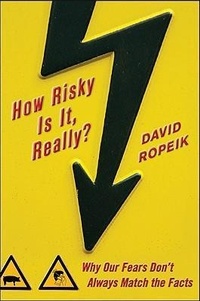
How Risky Is It, Really?: Why Our Fears Don't Always Match the Facts
Published on 16. April 2010
Book
Hardback
288 pages
978-0-07-162969-0 (ISBN)
Description
"Clear, balanced, and lively." -- Steven Pinker, bestselling author of How the Mind Works ARE YOU AFRAID OF THE "RIGHT" RISKS?Do you worry more about radiation from nuclear power or from the sun?Are you more afraid of getting cancer than heart disease?Are you safer talking on your cell phone or using a hands-free device when you drive?Do you think global warming is a serious threat to your health?GET THE FACTS BEHIND YOUR FEARS-AND DISCOVER . . .HOW RISKY IS IT, REALLY?International risk expert David Ropeik takes an in-depth look at our perceptions of risk and explains the hidden factors that make us unnecessarily afraid of relatively small threats and not afraid enough of some really big ones. This read is a comprehensive, accessible, and entertaining mixture of what's been discovered about how and why we fear-too much or too little. It brings into focus the danger of The Perception Gap: when our fears don't match the facts, and we make choices that create additional risks. This book will not decide for you what is really risky and what isn't. That's up to you. HOW RISKY IS IT, REALLY? will tell you how you make those decisions. Understanding how we perceive risk is the first step toward making wiser and healthier choices for ourselves as individuals and for society as a whole.TEST YOUR OWN "RISK RESPONSE" IN DOZENS OF SELF-QUIZZES!
More details
Language
English
Place of publication
London
United States
Publishing group
McGraw-Hill Education - Europe
Product notice
Unsewn / adhesive bound
Cloth over boards
With dust jacket
Illustrations
0 Illustrations
Dimensions
Height: 236 mm
Width: 161 mm
Thickness: 33 mm
Weight
581 gr
ISBN-13
978-0-07-162969-0 (9780071629690)
Schweitzer Classification
Other editions
Additional editions
E-Book
04/2010
1st Edition
McGraw-Hill Education
€56.69
Available for download
Person
David Ropeik is an international consultant and widely sought-after public speaker on risk perception and risk communication. Ropeik is an instructor at the Harvard University Extension School's Environmental Management Program and taught risk perception and risk communication at Harvard School of Public Heath (2000-2006). He was a commentator on risk for NPR Morning Edition program and has been a guest host for NPR's "The Connection." He has written articles about risk perception for The New York Times, The Washington Post, USA Today, LA Times, and The Boston Globe, and Nova among others.
Content
Introduction
Chapter One - This is Your Brain on Fear: The Neuroscience of The Risk Response
Amygdala to the Rescue
The Fear Response Continues
Built-in Fears
Chapter Two - Bounded Rationality: Reason Alone Can't Keep You Safe <
Reasoning by Instinct
The Framing Effect
Categorization - The Representativeness Effect
Loss Aversion
Anchoring and Adjustment
The Ready Recall/Awareness Effect
Innumeracy
Optimism Bias
Chapter Three - Fear Factors: Why Some Threats Feel Scarier Than Others
Risk Perception Factors
Trust
Risk versus Benefit
Control
Choice
Natural versus Human-Made
Pain and Suffering
Uncertainty
Catastrophic or Chronic
Can It Happen to Me?
New or Familiar Risk
Risk to Children
Personification
Chapter Four -The Wisdom, or The Madness, of The Crowds?
A Conversation About Climate Change
Cultural Cognition
Chicken Little, Polyanna, and Other Social Forces
And That's The Way It Is
Chapter Five - Closing The Perception Gap
The Risk of Getting Risk "Wrong", As Individuals
The Risk of Getting Risk "Wrong", As a Society
Toward Healthy Individual Choices
Toward Healthy Choices as A Society
Conclusion
End Notes
Chapter One - This is Your Brain on Fear: The Neuroscience of The Risk Response
Amygdala to the Rescue
The Fear Response Continues
Built-in Fears
Chapter Two - Bounded Rationality: Reason Alone Can't Keep You Safe <
Reasoning by Instinct
The Framing Effect
Categorization - The Representativeness Effect
Loss Aversion
Anchoring and Adjustment
The Ready Recall/Awareness Effect
Innumeracy
Optimism Bias
Chapter Three - Fear Factors: Why Some Threats Feel Scarier Than Others
Risk Perception Factors
Trust
Risk versus Benefit
Control
Choice
Natural versus Human-Made
Pain and Suffering
Uncertainty
Catastrophic or Chronic
Can It Happen to Me?
New or Familiar Risk
Risk to Children
Personification
Chapter Four -The Wisdom, or The Madness, of The Crowds?
A Conversation About Climate Change
Cultural Cognition
Chicken Little, Polyanna, and Other Social Forces
And That's The Way It Is
Chapter Five - Closing The Perception Gap
The Risk of Getting Risk "Wrong", As Individuals
The Risk of Getting Risk "Wrong", As a Society
Toward Healthy Individual Choices
Toward Healthy Choices as A Society
Conclusion
End Notes