

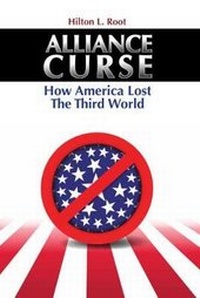
Alliance Curse
How America Lost the Third World
Published on 30. June 2008
Book
Hardback
250 pages
978-0-8157-7556-0 (ISBN)
Description
In Alliance CurseWhile espousing freedom and democracy, the U.S. contradicts itself by aiding governments that do not share those values. In addition to undercutting its own stated goal of promoting freedom, America makes the developing world even more wary of its intentions. Yes, the democracy we preach arouses aspirations and attracts immigrants, but those same individuals become our sternest critics; having learned to admire American values, they end up deploring U.S. policies toward their own countries. Long-term U.S. security is jeopardized by a legacy of resentment and distrust.
Alliance Curse proposes an analytical foundation for national security that challenges long-held assumptions about foreign affairs. It questions the wisdom of diplomacy that depends on questionable linkages or outdated suppositions. The end of the Soviet Union did not portend the demise of communism, for example. Democracy and socialism are not incompatible systems. Promoting democracy by linking it with free trade risks overemphasizing the latter goal at the expense of the former. The growing tendency to play China against India in an effort to retain American global supremacy will hamper relations with both -an intolerable situation in today's interdependent world.
Root buttresses his analysis with case studies of American foreign policy toward developing countries (e.g., Vietnam), efforts at state building, and nations growing in importance, such as China. He concludes with a series of recommendations designed to close the gap between security and economic development.
Alliance Curse proposes an analytical foundation for national security that challenges long-held assumptions about foreign affairs. It questions the wisdom of diplomacy that depends on questionable linkages or outdated suppositions. The end of the Soviet Union did not portend the demise of communism, for example. Democracy and socialism are not incompatible systems. Promoting democracy by linking it with free trade risks overemphasizing the latter goal at the expense of the former. The growing tendency to play China against India in an effort to retain American global supremacy will hamper relations with both -an intolerable situation in today's interdependent world.
Root buttresses his analysis with case studies of American foreign policy toward developing countries (e.g., Vietnam), efforts at state building, and nations growing in importance, such as China. He concludes with a series of recommendations designed to close the gap between security and economic development.
Reviews / Votes
"Roots prescriptions for American foreign policy--less focus on military security, more on economic development--are well-grounded and compelling." -- Publishers Weekly "His prescriptions for American foreign policy--less focus on military security, more on economic development--are well-grounded and compelling." -- Publishers Weekly "engaging and provocative...highly recommended." -- CHOICEMore details
Language
English
Place of publication
United States
Publishing group
Bloomsbury Publishing Plc
Weight
579 gr
ISBN-13
978-0-8157-7556-0 (9780815775560)
Copyright in bibliographic data and cover images is held by Nielsen Book Services Limited or by the publishers or by their respective licensors: all rights reserved.
Schweitzer Classification
Other editions
Additional editions
E-Book
11/2009
1st Edition
Brookings Institution
€25.49
Available for download
Person
Hilton L. Root is a professor at George Mason University's School of Public Policy and a senior fellow with the Mercatus Center. He has served as adviser to the U.S. Treasury and the Asian Development Bank and has taught at Stanford University and the University of Pennsylvania, USA. Root has a number of books to his credit, including Capital & Collusion: The Political Logic of Global Economic Development (Princeton, 2006), Governing for Prosperity , edited with Bruce Bueno de Mesquita (Yale, 2000), and The Key to the Asian Miracle, with J. E. Campos (Brookings, 1996).