

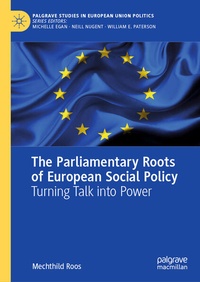
The Parliamentary Roots of European Social Policy
Description
Reviews / Votes
"There are two preconceived notions about the European Parliament in its early decades of existence: There is no good reason to care about the Parliament before it was granted 'real' powers in the late 1980s. And no one should obviously expect a weak Parliament to have any effective say over a policy where Community prerogatives are already weak, as is the case in social policy. Mechthild Roos' remarkable book challenges these two notions and demonstrates how a perfect marriage between political science and contemporary history looks like: She shows with analytical clarity and supported by empirically rich case studies that the young Parliament developed many of the institutional norms and practices that influenced its future trajectory. Fascinating are the accounts of how a small, self-selected group of personalities, at times, succeeded in socializing its peers to become daring and politically successful pro-European activists. A must read for any EU politics and integration buff."
-
Berthold Rittberger
, Chair of Political Science and International Relations at Ludwig Maximilian University of Munich, Germany.
"This is a superb work of exceptional scholarship: meticulously researched, persuasively argued, and beautifully written by an outstanding historian of European political and economic integration. It tells the story of the rise of the European Parliament through the emergence of European-level social policy, and the emergence of European-level social policy through the rise of the European Parliament. Roos blends ideas, institutions, personalities, policies, and politics into a fascinating account of early European Union history."
- Desmond Dinan , Professor of Public Policy and Jean Monnet Chair in European Public Policy at George Mason University, Virginia, USA.
"The institutional development and political influence of the European Parliament has been a core staple of EU research, but until now the focus has been almost exclusively on the period after direct elections in 1979. With this meticulously researched book Roos employs the tools of both historical analysis and political science to demonstrate not only the substantive policy influence of the EP in the realm of social policy during these early years, but also the important role played by MEPs themselves in pushing for increased institutional power and European integration. By providing us with new insights into the internal organization, broad political goals and tangible policy influence of the early European Parliament Roos provides significant new insights into the origins of the eventual formalization of EP powers in the decades after direct elections. This book is an important, and long overdue, contribution to the study of the European Parliament and the institutional evolution of the European Union more generally."
-
Amie Kreppel
, Jean Monnet Chair (
ad personam
), Director Center for European Studies and Professor of Political Science at University of Florida, USA.
More details
Other editions
Additional editions
Person
Content
Chapter 1. Introduction: The parliamentarisation of a consultative assembly.- Chapter 2. Conceptualising the European Parliament's gain in power, 1952-1979.- Chapter 3. The institutional evolution of the European Parliament prior to 1979.- Chapter 4. Creating a borderless Europe: The European Parliament's activism in the pursuit of a free movement of persons.- Chapter 5. Emancipating Europe: The European Parliament's involvement in Community equality policy.- Chapter 6. Forging Europe's next generations: The European Parliament's children and youth policy.- Chapter 7. Controlling the purse: How the European Parliament shaped social policy through the European Social Fund.- Chapter 8. Conclusion: The making of a parliament.