

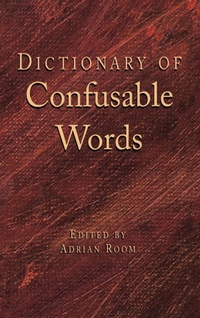
Dictionary of Confusable Words
Published on 1. May 2000
Book
Hardback
260 pages
978-1-57958-271-5 (ISBN)
Description
Adjacent or adjoining? Abuse or misuse? Consist, comprise, constitute, or compose? Guarantee or warranty? Pose, propose, or propound? Stationery or stationary? The Dictionary of Confusable Words aims to clear up the confusion in such cases. In more than 1,100 entries, the meaning of 3,000 individual words are given,the difference between them is explained, and an illustrative example showing the correct usage is provided.
The book also includes specific examples to show past and present usage of words, and words occuring as the second or subsequent in a group are cross-referenced to ther head word in the appropriate alphabetical place. Editor Adrian Room has also included some familiar proper names that are sometimes confused, such as Liberia and Libya (countries), Monterey and Monterrey (towns), and Lloyds and Lloyd's (financial institutions).
Classic or classical? Discreet or discrete? Continual or Continuous? Principle or Principal? Confused? Be confused no longer, with this handy book as your user-friendly guide.
The book also includes specific examples to show past and present usage of words, and words occuring as the second or subsequent in a group are cross-referenced to ther head word in the appropriate alphabetical place. Editor Adrian Room has also included some familiar proper names that are sometimes confused, such as Liberia and Libya (countries), Monterey and Monterrey (towns), and Lloyds and Lloyd's (financial institutions).
Classic or classical? Discreet or discrete? Continual or Continuous? Principle or Principal? Confused? Be confused no longer, with this handy book as your user-friendly guide.
Reviews / Votes
"Room's new work considers pairs and sets of words that are subject to uncertainty in the minds of even native speakers of English. Room takes confusables such as CORRESPONDENT/CO-RESPONDENT, MOLD/MILDEW and QUIET/QUIESCENT and clearly and succinctly explains how they differ. Room also provides an example of each confusable in a plausible sentence." -- Booklist/RBB"Room, the editor of many reference books on the English laguage, offers a welcome addition to usage guides... Recommended for academic and public libraries, especially those needing an accessible guide to difficult words and usage." -- Library Journal
More details
Language
English
Place of publication
New York
United States
Publishing group
Taylor & Francis Inc
Target group
College/higher education
Dimensions
Height: 235 mm
Width: 157 mm
Thickness: 19 mm
Weight
532 gr
ISBN-13
978-1-57958-271-5 (9781579582715)
Copyright in bibliographic data and cover images is held by Nielsen Book Services Limited or by the publishers or by their respective licensors: all rights reserved.
Schweitzer Classification
Other editions
Additional editions
Adrian Room
Dictionary of Confusable Words
E-Book
08/2013
1st Edition
Routledge
€73.49
Available for download
Adrian Room
Dictionary of Confusable Words
E-Book
08/2013
1st Edition
Routledge
€73.99
Available for download
Person
Adrian Room, Anne-Lucie Norton
Content
Part I Economic-Based Reparations: History and Future: Chapter 1; International Legal Responsibility & Reparations for Transatlantic Slavery, Nora Wittmann; Chapter 2: The trade in enslaved Africans and slavery after 1807, Marika Sherwood; Chapter 3: Learning lessons from history? The International Legal Framework for Combating Modern Slavery, Steve Peers; Chapter 4: Reparations: The Universal Periodic Review and the Right to Development, Rohan Kariyawasam; Part II Reparations as a Legal Strategy; Chapter 5: Formulating the Case for Reparations, Lord Anthony Gifford; Chapter 6: Litigation And Political Action To Address Historic Injustices In The United States: Problems And Prospects, Dinah Shelton; Chapter 7: Two Hundred Years After The Abolition Of The Transatlantic Slave Trade, Could There Be A Juridical Basis For The Call For Reparations, Kwesi Quartey; Chapter 8: Restitution After Slavery, Kate Bracegirdle; Chapter 9: Judge, Jurisprudence and Slavery in England 1729-1807, Sheila Dziobon; Part III Pluralism: Strategies for Reparations; Chapter 10: Slave Trade Reparations, Institutional Racism and the Law, Fernne Brennan, Chapter 11: The Value of Experience: What Post World War 2 Settlements Teach us About Reparations, Clemens Nathan; Chapter 12: An Interview with Clemens Nathan, Chris Burnett; Chapter 13: Reparations For Slavery And The Trans-Atlantic Slave Trade: The Case For Special Measures