

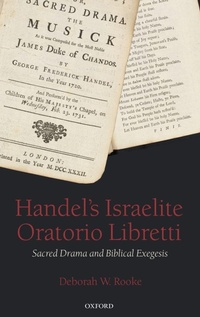
Handel's Israelite Oratorio Libretti
Sacred Drama and Biblical Exegesis
Published on 23. February 2012
Book
Hardback
280 pages
978-0-19-927928-9 (ISBN)
Description
Handel's Israelite oratorios are today little known among non-specialists, but in their own day they were unique, pioneering and extremely popular. Dating from the period 1732-1752, they combine the musical conventions of Italian opera with dramatic plots in English that are adaptations of Old Testament narratives. They constitute a form of biblical interpretation, but to date, there has been no thoroughgoing study of the theological ideas or the attitudes towards the biblical text that might be conveyed in the oratorios' libretti. This book aims to fill that gap from an interdisciplinary perspective.
Combining the insights of present-day biblical studies with those of Handelian studies, Deborah W. Rooke examines the libretti of ten oratorios - Esther, Deborah, Athalia, Saul, Samson, Joseph and his Brethren, Judas Macchabaeus, Solomon, Susanna and Jephtha - and evaluates the relationship between each libretto and the biblical story on which it is based. Rooke comments on each biblical text from a modern scholarly perspective, and then compares the modern interpretation with the version of the biblical narrative that appears in the relevant libretto. Where the libretto is based on a prior dramatic or literary adaptation of the biblical narrative, she also discusses the prior adaptation and how it relates to both the biblical text and the corresponding oratorio libretto. In this way the distinctive nuances of the oratorio libretti are highlighted, and each libretto is then analysed and interpreted in the light of eighteenth-century religion, scholarship, culture and politics. The result is a fascinating exploration not only of the oratorio libretti but also of how culture and context determines the nature of biblical interpretation.
Combining the insights of present-day biblical studies with those of Handelian studies, Deborah W. Rooke examines the libretti of ten oratorios - Esther, Deborah, Athalia, Saul, Samson, Joseph and his Brethren, Judas Macchabaeus, Solomon, Susanna and Jephtha - and evaluates the relationship between each libretto and the biblical story on which it is based. Rooke comments on each biblical text from a modern scholarly perspective, and then compares the modern interpretation with the version of the biblical narrative that appears in the relevant libretto. Where the libretto is based on a prior dramatic or literary adaptation of the biblical narrative, she also discusses the prior adaptation and how it relates to both the biblical text and the corresponding oratorio libretto. In this way the distinctive nuances of the oratorio libretti are highlighted, and each libretto is then analysed and interpreted in the light of eighteenth-century religion, scholarship, culture and politics. The result is a fascinating exploration not only of the oratorio libretti but also of how culture and context determines the nature of biblical interpretation.
Reviews / Votes
Every time [Rooke] described Handels works with reference to modern biblical scholarship, the pages turned themselves ... a good read * Sarah Lenton, Church Times * [Rooke] has amply demonstrated how biblical texts were interpreted by Handels librettists and in addition provides valuable insight into the world of early eighteenth-century biblical interpretation. * Richard H. Bell, The Journal of Theological Studies, *More details
Language
English
Place of publication
Oxford
United Kingdom
Target group
College/higher education
Professional and scholarly
Dimensions
Height: 240 mm
Width: 161 mm
Thickness: 20 mm
Weight
587 gr
ISBN-13
978-0-19-927928-9 (9780199279289)
Copyright in bibliographic data and cover images is held by Nielsen Book Services Limited or by the publishers or by their respective licensors: all rights reserved.
Schweitzer Classification
Person
Content
Introit ; 1. To Laugh or not to Laugh: the Question of Esther ; 2. A Gender Agenda: Deborah in Holy Writ and Handel ; 3. Jezebel, Joash and Jesus Christ: Aspects of Athalia ; 4. Saul: Tragedy, Treachery, and Theology ; 5. From Wild Man to War Hero: The Story of Samson ; 6. Joseph: saint or sinner? Italian Opera, Handelian Oratorio, and Eighteenth-century Commentaries ; 7. Judas Macchabaeus: Justifying the 1745 Anti-Jacobite Campaign ; 8. Solomon and his Women: A Handelian Triptych ; 9. Susanna: A Marriage Made in Heaven ; 10. Sex and Death, or the Death of Sex: The Fate of Jephthah's Daughter ; Postlude ; Bibliography