

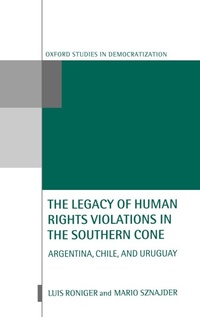
The Legacy of Human Rights Violations in the Southern Cone
Argentina, Chile, and Uruguay
Published on 15. July 1999
Book
Hardback
384 pages
978-0-19-829615-7 (ISBN)
Description
The new democracies of the Southern Cone have publicly professed to reject and condemn the uses of the state power in various forms against citizens under military rule, thus dissociating themselves from their predecessors. And yet the experiences of military rule have become a grim legacy, raising major issues and dilemmas to the forefront of the public agenda.
The Legacy of Human Rights Violations in the Southern Cone: Argentina, Chile, and Uruguay analyses in a systematic and comparative way the struggles and debates, the institutional paths and crises that took place in these societies following redemocratization in the 1980s and 1990s, as they confronted the legacy of violations committed under previous authoritarian governments and as the democratic administrations tried to balance normative principles and political contingency. The book also traces how these trends affected the development of politics of oblivion and memory and the restructuring of collective identity and solidarity following redemocratization.
Oxford Studies in Democratization is a series for scholars and students of comparative politics and related disciplines. The series will concentrate on the comparative study of the democratization process that accompanied the decline and termination of the cold war. The geographical focus of the series will primarily be Latin America, the Caribbean, Southern and Eastern Europe, and relevant experiences in Africa and Asia.
The Legacy of Human Rights Violations in the Southern Cone: Argentina, Chile, and Uruguay analyses in a systematic and comparative way the struggles and debates, the institutional paths and crises that took place in these societies following redemocratization in the 1980s and 1990s, as they confronted the legacy of violations committed under previous authoritarian governments and as the democratic administrations tried to balance normative principles and political contingency. The book also traces how these trends affected the development of politics of oblivion and memory and the restructuring of collective identity and solidarity following redemocratization.
Oxford Studies in Democratization is a series for scholars and students of comparative politics and related disciplines. The series will concentrate on the comparative study of the democratization process that accompanied the decline and termination of the cold war. The geographical focus of the series will primarily be Latin America, the Caribbean, Southern and Eastern Europe, and relevant experiences in Africa and Asia.
Reviews / Votes
well-researched ... laudable for its factual correctness ... The latter of the book is particularly stimulating, and offers refreshing, culture-based insights into the debate on the legacies of human rights violations. * Latin American Politics and Society 43:1 * Although Chile and Argentina are the classic pair of countless comparative studies, it is a definite plus that understudied Uruguay has also been included and that the authors clearly make a conscious effort to lend equal weight to the three cases. * Latin American Politics and Society 43:1 * the strength of their approach is that they combine their conceptual framework as seasoned sociologists with profound insights about Latin American political processes. * Latin American Politics and Society 43:1 * essential reading for political scientists ... comprehensive not only in subject but also in analysis. * American Political Science Review, vol. 94, no. 3 * an excellent description of the struggles faced by the new democratic societies to overcome the legacy of human rights abuses ... the book does a truly impressive job of incorporating multiple sources and bridging widely disparate theoretical perspectives; it will be of great interest to area studies specialists and students of comparative politics and historical sociology alike. * Comparative Political Studies, Febr. 2001 * Roniger and Sznajder draw on an impressive array of primary and secondary sources, including interviews, newspapers, literature, and film, to yield a rich and thorough description of the politics of human rights issues as it has unfolded during the past two decades. * Comparative Political Studies, Febr. 2001 * leaves little untouched in this comprehensive exploration of the legacies of human rights violations in the Southern Cone ... a very useful contribution to several debates. * Katherine Hite, Latin American Studies, Vol.33, 2001 * ambitious and very rich multidisciplinary study ... the authors provide ample and fascinating treatments of the role of Southern Cone intellectuals in today's formal political realm. * Katherine Hite, Latin American Studies, Vol. 33, 2001 * an excellent, well-researched, and readable account. * CHOICE, Oct 00, Vol.38, No.2. *More details
Series
Language
English
Place of publication
Oxford
United Kingdom
Target group
Professional and scholarly
Dimensions
Height: 240 mm
Width: 161 mm
Thickness: 25 mm
Weight
740 gr
ISBN-13
978-0-19-829615-7 (9780198296157)
Copyright in bibliographic data and cover images is held by Nielsen Book Services Limited or by the publishers or by their respective licensors: all rights reserved.
Schweitzer Classification
Persons
RONIGER is a Senior Lecturer at the Hebrew University and Visiting Professor at Wake Forest University
SZNAJDER is a Senior Lecturer at the Hebrew University and Visiting Scholar at the Centre of Latin American Studies at Clare Hall, Cambridge University
SZNAJDER is a Senior Lecturer at the Hebrew University and Visiting Scholar at the Centre of Latin American Studies at Clare Hall, Cambridge University
Content
Introduction ; Repression and the Discourse of Human Rights Violations in the Southern Cone ; Shaping the Public Sphere and the Legacy of Human Right Violations ; National Reconciliation and the Disruptive Potential of the Legacy of Human Rights Violations ; Restructuring the Realm of Human Rights in the Southern Cone ; The Multiple Refraction of the Various Institutional Paths ; Memory and Oblivion in the Redemocratized Southern Cone ; The Transformation of Collective Identities in Argentina, Chile, and Uruguay ; Conclusions