

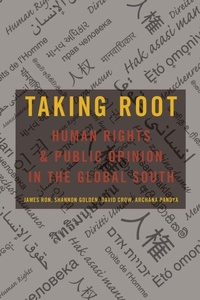
Taking Root
Human Rights and Public Opinion in the Global South
Published on 11. January 2018
Book
Paperback/Softback
272 pages
978-0-19-997505-1 (ISBN)
Description
Human rights organizations have grown exponentially across the globe, particularly in the global South, and the term human rights is now common parlance among politicians and civil society activists. As international donors pour money into global human rights promotion, some governments, scholars, activists, and other critics fear a subtle, Western-led campaign for political, economic, and cultural domination.
While debates about human rights are waged in elite circles, what do publics in the global South think about human rights ideas and the organizations that promote them? Drawing on large-scale public opinion surveys and interview with human rights practioners in India, Mexico, Morocco, and Nigeria, Taking Root finds that most people are in fact broadly supportive of human rights discourse, trust local human rights groups, and do not view human rights as a tool of foreign powers. Pro-human rights constituencies also tend to be highly skeptical of the U.S. government, multinational corporations, and their own governments. However, this general public support for human rights isn't grounded in strong commitments of public engagement, money, or local ties to the human rights sector. Publics in the global South do donate to charitable causes and organizations, but rarely give to local rights groups. Rights organizations instead seek aid from foreign sources, an increasingly untenable strategy as foreign aid to civil society declines. The book also describes the complex relations between religiosity and support for human rights as faith communities, worldviews, and traditions strongly influence the public's views of human rights, but often in contradictory ways.
As the most informative and comprehensive account available of public perceptions of human rights across several regions of the world, Taking Root will challenge a number of accepted truths held by human rights supporters and skeptics alike.
While debates about human rights are waged in elite circles, what do publics in the global South think about human rights ideas and the organizations that promote them? Drawing on large-scale public opinion surveys and interview with human rights practioners in India, Mexico, Morocco, and Nigeria, Taking Root finds that most people are in fact broadly supportive of human rights discourse, trust local human rights groups, and do not view human rights as a tool of foreign powers. Pro-human rights constituencies also tend to be highly skeptical of the U.S. government, multinational corporations, and their own governments. However, this general public support for human rights isn't grounded in strong commitments of public engagement, money, or local ties to the human rights sector. Publics in the global South do donate to charitable causes and organizations, but rarely give to local rights groups. Rights organizations instead seek aid from foreign sources, an increasingly untenable strategy as foreign aid to civil society declines. The book also describes the complex relations between religiosity and support for human rights as faith communities, worldviews, and traditions strongly influence the public's views of human rights, but often in contradictory ways.
As the most informative and comprehensive account available of public perceptions of human rights across several regions of the world, Taking Root will challenge a number of accepted truths held by human rights supporters and skeptics alike.
Reviews / Votes
"Taking Root should be required reading for every human rights scholar and activist. In response to so many conflicting claims about what people in the global South think about human rights, Ron, Golden, Crow and Pandya present answers based on hundreds of qualitative interviews and thousands of randomized survey responses by ordinary people in Mexico, India, Morocco, and Nigeria. The findings about how these individuals actually perceive human rightsideas and institutions are eye-opening, challenging much of the received wisdom in the field."
--Kathryn Sikkink, Carol K. Pforzheimer Professor, Harvard University
"This is a rigorous, relevant, and exemplary study of popular attitudes toward local human rights organizations. Ron and his collaborators brilliantly analyze the chances of forging common cause with religious minorities, believers distrustful of their own religious institutions, and even establishment religious circles, where the surveys show that increased contact pays off. They provide nothing less than the strategic road map for rights advocacy in the
coming decades."
--Jack Snyder, Columbia University
"Little is known of why people support human rights, particularly in the developing world. Taking Root begins to fill that gap. It offers the most complete study yet of popular views on human rights and the steps that human rights groups can take to build popular support. It is essential reading for those seeking to reinforce human rights values in the face of the populist threat."
--Kenneth Roth, Executive Director, Human Rights Watch
"Taking Root is the most comprehensive account available of public perceptions of human rights across several regions of the world, yielding insights and hypotheses that will have a dramatic impact on the work of advocates and scholars. A unique treasure trove of myth-busting data and analysis, no-one who works on human rights can afford to be without it."
--Stephen Hopgood, Professor of International Relations, SOAS, University of London
More details
Series
Language
English
Place of publication
New York
United States
Target group
College/higher education
Professional and scholarly
Illustrations
22 b/w illus.
Dimensions
Height: 210 mm
Width: 140 mm
Thickness: 15 mm
Weight
332 gr
ISBN-13
978-0-19-997505-1 (9780199975051)
Copyright in bibliographic data and cover images is held by Nielsen Book Services Limited or by the publishers or by their respective licensors: all rights reserved.
Schweitzer Classification
Other editions
Additional editions
James Ron | Shannon Golden | David Crow
Taking Root
Human Rights and Public Opinion in the Global South
Book
01/2018
Oxford University Press Inc
€195.00
Shipment within 15-20 days
James Ron | Shannon Golden | David Crow
Taking Root
Human Rights and Public Opinion in the Global South
E-Book
11/2017
OUP eBook
€15.49
Available for download
James Ron | Shannon Golden | David Crow
Taking Root
Human Rights and Public Opinion in the Global South
E-Book
11/2017
OUP eBook
€17.49
Available for download
Persons
James Ron is Harold E. Stassen Chair of International Affairs at the University of Minnesota.
Shannon Golden is a Research Assosicate at the Center for Victims of Torture in St. Paul, Minnesota.
David Crow is Assistant Professor in the Department of International Studies at CIDE in Mexico City.
Archana Pandya is Managing Editor at openGlobalRights.
Shannon Golden is a Research Assosicate at the Center for Victims of Torture in St. Paul, Minnesota.
David Crow is Assistant Professor in the Department of International Studies at CIDE in Mexico City.
Archana Pandya is Managing Editor at openGlobalRights.
Author
Harold E. Stassen Chair of International AffairsHarold E. Stassen Chair of International Affairs, University of Minnesota, Department of Political Science and Humphrey School of Public Affairs
Research AssociateResearch Associate, Center for Victims of Torture
Assistant Professor of International StudiesAssistant Professor of International Studies, CIDE, Mexico
Managing EditorManaging Editor, openGlobalRights
Content
Preface
Chapter 1: Public Opinion and Human Rights
Chapter 2: Reach: Human Rights Exposure and Engagement
Chapter 3: Reputation: Human Rights Meanings and Trust
Chapter 4: Resources: Universal Values, Foreign Money
Chapter 5: Religion: Human Rights Ally and Rival
Chapter 6: Cautious Optimism
Appendix A: Data & Methods
Appendix B: Regression Tables
Notes
References
Index
Chapter 1: Public Opinion and Human Rights
Chapter 2: Reach: Human Rights Exposure and Engagement
Chapter 3: Reputation: Human Rights Meanings and Trust
Chapter 4: Resources: Universal Values, Foreign Money
Chapter 5: Religion: Human Rights Ally and Rival
Chapter 6: Cautious Optimism
Appendix A: Data & Methods
Appendix B: Regression Tables
Notes
References
Index