

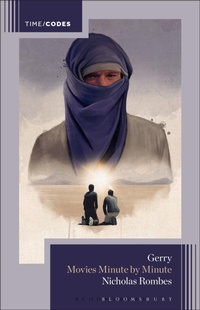
Gerry
Movies Minute by Minute
Published on 6. February 2025
Book
Paperback/Softback
104 pages
978-1-5013-9971-8 (ISBN)
Description
A minute-by-minute analysis of Gus Van Sant film, Gerry (2002).
Blending film criticism with creative nonfiction, each book in the Timecodes series focuses on one film, exploring it minute by minute beginning with minute one, and ending with the final minute before the closing credits.
In the canon of director Gus Van Sant's films, Gerry (2002) stands out as a singular work, a boldly experimental film that nonetheless is accessible, darkly humorous, and profound. Gerry: Minute by Minute is a non-traditional critical study of this film, a bold, impressionistic series of vignettes that circle around questions which are highly specific to Gerry itself but which are also universal: what is it about certain works of art-films, books, paintings, music-that attach themselves to us so that we carry them with us on our journey through life? What does it mean to walk with these works inside us, as if they are a part of us?
The book's structure unfolds chronologically along with the film, with one moment from each of the film's 100 minutes serving as the basis for the chapters. Each of the 100 vignette chapters takes on topics ranging from the particulars of the film itself, including: the inventive use of camera movement and sound; the productive nature of collaboration; the driving themes and philosophies that inform the film; the blistering heat, in Death Valley, of its production; the place of Gerry in American cinema and its European influences, especially Bela Tarr; the impact of 9-11 on the cultural landscape of 2001-02, when Gerry was filmed and released; and what it means to "walk" with a film or a book, carrying it our heads as it informs who we are, often in subtle ways invisible to those around us.
Blending film criticism with creative nonfiction, each book in the Timecodes series focuses on one film, exploring it minute by minute beginning with minute one, and ending with the final minute before the closing credits.
In the canon of director Gus Van Sant's films, Gerry (2002) stands out as a singular work, a boldly experimental film that nonetheless is accessible, darkly humorous, and profound. Gerry: Minute by Minute is a non-traditional critical study of this film, a bold, impressionistic series of vignettes that circle around questions which are highly specific to Gerry itself but which are also universal: what is it about certain works of art-films, books, paintings, music-that attach themselves to us so that we carry them with us on our journey through life? What does it mean to walk with these works inside us, as if they are a part of us?
The book's structure unfolds chronologically along with the film, with one moment from each of the film's 100 minutes serving as the basis for the chapters. Each of the 100 vignette chapters takes on topics ranging from the particulars of the film itself, including: the inventive use of camera movement and sound; the productive nature of collaboration; the driving themes and philosophies that inform the film; the blistering heat, in Death Valley, of its production; the place of Gerry in American cinema and its European influences, especially Bela Tarr; the impact of 9-11 on the cultural landscape of 2001-02, when Gerry was filmed and released; and what it means to "walk" with a film or a book, carrying it our heads as it informs who we are, often in subtle ways invisible to those around us.
Reviews / Votes
Dazzlingly impressive ... Rombes covers multiple bases of culture and thought. * Film International * Gus Van Sant's film Gerry is a lot of things: a singular and immersive cinematic experience; an absurdist comedy with plenty of tragedy and horror in the mix; and a compelling homage to the works of Bela Tarr. In his new book, Nicholas Rombes memorably deconstructs the images, themes, and influences that shaped Gerry and makes a compelling case for it as the precursor to an entirely new genre. It's a thoughtful look at a cult classic - and a powerful argument for the staying power of this haunting narrative. A meticulously-crafted look at a meticulously-crafted film. * Tobias Carroll, Writer/Editor, USA * While Rombes' minute-by-minute reading of Gerry falls somewhere between Salvador Dali's critical paranoiac method and Roland Barthes' code wizardry in S/Z, this erudite narrative about a difficult film is both lucid and entertaining. This is the work of an obsessive fan equipped with an admirable grasp of film theory, cinematic history, media philosophy, and high-brow Hollywood trivia. In a technocapitalist regime that promotes doom scrolling, tiktok zombification, and the restriction of thought to 280 characters, what Rombes accomplishes here is a triumphant feat of sustained and careful attention. Gerry A (the book) is a thrilling joy ride to accompany the land-loping hallucination that is Gerry B (the film). "Power on to the thing!" * Marcel O'Gorman, Founding Director, Critical Media Lab, University of Waterloo, Canada * In this brilliant book, Nicholas Rombes takes a deep dive into one single movie: Gerry (Gus Van Sant, 2002). But in examining this single film in depth, Rombes also explores movies and the world in breadth, moving laterally to consider all sorts of questions about truth and fiction, the workings of narrative, the uses of technology, his own hopes and memories, and many other things.More details
Series
Language
English
Place of publication
New York
United States
Publishing group
Bloomsbury Publishing Plc
Target group
Young adult
Illustrations
11 bw illus
Dimensions
Height: 197 mm
Width: 128 mm
Thickness: 11 mm
Weight
120 gr
ISBN-13
978-1-5013-9971-8 (9781501399718)
Copyright in bibliographic data and cover images is held by Nielsen Book Services Limited or by the publishers or by their respective licensors: all rights reserved.
Schweitzer Classification
Other editions
Person
Nicholas Rombes is a professor of English at the University of Detroit Mercy, USA. His books include Ramones (Continuum 2005), New Punk Cinema (2005), and Cinema in the Digital Age (2017). He has written for Exquisite Corpse, McSweeney's online, and CTheory.
Content
Preface
Minutes 1-100
Endnotes
Index
Minutes 1-100
Endnotes
Index