

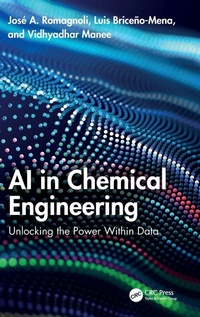
AI in Chemical Engineering
Unlocking the Power Within Data
1st Edition
Published on 31. December 2024
Book
Hardback
286 pages
978-1-032-59700-3 (ISBN)
Description
Industry 4.0 is revolutionizing chemical manufacturing. Today's chemical companies are swiftly embracing the digital era, recognizing the significant benefits of interconnected products, production equipment, and personnel. As technology advances and production volumes grow, there is an increasing need for new computational tools and innovative solutions to address everyday challenges. AI in Chemical Engineering: Unlocking the Power Within Data introduces readers to the essential concepts of machine learning and their application in the chemical and process industries, aiming to enhance efficiency, adaptability, and profitability. This work delves into the transformation of traditional plant operations into integrated and intelligent systems, providing readers with a foundation for developing and understanding the tools necessary for data collection and analysis, thereby gaining valuable insights and practical applications.
Introduces the principles and applications of unsupervised learning and discusses the role of machine learning in extracting information from plant data and transforming it into knowledge
Conveys the concepts, principles, and applications of supervised learning, setting the stage for developing advanced monitoring systems, complex predictive models, and advanced computer vision applications
Explores implementation of reinforced learning ideas for chemical process control and optimization, investigating various model structures and discussing their practical implementation in both simulation and experimental units
Incorporates sample code examples in Python to illustrate key concepts
Includes real-life case studies in the context of chemical engineering and covers a wide variety of chemical engineering applications from oil and gas to bioengineering and electrochemistry
Clearly defines types of problems in chemical engineering subject to AI solutions and relates them to subfields of AI
This practical text, designed for advanced chemical engineering students and industry practitioners, introduces concepts and theories in a logical and sequential manner. It serves as an essential resource, helping readers understand both current and emerging developments in this important and evolving field.
Introduces the principles and applications of unsupervised learning and discusses the role of machine learning in extracting information from plant data and transforming it into knowledge
Conveys the concepts, principles, and applications of supervised learning, setting the stage for developing advanced monitoring systems, complex predictive models, and advanced computer vision applications
Explores implementation of reinforced learning ideas for chemical process control and optimization, investigating various model structures and discussing their practical implementation in both simulation and experimental units
Incorporates sample code examples in Python to illustrate key concepts
Includes real-life case studies in the context of chemical engineering and covers a wide variety of chemical engineering applications from oil and gas to bioengineering and electrochemistry
Clearly defines types of problems in chemical engineering subject to AI solutions and relates them to subfields of AI
This practical text, designed for advanced chemical engineering students and industry practitioners, introduces concepts and theories in a logical and sequential manner. It serves as an essential resource, helping readers understand both current and emerging developments in this important and evolving field.
More details
Language
English
Place of publication
London
United Kingdom
Publishing group
Taylor & Francis Ltd
Target group
College/higher education
Professional and scholarly
Postgraduate and Professional Practice & Development
Illustrations
15 s/w Abbildungen, 182 farbige Abbildungen, 53 Farbfotos bzw. farbige Rasterbilder, 15 s/w Zeichnungen, 129 farbige Zeichnungen, 14 s/w Tabellen
14 Tables, black and white; 129 Line drawings, color; 15 Line drawings, black and white; 53 Halftones, color; 182 Illustrations, color; 15 Illustrations, black and white
Dimensions
Height: 240 mm
Width: 161 mm
Thickness: 21 mm
Weight
628 gr
ISBN-13
978-1-032-59700-3 (9781032597003)
Copyright in bibliographic data and cover images is held by Nielsen Book Services Limited or by the publishers or by their respective licensors: all rights reserved.
Schweitzer Classification
Other editions
Additional editions
Jose A. Romagnoli | Luis Briceno-Mena | Vidhyadhar Manee
AI in Chemical Engineering
Unlocking the Power Within Data
E-Book
12/2024
1st Edition
CRC Press
€158.99
Available for download
Jose A. Romagnoli | Luis Briceno-Mena | Vidhyadhar Manee
AI in Chemical Engineering
Unlocking the Power Within Data
E-Book
12/2024
1st Edition
CRC Press
€158.99
Available for download
Persons
Jose A. Romagnoli is the Gordon & Mary Cain Endowed Chair Professor of Process Systems Engineering, Department of Chemical Engineering, Louisiana State University. He received his Ph.D. from University of Minnesota.
Luis A. Briceno-Mena works at Dow on their Machine Learning Optimization and Statistics team. He received his Ph.D. in Chemical Engineering from Louisiana State University.
Vidhyadhar Manee is a Senior Scientist in Process Research at Boehringer Ingelheim Pharmaceuticals Inc. He received his Ph.D. in Chemical Engineering from Louisiana State University.
Luis A. Briceno-Mena works at Dow on their Machine Learning Optimization and Statistics team. He received his Ph.D. in Chemical Engineering from Louisiana State University.
Vidhyadhar Manee is a Senior Scientist in Process Research at Boehringer Ingelheim Pharmaceuticals Inc. He received his Ph.D. in Chemical Engineering from Louisiana State University.
Content
1. Smart Manufacturing and Machine Learning. 2. Data and Data Pretreatment. 3. Dimensionality Reduction (DR). 4. Clustering. 5. Unsupervised Learning Case Study. 6. Concepts and Definitions. 7. Predictive Models. 8. Supervised Learning Case Studies. 9. Deep Learning. 10. Deep Learning Case Studies. 11. Reinforcement Learning. 12. Reinforcement Learning Case Studies. 13. Generative AI. Appendix A. FASTMAN-JMP Tool Architecture. Appendix B. Tennessee Eastman Process (TEP). Appendix C. High-Temperature PEM Fuel Cell Modelling. Appendix D. Distance Metrics for Clustering.