

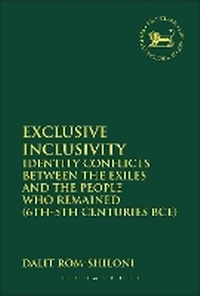
Exclusive Inclusivity
Identity Conflicts between the Exiles and the People who Remained (6th-5th Centuries BCE)
Published on 29. January 2015
Book
Paperback/Softback
256 pages
978-0-567-66150-0 (ISBN)
Description
The sixth and fifth centuries BCE were a time of constant re-identifications within Judean communities, both in exile and in the land; it was a time when Babylonian exilic ideologies captured a central position in Judean (Jewish) history and literature at the expense of silencing the voices of any other Judean communities.
Proceeding from the later biblical evidence to the earlier, from the Persian period sources (Ezra-Nehemiah, Haggai, Zechariah, and Deutero-Isaiah) to the Neo-Babylonian prophecy of Ezekiel and Jeremiah, Exclusive Inclusivity explores the ideological transformations within these writings using the sociological rubric of exclusivity. Social psychology categories of ethnicity and group identity provide the analytical framework to clarify that Ezekiel, the prophet of the Jehoiachin Exiles, was the earliest constructor of these exclusive ideologies. Thus, already from the Neo-Babylonian period, definitions of otherness were being set to shape the self-understanding of each of the post-586 communities, in Judah (Yehud) and in the Babylonian Diaspora, as the exclusive People of God. As each community reidentified itself as the in-group, arguments of otherness were adduced to diregard and delegitimize the sister community. The polemics against "foreigners" in the Persian period literature are the ideological successors to the earlier ideological conflict.
Proceeding from the later biblical evidence to the earlier, from the Persian period sources (Ezra-Nehemiah, Haggai, Zechariah, and Deutero-Isaiah) to the Neo-Babylonian prophecy of Ezekiel and Jeremiah, Exclusive Inclusivity explores the ideological transformations within these writings using the sociological rubric of exclusivity. Social psychology categories of ethnicity and group identity provide the analytical framework to clarify that Ezekiel, the prophet of the Jehoiachin Exiles, was the earliest constructor of these exclusive ideologies. Thus, already from the Neo-Babylonian period, definitions of otherness were being set to shape the self-understanding of each of the post-586 communities, in Judah (Yehud) and in the Babylonian Diaspora, as the exclusive People of God. As each community reidentified itself as the in-group, arguments of otherness were adduced to diregard and delegitimize the sister community. The polemics against "foreigners" in the Persian period literature are the ideological successors to the earlier ideological conflict.
More details
Series
Language
English
Place of publication
Edinburgh
United Kingdom
Publishing group
Bloomsbury Publishing PLC
Target group
College/higher education
Illustrations
10 illus
Dimensions
Height: 234 mm
Width: 156 mm
Weight
476 gr
ISBN-13
978-0-567-66150-0 (9780567661500)
Copyright in bibliographic data and cover images is held by Nielsen Book Services Limited or by the publishers or by their respective licensors: all rights reserved.
Schweitzer Classification
Other editions
Additional editions
Dalit Rom-Shiloni
Exclusive Inclusivity
Identity Conflicts Between the Exiles and the People Who Remained (6th-5th Centuries BCE)
E-Book
07/2013
1st Edition
T.& T.Clark Ltd
€43.49
Available for download
Person
Dalit Rom-Shiloni is Senior Lecturer of Hebrew Bible at Tel Aviv University, Israel.
Content
Preface
Abbreviations
1. Introduction
Part I : Persian Period Ideologies of Exclusivity (Post 538 to Fifth Century BCE)
2. Ezra-Nehemiah
3. Zechariah (1-8) and Haggai: The Restoration Prophets.
4. 'The People of the Land', 'All the Remnant of the People', 'The People that Remained': Relative Designations of Exclusivity - Core and Periphery
5. Deutero-Isaiah: From Babylon to Jerusalem
Part II: Neo-Babylonian Exclusionary Strategies (Early Sixth Century to Circa 520 BCE)
6. Ezekiel and his Book: Homogeneity of Exilic Perspectives
7. Jeremiah and his Book: Two Antagonistic Perspectives
8. Summary and Conclusions
Bibliography of Works Cited
Index of References
Index of Authors
Abbreviations
1. Introduction
Part I : Persian Period Ideologies of Exclusivity (Post 538 to Fifth Century BCE)
2. Ezra-Nehemiah
3. Zechariah (1-8) and Haggai: The Restoration Prophets.
4. 'The People of the Land', 'All the Remnant of the People', 'The People that Remained': Relative Designations of Exclusivity - Core and Periphery
5. Deutero-Isaiah: From Babylon to Jerusalem
Part II: Neo-Babylonian Exclusionary Strategies (Early Sixth Century to Circa 520 BCE)
6. Ezekiel and his Book: Homogeneity of Exilic Perspectives
7. Jeremiah and his Book: Two Antagonistic Perspectives
8. Summary and Conclusions
Bibliography of Works Cited
Index of References
Index of Authors