

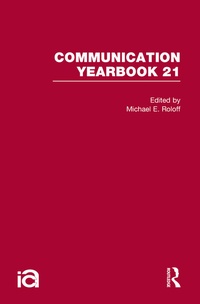
Communication Yearbook 21
1st Edition
Published on 25. October 2011
Book
Hardback
530 pages
978-0-415-87315-4 (ISBN)
Description
Communication Yearbook 21 reflects the rich diversity of the field of communication, both in terms of content areas and methods. The topics of the eleven reviews range from interpersonal influence to media practices and effects. The authors address issues such as organizational democracy and change, intercultural negotiation, journalism and broadcasting practices, the management off crisis and the relationship between media and the presidency. The volume was originally published in 1998. In addressing these issues, narratives, historical accounts and meta-analytic techniques are employed.
More details
Language
English
Place of publication
London
United Kingdom
Publishing group
Taylor & Francis Ltd
Target group
College/higher education
Product notice
Paper over boards
Dimensions
Height: 229 mm
Width: 152 mm
Weight
1150 gr
ISBN-13
978-0-415-87315-4 (9780415873154)
Copyright in bibliographic data and cover images is held by Nielsen Book Services Limited or by the publishers or by their respective licensors: all rights reserved.
Schweitzer Classification
Other editions
Additional editions
Michael Roloff
Communication Yearbook 21
Book
02/2022
1st Edition
Routledge
€73.40
Shipment within 10-20 days
Person
Michael Roloff
Content
1. The Door-in-the-Face Influence Strategy: A Random-Effects Meta-Analytic Review Daniel J. O'Keefe and Scott L. Hale 2. Democracy, Participation, and Communication at Work: A Multidisciplinary Review George Cheney, Joseph Straub, Laura Speirs-Glebe, Cynthia Stohl, Dan DeGooyer, Jr., Susan Whalen, Kathy Garvin-Doxas and David Carlone 3. Reconceptualizing Organizational Change Implementation as a Communication Problem: A review of Literature and Research Agenda Laurie K. Lewis and David R. Siebold 4. The Business of Business Negotiation: Intercultural Perspectives Deborah A. Cai and Laura E. Drake 5. Constructing a Theoretical Framework for Evaluating Public Relations Programs and Activities Sherry Devereaux Fergerson 6. Communication, Organization, and Crisis Matthew W. Seeger, Timothy L. Sellnow and Robert R. Ulmer 7. Old Wine in a New Bottle: Public Journalism, Developmental Journalism and Social ResponsibilityShelton A. Gunaratne 8. Programming Theory Under Stress: The Active Industry and the Active Audience Susan Tyler Eastman 9. Quick Communicators: Editorial Cartoonists in Communication Overdrive W. Bradford Mello 10. The Rhetorical Presidency: Deepening Vision, Widening Exchange Mary E. Stuckey and Frederick J. Antczak 11. Attention, Resource Allocation, and Communication Research: What Do Secondary Task Reduction Times Measure, Anyway? Annie Lang and Michael D. Basil