

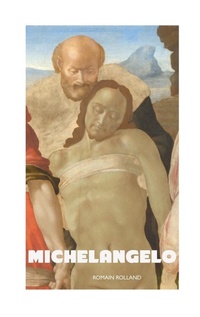
Michelangelo
Published on 30. October 2017
Book
Hardback
196 pages
978-1-86171-695-8 (ISBN)
Description
MICHELANGELO BUONARROTI
By Romain Rolland
A guide to the life and work of Michelangelo Buonarroti, the Renaissance master, first published in English in 1900. Featuring chapters on the early sculptures such as Moses, David and Cupid to the crowning achievements of the Medici tombs, plus Michelangelo’s work in paintings such as the Last Judgement and of course the Sistine Chapel.
Fully illustrated, including images from every stage in Michelangelo’s career. Painters Series. 196 pages.
www.crmoon.com
More details
Series
Language
English
Product notice
sewn/stitched
Cloth over boards
Illustrations
Illustrations
Dimensions
Height: 240 mm
Width: 161 mm
Thickness: 15 mm
Weight
464 gr
ISBN-13
978-1-86171-695-8 (9781861716958)
Copyright in bibliographic data and cover images is held by Nielsen Book Services Limited or by the publishers or by their respective licensors: all rights reserved.
Schweitzer Classification
Persons
Romain Rolland (January 29, 1866 - December 30, 1944) was a French dramatist, novelist, essayist, art historian, and mystic who received the Nobel Prize in Literature in 1915 "as a tribute to the lofty idealism of his literary production and to the sympathy and love of truth with which he has described different types of human beings." He was a key Stalinist supporter in France, and he is also known for his correspondence with and effect on Sigmund Freud. Rolland was born in Clamecy, Nièvre, from a family that included both affluent townpeople and farmers. In his introspective Voyage intérieur (1942), he sees himself as a "antique species" representative. In Colas Breugnon (1919), he would play these forefathers. Accepted into the École Normale Supérieure in 1886, he initially studied philosophy, but his freedom of spirit drove him to forsake it in order to avoid submission to the prevalent ideology. In 1889, he got his bachelor's degree in history and spent two years in Rome, where he met Malwida von Meysenbug, a friend of Nietzsche and Wagner, and discovered Italian masterpieces that shaped his thinking.