

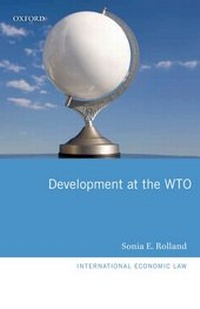
Development at the WTO
Published on 5. September 2013
Book
Paperback/Softback
400 pages
978-0-19-968227-0 (ISBN)
Description
Seeking to open paths for reconsidering the trade and development relationship at the WTO, this book takes into account both the heritage of the trade regime and its present dynamics. It argues that the institutional processes for creating and implementing trade rules at the WTO and the actual regulatory outcomes are inseparable. A consideration of the WTO's development dimension must examine both jointly.
It shows that the shortcomings of the Doha Development Round are in part due to a failure to assess trade rules as part of the legal processes and institutions that produced them. This book devotes significant analysis to the systemic impact of the WTO as an institution on developing and least developed members. From a pragmatic perspective, it provides a coherent and systematic analysis of the legal meaning, the implementation, and the adjudication of special and differential treatment rules for developing members. It then evaluates the different regulatory approaches to trade and development from a more theoretical perspective. The book finishes by presenting a range of proposals for a better balance between trade liberalization and the development needs of many WTO members.
It shows that the shortcomings of the Doha Development Round are in part due to a failure to assess trade rules as part of the legal processes and institutions that produced them. This book devotes significant analysis to the systemic impact of the WTO as an institution on developing and least developed members. From a pragmatic perspective, it provides a coherent and systematic analysis of the legal meaning, the implementation, and the adjudication of special and differential treatment rules for developing members. It then evaluates the different regulatory approaches to trade and development from a more theoretical perspective. The book finishes by presenting a range of proposals for a better balance between trade liberalization and the development needs of many WTO members.
Reviews / Votes
Developing countries maintain that their right to development is fundamental to today's global governance. But what does it mean? Congratulations to Sonia Rolland who, with this book, successfully meets the challenge of exploring how development is actually operationalized in the WTO. * Gabrielle Marceau Counsellor, Legal Affairs, WTO Secretariat and Professor, Law School, University of Geneva * Skillfully using an institutional framework of analysis, Development at the World Trade Organization explains the meanings of "development" and the concept of "special and differential treatment"...It [offers] insightful and creative suggestions for a fair balance between free trade and the development needs of poor countries...[T]his book is a clear, cogent, succinct, and persuasive account of whether, how, and the extent to which the WTO helps promote development-veritably, a marvelous contribution, both scholarly and practical, on a topic of global importance. * Raj Bhala, Associate Dean for International and Comparative Law Rice Distinguished Professor, the University of Kansas School of Law *More details
Series
Language
English
Place of publication
Oxford
United Kingdom
Target group
Professional and scholarly
Dimensions
Height: 233 mm
Width: 166 mm
Thickness: 23 mm
Weight
612 gr
ISBN-13
978-0-19-968227-0 (9780199682270)
Copyright in bibliographic data and cover images is held by Nielsen Book Services Limited or by the publishers or by their respective licensors: all rights reserved.
Schweitzer Classification
Other editions
Additional editions
Sonia E. Rolland
Development at the WTO
Book
02/2012
1st Edition
Oxford University Press
€135.70
Shipment within 15-20 days
Person
Sonia Rolland conducts research and teaches at Northeastern University School of Law, Boston. Her work focuses on public international law and trade law, and is informed by regular exchanges with delegates and members of the WTO community. She has practiced law in Washington DC and has clerked at the International Court of Justice. She earned a Ph.D. from the University of Cambridge, a J.D. degree from the University of Michigan, an M.A. from the Universite Paris 10-Nanterre (France), and the Diplome of the Institut d'Etudes Politiques de Paris.
Content
PART 1: DEVELOPMENT AND ITS INSTITUTIONS IN INTERNATIONAL ECONOMIC LAW: WHO DECIDES WHAT DEVELOPMENT MEANS?; PART 2: FRAMING DEVELOPMENT AT THE GATT AND WTO; PART 3: UNDERSTANDING AND CONTEXTUALIZING WTO DEVELOPMENT PROVISIONS; PART 4: RETHINKING THE TRADE AND DEVELOPMENT RELATIONSHIP AT THE WTO