

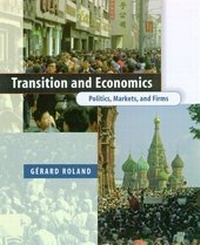
Transition and Economics
Politics, Markets, and Firms
Published on 14. August 2000
Book
Hardback
432 pages
978-0-262-18203-4 (ISBN)
Description
The transition from socialism to capitalism in former socialist economies
is one of the main economic events of the twentieth century. Not only does it affect
the lives of approximately 1.65 billion people, but it is contributing to a shift in
emphasis in economics from standard price and monetary theory to contracting and its
institutional environment. Economic research in transition shows not only that
institutions matter but also how their evolution toward higher efficiency depends on
initial conditions and on sustained political support.Unlike early policy literature
on transition economics, which focused on the so-called Washington consensus, this
book provides an overview of current research, analyzing issues raised by transition
for which economic theorists and policy makers had no ready answers. It shows how
research on transition contributes to our understanding of capitalism as an economic
system and of the dynamics of large-scale institutional change.The book is divided
into three parts. The first part looks at how large-scale reforms are decided
dynamically through the political process. The second part looks at the general
equilibrium and macroeconomic effects of liberalization in economies without
preexisting markets. The third part looks at the economic behavior of firms in the
transition from state to private ownership and compares the effects of
privatization, restructuring, and financial reform. Although focused on transition
economics, the discussions are relevant to topics in political economics,
development, public economics, corporate finance, and micro- and
macroeconomics.
is one of the main economic events of the twentieth century. Not only does it affect
the lives of approximately 1.65 billion people, but it is contributing to a shift in
emphasis in economics from standard price and monetary theory to contracting and its
institutional environment. Economic research in transition shows not only that
institutions matter but also how their evolution toward higher efficiency depends on
initial conditions and on sustained political support.Unlike early policy literature
on transition economics, which focused on the so-called Washington consensus, this
book provides an overview of current research, analyzing issues raised by transition
for which economic theorists and policy makers had no ready answers. It shows how
research on transition contributes to our understanding of capitalism as an economic
system and of the dynamics of large-scale institutional change.The book is divided
into three parts. The first part looks at how large-scale reforms are decided
dynamically through the political process. The second part looks at the general
equilibrium and macroeconomic effects of liberalization in economies without
preexisting markets. The third part looks at the economic behavior of firms in the
transition from state to private ownership and compares the effects of
privatization, restructuring, and financial reform. Although focused on transition
economics, the discussions are relevant to topics in political economics,
development, public economics, corporate finance, and micro- and
macroeconomics.
More details
Series
Language
English
Place of publication
Cambridge, Mass.
United States
Publishing group
MIT Press Ltd
Target group
Professional and scholarly
Interest Age: From 18 years
Illustrations
Illustrations
Dimensions
Height: 229 mm
Width: 203 mm
Thickness: 25 mm
Weight
862 gr
ISBN-13
978-0-262-18203-4 (9780262182034)
Copyright in bibliographic data and cover images is held by Nielsen Book Services Limited or by the publishers or by their respective licensors: all rights reserved.
Schweitzer Classification