

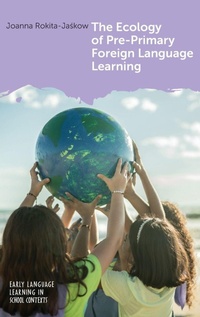
The Ecology of Pre-Primary Foreign Language Learning
Published on 29. January 2025
Book
Hardback
167 pages
978-1-80041-785-4 (ISBN)
Description
This book synthesises research on very early language learning in pre-primary organised instruction settings such as kindergarten, nursery or afternoon classes. Using a framework of ecological development, it investigates the nested systems in which very young learners operate, the other agents involved in each of these systems and the influence these agents have on children's foreign language learning. It explores the ecosystems of the individual learner and their family, educational institutions, general social climate and language education policies, resulting in a holistic view of early language learning and the key transitions into and out of pre-primary formal instruction settings. This is the first book to gather research to date on very young learners in formal settings, offering a comprehensive state of the art to researchers and graduate students in early language learning, second language acquisition and early years pedagogy.
Reviews / Votes
Joanna Rokita-Jaskow uses a critical ecological perspective in her exploration of foreign-language programs in pre-schools, presenting research that both supports and challenges their implementation. The book offers valuable guidance to policymakers, parents, and teachers, outlining contextual conditions that they must consider. The key takeaway is that very young children's progress is slow, and early exposure to a new language does not necessarily ensure long-term success. * Marianne Nikolov, Professor Emerita, University of Pecs, Hungary * This ambitious volume provides a contemporary overview of foreign language acquisition in young learners. Situated within an ecological framework that emphasizes key concepts of human development, it offers new insights into the various factors influencing children's foreign language learning. It is an essential read that underscores the significance and advantages of early foreign language education. * Victoria A. Murphy, University of Oxford, UK * An insightful, comprehensive and compelling exploration of the intricate ecosystem involved in early language learning. From cognitive propensities to societal influences, this book offers invaluable insights for educators, policymakers, and researchers. A must-read for those seeking to enhance the effectiveness and impact of early language education. * ?homai Alexiou, Aristotle University of Thessaloniki, Greece *More details
Series
Language
English
Place of publication
Bristol
United Kingdom
Target group
College/higher education
Dimensions
Height: 240 mm
Width: 161 mm
Thickness: 15 mm
Weight
443 gr
ISBN-13
978-1-80041-785-4 (9781800417854)
Copyright in bibliographic data and cover images is held by Nielsen Book Services Limited or by the publishers or by their respective licensors: all rights reserved.
Schweitzer Classification
Other editions
Additional editions
Joanna Rokita-Jaskow
The Ecology of Pre-Primary Foreign Language Learning
Book
01/2025
Multilingual Matters
€42.20
Shipment within 10-20 days
Person
Joanna Rokita-Jaskow is Associate Professor of Applied Linguistics and Head of ELT at the University of the National Education Commission (UKEN), Poland. Her research explores foreign language education at pre-primary and primary levels, multilingualism in schools and teacher education, and she is the Vice-Chair of the Early Language Learning Research Association.
Content
Acknowledgement
Abbreviations
Introduction
Chapter 1: The Child's Biosystem: How Children Learn to Communicate in Their First and Foreign Languages
Chapter 2 Microsystem: The Educational Institution
Chapter 3. Mesosystem: Family Environment
Chapter 4. Exosystem: The Affordances of the Linguistic Landscape
Chapter 5. Macrosystem: Early Language Learning Policy and Planning
Chapter 6: The Chronosystem
Concluding Remarks
References
Abbreviations
Introduction
Chapter 1: The Child's Biosystem: How Children Learn to Communicate in Their First and Foreign Languages
Chapter 2 Microsystem: The Educational Institution
Chapter 3. Mesosystem: Family Environment
Chapter 4. Exosystem: The Affordances of the Linguistic Landscape
Chapter 5. Macrosystem: Early Language Learning Policy and Planning
Chapter 6: The Chronosystem
Concluding Remarks
References