

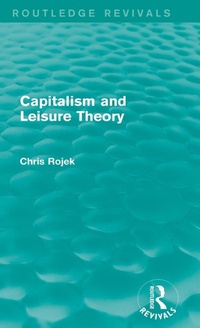
Capitalism and Leisure Theory (Routledge Revivals)
1st Edition
Published on 25. September 2013
Book
Hardback
208 pages
978-0-415-73460-8 (ISBN)
Description
First published in 1985, this title explores theories of leisure in a capitalist society. Basing his argument on a refutation of the conventional association of leisure with freedom and free time, Chris Rojek examines the four main structural characteristics of modern leisure practice: privatisation, individuation, commercialisation and pacification. The writings of Marx, Durkheim, Weber, and Freud are used to locate the question of leisure in more mainstream social theory. This interesting reissue will be of particular value to students of sociology and leisure studies, and those with an interest in the relationship between leisure and power.
More details
Series
Language
English
Place of publication
London
United Kingdom
Publishing group
Taylor & Francis Ltd
Target group
College/higher education
Dimensions
Height: 222 mm
Width: 145 mm
Thickness: 16 mm
Weight
416 gr
ISBN-13
978-0-415-73460-8 (9780415734608)
Copyright in bibliographic data and cover images is held by Nielsen Book Services Limited or by the publishers or by their respective licensors: all rights reserved.
Schweitzer Classification
Other editions
Additional editions
Book
04/2015
1st Edition
Routledge
€63.10
Shipment within 15-20 days
E-Book
12/2013
1st Edition
Routledge
€55.49
Available for download
E-Book
12/2013
1st Edition
Routledge
€55.49
Available for download
Person
Content
Introduction: Leisure without Society?; Part 1 Leisure Today and the Submerged Tradition in Leisure Theory; Chapter 1 The Structural Characteristics of Modern Leisure Practice; Chapter 2 Leisure and Social Intervention; Chapter 3 Laissez-Faire Leisure; Part 2 Leisure Theory and Multi-Paradigmatic Rivalry; Chapter 4 Social Formalism and Leisure; Chapter 5 Neo-Marxist Approaches to Leisure; Chapter 6 Leisure, Signification, and Power; Chapter 7 Leisure and Figurational Sociology; Chapter 8 The Sociology of Pleasure;