

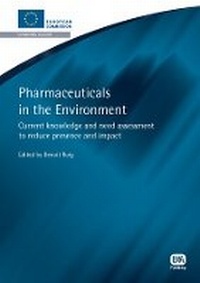
Pharmaceuticals in the Environment
Published on 14. August 2010
Book
Paperback/Softback
216 pages
978-1-84339-314-6 (ISBN)
Description
About 4000 medical compounds are being used in the drugs applied today. It is estimated that worldwide consumption of active compounds amounts to some 100,000 tons or more per year. Consequently, there is a need to highlight the most important questions and issues related to presence of pharmaceuticals in the environment.
Pharmaceuticals in the Environment: current knowledge and need assessment to reduce presence and impact brings together results of previous and on-going EU projects with published data from both governmental sources and scientific literature and manufacturers' data on production and usage of pharmaceuticals. This book puts together the current knowledge and emphasises questions that deserve attention such as: What is the spectrum of most relevant pharmaceutical products (PPs) for the aquatic environment? Which indicators for supporting environmental managers, health authorities? What is the efficiency of urban and industrial sewage treatment plants over a year? What is the fate and behaviour of PPs in sewage treatment plants? If receiving waters are used for potable water supplies, does the presence of these compounds represent a potential hazard to human health? Could we solve some problems by environmental or cleaner technologies? What regulatory approaches, incentives, prevention actions can be implemented in order to lower PPs concentration in the environment? Does a European practical guidance can be developed? Can the impacts of PPs on the environment be reduced through the use of eco-pharmaco-stewardship approaches including the use of clean synthesis, classification and labelling, and better communication of methods of 'good practice'? How can we better monitor the environmental impact of a pharmaceutical once it has received a marketing authorisation?
Pharmaceuticals in the Environment: current knowledge and need assessment to reduce presence and impact brings together results of previous and on-going EU projects with published data from both governmental sources and scientific literature and manufacturers' data on production and usage of pharmaceuticals. This book puts together the current knowledge and emphasises questions that deserve attention such as: What is the spectrum of most relevant pharmaceutical products (PPs) for the aquatic environment? Which indicators for supporting environmental managers, health authorities? What is the efficiency of urban and industrial sewage treatment plants over a year? What is the fate and behaviour of PPs in sewage treatment plants? If receiving waters are used for potable water supplies, does the presence of these compounds represent a potential hazard to human health? Could we solve some problems by environmental or cleaner technologies? What regulatory approaches, incentives, prevention actions can be implemented in order to lower PPs concentration in the environment? Does a European practical guidance can be developed? Can the impacts of PPs on the environment be reduced through the use of eco-pharmaco-stewardship approaches including the use of clean synthesis, classification and labelling, and better communication of methods of 'good practice'? How can we better monitor the environmental impact of a pharmaceutical once it has received a marketing authorisation?
More details
Series
Language
English
Place of publication
London
United Kingdom
Target group
College/higher education
Professional and scholarly
Dimensions
Height: 234 mm
Width: 156 mm
Thickness: 18 mm
ISBN-13
978-1-84339-314-6 (9781843393146)
Copyright in bibliographic data and cover images is held by Nielsen Book Services Limited or by the publishers or by their respective licensors: all rights reserved.
Schweitzer Classification
Other editions
Additional editions
Benoit Roig
Pharmaceuticals in the Environment
Current knowledge and need assessment to reduce presence and impact
E-Book
08/2010
IWA Publishing
€130.99
Available for download
Content
Contents: Introduction; Policy framework at EU level; Exposure based on life cycle; Real situation: occurrence of the main investigated PPs in water bodies; Performance of conventional treatment processes of the most resistant PPs; Biological monitoring and endpoints; Environmental risk assessment and prioritization strategies for human pharmaceuticals, review and discussion; Recommendations on research and development; Recommendations on Communication and Education