

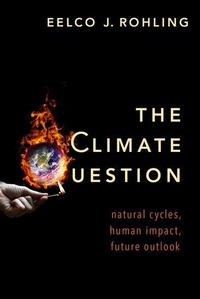
The Climate Question
Natural Cycles, Human Impact, Future Outlook
Published on 30. May 2019
Book
Hardback
176 pages
978-0-19-091087-7 (ISBN)
Description
In 2015, annual average atmospheric carbon dioxide (CO2) levels surpassed a level of 400 parts per million (ppm) for the first time in three million years. This has caused widespread concern among climate scientists, and not least among those that work on natural climate variability in prehistoric times, before humans. These people are known as "past climate" or palaeoclimate researchers, and author Eelco J. Rohling is one of them. The Climate Question offers a background to these concerns in straightforward terms, with examples, and is motivated by Rohling's personal experience in being intensely quizzed about whether modern change is not all just part of a natural cycle, whether nature will not simply resolve the issue for us, or whether it won't be just up to some novel engineering to settle things quickly.
This book discusses in straightforward terms why climate changes, how it has changed naturally before the industrial revolution made humans important, and how it has changed since then. It compares the scale and rapidity of variations in pre-industrial times with those since the industrial revolution, infers the extent of humanity's impacts, and looks at what these may lead to in the future. Rohling brings together both data and process understanding of climate change. Finally, the book evaluates what Mother Nature could do to deal with the human impact by itself, and what our options are to lend her a hand.
This book discusses in straightforward terms why climate changes, how it has changed naturally before the industrial revolution made humans important, and how it has changed since then. It compares the scale and rapidity of variations in pre-industrial times with those since the industrial revolution, infers the extent of humanity's impacts, and looks at what these may lead to in the future. Rohling brings together both data and process understanding of climate change. Finally, the book evaluates what Mother Nature could do to deal with the human impact by itself, and what our options are to lend her a hand.
Reviews / Votes
Prior to reading this, I had yet to become more closely familiar with what I now consider to be the irrefutable evidence that drastic action is needed... I liked the longitudinal way in which the author slowly but definitely lays out the evidenceThe style in which this volume addresses the reader is very easy to understand and easy to follow. * Dr Michael Kindler, Asia Pacific Centre for Leadership and Change * This slim volume is the best possible source for those who wish to understand how much humans and natural forces have changed the climate in the past and present, and what realistic options we have to prevent runaway climate change... solidly based in how climate change and the carbon cycle work in the real world. It avoids any digressions into hypothetical models or unproven technologies. It should be read by every policy maker whose actions, or lack thereof, affect our planet's future. * Dr. Thomas J. F. Goreau, Remineralize the Earth *More details
Language
English
Place of publication
New York
United States
Product notice
sewn/stitched
Cloth over boards
Illustrations
17
Dimensions
Height: 218 mm
Width: 172 mm
Thickness: 20 mm
Weight
328 gr
ISBN-13
978-0-19-091087-7 (9780190910877)
Copyright in bibliographic data and cover images is held by Nielsen Book Services Limited or by the publishers or by their respective licensors: all rights reserved.
Schweitzer Classification
Other editions
Additional editions
E-Book
04/2019
1st Edition
OUP eBook
€24.99
Available for download
E-Book
04/2019
1st Edition
OUP eBook
€24.99
Available for download
Person
Eelco J. Rohling is based at the Research School of Earth Sciences, The Australian National University, Canberra (since 2013), and secondarily affiliated with the University of Southampton, National Oceanography Centre Southampton, UK (since 1994). His research focuses on ocean and climate change with emphasis on sea level, climate sensitivity, and past episodes of enhanced carbon burial in ocean sediments.
Content
- 1. Introduction
- 2. Past climates: How We Get Our Data
- -Data from ice
- -Data from land
- -Data from the sea
- -Data about sea-level changes
- -Recap and outlook
- 3. Energy balance of climate
- -The greenhouse gases
- -A perspective from studies of past climates
- -Recap and outlook
- 4. Causes of climate change
- -Carbon-cycle changes
- -Astronomical variability
- -Large (super-)volcanic eruptions, and asteroid impacts
- -Variability in the intensity of solar radiation
- -Recap and outlook
- 5. Changes during the industrial age
- -Direct effects
- -Global responses and climate sensitivity
- -Sea-level change
- -Common reactions to the geological perspective
- -Recap and outlook
- 6. Mother Nature to the rescue?
- -Weathering, reforestation, and carbon burial
- -Requirement for human intervention
- -Human intervention in carbon removal
- 7. Summary
- 8. Epilogue
- Glossary
- Acknowledgements
- References and notes