

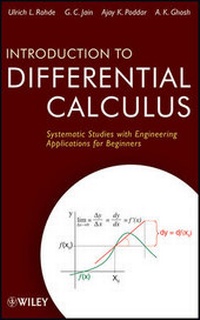
Introduction to Differential Calculus
Systematic Studies with Engineering Applications for Beginners
Published on 9. February 2012
Book
Hardback
784 pages
978-1-118-11775-0 (ISBN)
Description
Enables readers to apply the fundamentals of differential calculus to solve real-life problems in engineering and the physical sciences
Introduction to Differential Calculus fully engages readers by presenting the fundamental theories and methods of differential calculus and then showcasing how the discussed concepts can be applied to real-world problems in engineering and the physical sciences. With its easy-to-follow style and accessible explanations, the book sets a solid foundation before advancing to specific calculus methods, demonstrating the connections between differential calculus theory and its applications.
The first five chapters introduce underlying concepts such as algebra, geometry, coordinate geometry, and trigonometry. Subsequent chapters present a broad range of theories, methods, and applications in differential calculus, including:
* Concepts of function, continuity, and derivative
* Properties of exponential and logarithmic function
* Inverse trigonometric functions and their properties
* Derivatives of higher order
* Methods to find maximum and minimum values of a function
* Hyperbolic functions and their properties
Readers are equipped with the necessary tools to quickly learn how to understand a broad range of current problems throughout the physical sciences and engineering that can only be solved with calculus. Examples throughout provide practical guidance, and practice problems and exercises allow for further development and fine-tuning of various calculus skills. Introduction to Differential Calculus is an excellent book for upper-undergraduate calculus courses and is also an ideal reference for students and professionals alike who would like to gain a further understanding of the use of calculus to solve problems in a simplified manner.
Reviews / Votes
"The book is addressed mainly to students studying non-mathematical subjects. It will be also helpful for those who want to understand why it is important to study Calculus and how to apply it." (Zentralblatt MATH, 1 December 2012)More details
Product info
gebunden
Edition
1. Auflage
Language
English
Place of publication
New York
United States
Target group
Professional and scholarly
Product notice
sewn/stitched
Paper over boards
Dimensions
Height: 240 mm
Width: 161 mm
Thickness: 46 mm
Weight
1320 gr
ISBN-13
978-1-118-11775-0 (9781118117750)
Schweitzer Classification
Other editions
Additional editions
Ulrich L. Rohde | G. C. Jain | Ajay K. Poddar
Introduction to Differential Calculus
Systematic Studies with Engineering Applications for Beginners
E-Book
01/2012
Wiley
€146.99
Available for download
Ulrich L. Rohde | G. C. Jain | Ajay K. Poddar
Introduction to Differential Calculus
Systematic Studies with Engineering Applications for Beginners
E-Book
11/2011
Wiley
€146.99
Available for download
Persons
Ulrich L. Rohde, PhD, ScD, Dr-Ing, is Chairman of Synergy Microwave Corporation, President of Communications Consulting Corporation, and a Partner of Rohde & Schwarz. A Fellow of the IEEE, Professor Rohde holds several patents and has published more than 200 scientific papers.
G. C. Jain, BSc, is a retired scientist from the Defense Research and Development Organization in India.
Ajay K. Poddar, PhD, is Chief Scientist at Synergy Microwave Corporation. A Senior Member of the IEEE, Dr. Poddar holds several dozen patents and has published more than 180 scientific papers.
A. K. Ghosh, PhD, is Professor in the Department of Aerospace Engineering at IIT Kanpur, India. He has published more than 120 scientific papers.
Content
Foreword xiii
Preface xvii
Biographies xxv
Introduction xxvii
Acknowledgments xxix
1 From Arithmetic to Algebra (What must you know to learn Calculus?) 1
2 The Concept of a Function (What must you know to learn Calculus?) 19
3 Discovery of Real Numbers: Through Traditional Algebra (What must you know to learn Calculus?) 41
4 From Geometry to Coordinate Geometry (What must you know to learn Calculus?) 63
5 Trigonometry and Trigonometric Functions (What must you know to learn Calculus?) 97
6 More About Functions (What must you know to learn Calculus?) 129
7a The Concept of Limit of a Function (What must you know to learn Calculus?) 149
7a.1 Introduction 149
7a.2 Useful Notations 149
7a.3 The Concept of Limit of a Function: Informal Discussion 151
7a.4 Intuitive Meaning of Limit of a Function 153
7a.5 Testing the Definition [Applications of the ", d Definition of Limit] 163
7a.6 Theorem (B): Substitution Theorem 174
7a.7 Theorem (C): Squeeze Theorem or Sandwich Theorem 175
7a.8 One-Sided Limits (Extension to the Concept of Limit) 175
7b Methods for Computing Limits of Algebraic Functions (What must you know to learn Calculus?) 177
7b.1 Introduction 177
7b.2 Methods for Evaluating Limits of Various Algebraic Functions 178
7b.3 Limit at Infinity 187
7b.4 Infinite Limits 190
7b.5 Asymptotes 192
8 The Concept of Continuity of a Function, and Points of Discontinuity (What must you know to learn Calculus?) 197
9 The Idea of a Derivative of a Function 235
10 Algebra of Derivatives: Rules for Computing Derivatives of Various Combinations of Differentiable Functions 275
11a Basic Trigonometric Limits and Their Applications in Computing Derivatives of Trigonometric Functions 307
11a.1 Introduction 307
11a.2 Basic Trigonometric Limits 308
11a.3 Derivatives of Trigonometric Functions 314
11b Methods of Computing Limits of Trigonometric Functions 325
11b.1 Introduction 325
11b.2 Limits of the Type (I) 328
11b.3 Limits of the Type (II) [ lim f(x), where a&rae;0] 332
11b.4 Limits of Exponential and Logarithmic Functions 335
12 Exponential Form(s) of a Positive Real Number and its Logarithm(s): Pre-Requisite for Understanding Exponential and Logarithmic Functions (What must you know to learn Calculus?) 339
13a Exponential and Logarithmic Functions and Their Derivatives (What must you know to learn Calculus?) 359
13a.1 Introduction 359
13a.2 Origin of e 360
13a.3 Distinction Between Exponential and Power Functions 362
13a.4 The Value of e 362
13a.5 The Exponential Series 364
13a.6 Properties of e and Those of Related Functions 365
13a.7 Comparison of Properties of Logarithm(s) to the Bases 10 and e 369
13a.8 A Little More About e 371
13a.9 Graphs of Exponential Function(s) 373
13a.10 General Logarithmic Function 375
13a.11 Derivatives of Exponential and Logarithmic Functions 378
13a.12 Exponential Rate of Growth 383
13a.13 Higher Exponential Rates of Growth 383
13a.14 An Important Standard Limit 385
13a.15 Applications of the Function ex: Exponential Growth and Decay 390
13b Methods for Computing Limits of Exponential and Logarithmic Functions 401
13b.1 Introduction 401
13b.2 Review of Logarithms 401
13b.3 Some Basic Limits 403
13b.4 Evaluation of Limits Based on the Standard Limit 410
14 Inverse Trigonometric Functions and Their Derivatives 417
15a Implicit Functions and Their Differentiation 453
15a.1 Introduction 453
15a.2 Closer Look at the Difficulties Involved 455
15a.3 The Method of Logarithmic Differentiation 463
15a.4 Procedure of Logarithmic Differentiation 464
15b Parametric Functions and Their Differentiation 473
15b.1 Introduction 473
15b.2 The Derivative of a Function Represented Parametrically 477
15b.3 Line of Approach for Computing the Speed of a Moving Particle 480
15b.4 Meaning of dy/dx with Reference to the Cartesian Form y = f(x) and Parametric Forms x = f(t), y = g(t) of the Function 481
15b.5 Derivative of One Function with Respect to the Other 483
16 Differentials "dy" and "dx": Meanings and Applications 487
17 Derivatives and Differentials of Higher Order 511
18 Applications of Derivatives in Studying Motion in a Straight Line 535
19a Increasing and Decreasing Functions and the Sign of the First Derivative 551
19a.1 Introduction 551
19a.2 The First Derivative Test for Rise and Fall 556
19a.3 Intervals of Increase and Decrease (Intervals of Monotonicity) 557
19a.4 Horizontal Tangents with a Local Maximum/Minimum 565
19a.5 Concavity, Points of Inflection, and the Sign of the Second Derivative 567
19b Maximum and Minimum Values of a Function 575
19b.1 Introduction 575
19b.2 Relative Extreme Values of a Function 576
19b.3 Theorem A 580
19b.4 Theorem B: Sufficient Conditions for the Existence of a Relative Extrema--In Terms of the First Derivative 584
19b.5 Sufficient Condition for Relative Extremum (In Terms of the Second Derivative) 588
19b.6 Maximum and Minimum of a Function on the Whole Interval (Absolute Maximum and Absolute Minimum Values) 593
19b.7 Applications of Maxima and Minima Techniques in Solving Certain Problems Involving the Determination of the Greatest and the Least Values 597
20 Rolle's Theorem and the Mean Value Theorem (MVT) 605
21 The Generalized Mean Value Theorem (Cauchy's MVT), L' Hospital's Rule, and their Applications 625
infinity / infinity 638
22 Extending the Mean Value Theorem to Taylor's Formula: Taylor Polynomials for Certain Functions 653
23 Hyperbolic Functions and Their Properties 677
Appendix A (Related To Chapter-2) Elementary Set Theory 703
Appendix B (Related To Chapter-4) 711
Appendix C (Related To Chapter-20) 735
Index 739