

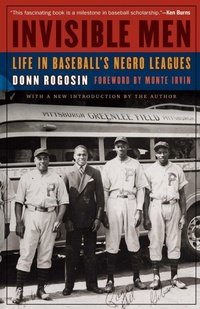
Invisible Men
Life in Baseball's Negro Leagues
Published on 1. October 2020
Book
Paperback/Softback
342 pages
978-1-4962-2339-5 (ISBN)
Description
This fascinating book is a milestone in baseball scholarship.-Ken Burns
This remarkable narrative is filled with the memories of many surviving Negro League players. What emerges is a glorious chapter in African American history and an often overlooked aspect of our American past. This edition features a new introduction by the author.
Jackie Robinson was a Negro Leaguer before he became a Major Leaguer. So too were Satchel Paige, Josh Gibson, Monte Irvin, Roy Campanella, Willie Mays, and Willie Wells before entering the Baseball Hall of Fame. Invisible Men is the story of their lives in baseball.
The Negro baseball leagues were among the most important Black institutions in segregated America, and the players were known and revered throughout Black America, both north and south. At a time when baseball was America's favorite sport, the Negro League players crossed the color barrier to play memorable games with their white Major League counterparts and paved the way for Latin American ballplayers to become part of baseball's history. The Negro Leaguers helped lay the groundwork for the civil rights movement with their achievements and examples.
This remarkable narrative is filled with the memories of many surviving Negro League players. What emerges is a glorious chapter in African American history and an often overlooked aspect of our American past. This edition features a new introduction by the author.
Jackie Robinson was a Negro Leaguer before he became a Major Leaguer. So too were Satchel Paige, Josh Gibson, Monte Irvin, Roy Campanella, Willie Mays, and Willie Wells before entering the Baseball Hall of Fame. Invisible Men is the story of their lives in baseball.
The Negro baseball leagues were among the most important Black institutions in segregated America, and the players were known and revered throughout Black America, both north and south. At a time when baseball was America's favorite sport, the Negro League players crossed the color barrier to play memorable games with their white Major League counterparts and paved the way for Latin American ballplayers to become part of baseball's history. The Negro Leaguers helped lay the groundwork for the civil rights movement with their achievements and examples.
Reviews / Votes
"This fascinating book is a milestone in baseball scholarship."-Ken Burns "There are certain tales of the arena so inspiring and enraging that they need periodic retelling. And when they can be retold with fresh scholarship and from a contemporary perspective, there is cause for cheering in both the bleachers and the library stacks."-Robert Lipsyte, New York Times Book Review "[Invisible Men] is both highly readable and thoughtfully provocative a quarter-century after its initial publication. . . . The two main strengths Rogosin brings to his book are the comprehensive sampling of first-hand accounts, and a passion for setting the Negro leagues in the context of American culture (and vice versa). . . . Through numerous stories and vintage photographs Invisible Men renders visible the still-unsung heroes of the Negro Leagues and conveys the full range of life of the Negro Leagues admirably, providing insiders' views of the rise and fall of a key African-American sports and social institution."-Material Culture "[Invisible Men] is still relevant, perhaps more relevant than ever as it recounts in telling detail life in baseball's Negro Leagues."-Sportsology.net "Enhanced by a superb selection of photographs and a useful index, this volume will appeal to the general reader as well as to the scholar, and it should find a place on many student reading lists. . . . It shows how sports history can enlighten areas of the past beyond the fields of play."-Jim Harper, Journal of Southern History "With fifty-two pages of appendices detailing year-by-year league standings and box scores from East-West all-star games, it is a valuable resource. . . . Invisible Men broke new ground when it was published and serves as an important document of early Negro League research."-Roberta J. Newman, Journal of African American HistoryMore details
Edition
New Edition
Language
English
Place of publication
Lincoln
United States
Edition type
New edition
Product notice
Paperback (trade)
Illustrations
40 photographs, 10 illustrations, 2 appendixes, index
Dimensions
Height: 212 mm
Width: 140 mm
Thickness: 25 mm
Weight
412 gr
ISBN-13
978-1-4962-2339-5 (9781496223395)
Copyright in bibliographic data and cover images is held by Nielsen Book Services Limited or by the publishers or by their respective licensors: all rights reserved.
Schweitzer Classification
Other editions
Additional editions
E-Book
10/2020
University of Nebraska Press
€39.49
Available for download
E-Book
03/2007
Bison Books
€20.99
Available for download
Previous edition
Book
03/2007
University of Nebraska Press
€45.99
Article exhausted; check for reprint
Persons
Donn Rogosin has produced and written documentaries for public television including the definitive film about the Negro Leagues, There Was Always Sun Shining Someplace, and East Wind, West Wind: Pearl Buck, the Woman Who Embraced the World. He has been a commentator for NPR's Morning Edition and is a past chairman of the New York State Humanities Council. He holds a PhD in American studies from the University of Texas. Monte Irvin played eight years in the Negro Leagues and eight years in the Major Leagues. He was inducted into the Hall of Fame in 1973.
Content
Foreword
Preface
Introduction: Present at the Reawakening
I. The World That Negro Baseball Made
II. Up from Obscurity
III. The Cult of Professionalism
IV. The Heat of the Harlem Moon
V. On the Road
VI. The Latin Connection
VII. Dusk and Dawn
Appendix
Index
Preface
Introduction: Present at the Reawakening
I. The World That Negro Baseball Made
II. Up from Obscurity
III. The Cult of Professionalism
IV. The Heat of the Harlem Moon
V. On the Road
VI. The Latin Connection
VII. Dusk and Dawn
Appendix
Index