

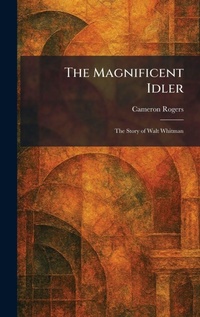
The Magnificent Idler
Description
"The Magnificent Idler: The Story of Walt Whitman" provides a vivid and engaging biographical portrait of one of America's most influential and revolutionary literary figures. This work delves into the life and development of the poet who would eventually produce the monumental "Leaves of Grass." The narrative traces Whitman's journey from his early days in Long Island and Brooklyn to his experiences during the American Civil War and his rise as a distinctive voice of democracy.
The biography captures the essence of Whitman's unconventional spirit-the "magnificent idler" who found profound inspiration in the common experiences of daily life and the vast landscapes of the United States. It explores the personal and professional milestones that shaped Whitman's unique poetic style, characterized by its free verse and expansive humanism. Readers will gain insight into the cultural and social milieu of 19th-century America that informed Whitman's work and his enduring legacy as a pioneer of modern literature.
Ideal for students of literature and enthusiasts of American history, this book offers a compelling look at the man behind the poetry, celebrating the creative genius who redefined the American literary landscape.
This work has been selected by scholars as being culturally important, and is part of the knowledge base of civilization as we know it. This work was reproduced from the original artifact, and remains as true to the original work as possible. Therefore, you may see the original copyright references, library stamps (as most of these works have been housed in our most important libraries around the world), and other notations in the work.
This work is in the public domain in the United States of America, and possibly other nations. Within the United States, you may freely copy and distribute this work, as no entity (individual or corporate) has a copyright on the body of the work.
As a reproduction of a historical artifact, this work may contain missing or blurred pages, poor pictures, errant marks, etc. Scholars believe, and we concur, that this work is important enough to be preserved, reproduced, and made generally available to the public. We appreciate your support of the preservation process, and thank you for being an important part of keeping this knowledge alive and relevant.