

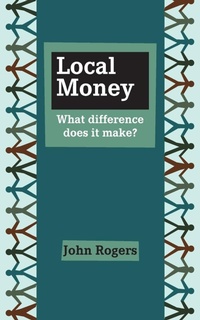
Local Money
What Difference Does it Make?
Published on 12. June 2013
Book
Paperback/Softback
64 pages
978-1-909470-19-4 (ISBN)
Description
Local money has been used for hundreds of years and throughout the world, yet very few of us understand what it's all about. Recently, Bristol and Brixton launched their own 'Pounds', but why? We all need money - to stay alive, to buy essential goods and services. But when jobs and money are in short supply it's largely because 97% of national money is controlled by the private banking industry. They trade, gamble and invest money where they can earn the biggest profit. And when the banks are in trouble so are ordinary people. By contrast, local currencies are owned by the community. They are designed to support local businesses, local jobs, local producers and services, local crafts and artists, community initiatives, charities, volunteers, etc. They create strong social networks and ensure that the community thrives even in a recession. By keeping the currency local, they protect it from speculators who will only invest if there is a profit to be had. This pamphlet explains the practical differences between national and local money - how local currencies work, what they can do that national money can't do, and why they are needed.
If you are lucky enough to have a local currency, find out why you should join it. If you don't, you might be inspired to start one!
Local money has been used for hundreds of years and throughout the world, yet very few of us understand what it's all about. Recently, Bristol and Brixton launched their own 'Pounds', but why? We all need money - to stay alive, to buy essential goods and services. But when jobs and money are in short supply it's largely because 97% of national money is controlled by the private banking industry. They trade, gamble and invest money where they can earn the biggest profit. And when the banks are in trouble so are ordinary people. By contrast, local currencies are owned by the community. They are designed to support local businesses, local jobs, local producers and services, local crafts and artists, community initiatives, charities, volunteers, etc. They create strong social networks and ensure that the community thrives even in a recession. By keeping the currency local, they protect it from speculators who will only invest if there is a profit to be had. This pamphlet explains the practical differences between national and local money - how local currencies work, what they can do that national money can't do, and why they are needed.
If you are lucky enough to have a local currency, find out why you should join it. If you don't, you might be inspired to start one!
If you are lucky enough to have a local currency, find out why you should join it. If you don't, you might be inspired to start one!
Local money has been used for hundreds of years and throughout the world, yet very few of us understand what it's all about. Recently, Bristol and Brixton launched their own 'Pounds', but why? We all need money - to stay alive, to buy essential goods and services. But when jobs and money are in short supply it's largely because 97% of national money is controlled by the private banking industry. They trade, gamble and invest money where they can earn the biggest profit. And when the banks are in trouble so are ordinary people. By contrast, local currencies are owned by the community. They are designed to support local businesses, local jobs, local producers and services, local crafts and artists, community initiatives, charities, volunteers, etc. They create strong social networks and ensure that the community thrives even in a recession. By keeping the currency local, they protect it from speculators who will only invest if there is a profit to be had. This pamphlet explains the practical differences between national and local money - how local currencies work, what they can do that national money can't do, and why they are needed.
If you are lucky enough to have a local currency, find out why you should join it. If you don't, you might be inspired to start one!
More details
Language
English
Place of publication
Bridport
United Kingdom
Dimensions
Height: 203 mm
Width: 127 mm
Thickness: 4 mm
Weight
80 gr
ISBN-13
978-1-909470-19-4 (9781909470194)
Copyright in bibliographic data and cover images is held by Nielsen Book Services Limited or by the publishers or by their respective licensors: all rights reserved.
Schweitzer Classification
Other editions
Additional editions
Person
John Rogers cut his teeth with local currencies by running a local exchange system in Wales for 10 years. He co-founded the Wales Institute for Community Currencies at the University of Newport, which he directed with Geoff Thomas from 2003-2007. They coordinated research into the effects of time banking in ex-mining communities, which was published by the Joseph Rowntree Foundation in 'Hidden Work'. John is co-author with Margrit Kennedy and Bernard Lietaer of People Money - the Promise of Regional Currencies and an Associate Scholar with the Institute for Leadership and Sustainability (IFLAS) at the University of Cumbria. He offers training and consulting for local currencies through Value for People and has spoken and led workshops at many international conferences.
John Rogers cut his teeth with local currencies by running a local exchange system in Wales for 10 years. He co-founded the Wales Institute for Community Currencies at the University of Newport, which he directed with Geoff Thomas from 2003-2007. They coordinated research into the effects of time banking in ex-mining communities, which was published by the Joseph Rowntree Foundation in 'Hidden Work'. John is co-author with Margrit Kennedy and Bernard Lietaer of People Money - the Promise of Regional Currencies and an Associate Scholar with the Institute for Leadership and Sustainability (IFLAS) at the University of Cumbria. He offers training and consulting for local currencies through Value for People and has spoken and led workshops at many international conferences.
John Rogers cut his teeth with local currencies by running a local exchange system in Wales for 10 years. He co-founded the Wales Institute for Community Currencies at the University of Newport, which he directed with Geoff Thomas from 2003-2007. They coordinated research into the effects of time banking in ex-mining communities, which was published by the Joseph Rowntree Foundation in 'Hidden Work'. John is co-author with Margrit Kennedy and Bernard Lietaer of People Money - the Promise of Regional Currencies and an Associate Scholar with the Institute for Leadership and Sustainability (IFLAS) at the University of Cumbria. He offers training and consulting for local currencies through Value for People and has spoken and led workshops at many international conferences.