

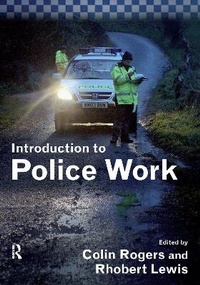
Introduction to Police Work
Published on 19. August 2016
Book
Hardback
328 pages
978-1-138-17817-5 (ISBN)
Description
Policing is in a profound period of change, the result of recent government reform, a renewed drive for professionalism as well as the need to adapt to a rapidly changing society. This book provides a highly readable and up to date introduction to the work of the police, exploring what this currently involved and the directions it may be going in. It is designed for student police officers starting their probation and training, students studying public or uniformed service courses in colleges, students taking undergraduate courses in policing and criminal justice, and anybody else who wants to know about policing today.
The book describes all the key elements of policing work. The first two parts look at how the police functions as an organization, with chapters devoted to important new areas of crime reduction partnerships and forensic support in investigation and enforcement. The third section covers key aspects of practical police work, with coverage of such challenging areas as anti-social behaviour and terrorism. The book contains a wide range of practical tasks and activities, and links are made throughout to the new Initial Police Learning and Development Programme and National Occupational Standards in Policing.
The book describes all the key elements of policing work. The first two parts look at how the police functions as an organization, with chapters devoted to important new areas of crime reduction partnerships and forensic support in investigation and enforcement. The third section covers key aspects of practical police work, with coverage of such challenging areas as anti-social behaviour and terrorism. The book contains a wide range of practical tasks and activities, and links are made throughout to the new Initial Police Learning and Development Programme and National Occupational Standards in Policing.
More details
Language
English
Place of publication
London
United Kingdom
Publishing group
Taylor & Francis Ltd
Target group
College/higher education
Dimensions
Height: 246 mm
Width: 174 mm
Weight
453 gr
ISBN-13
978-1-138-17817-5 (9781138178175)
Copyright in bibliographic data and cover images is held by Nielsen Book Services Limited or by the publishers or by their respective licensors: all rights reserved.
Schweitzer Classification
Other editions
Additional editions
Colin Rogers | Rhobert Lewis
Introduction to Police Work
E-Book
09/2013
1st Edition
Willan Publishing
€55.49
Available for download
Colin Rogers | Rhobert Lewis
Introduction to Police Work
E-Book
09/2013
1st Edition
Willan Publishing
€55.49
Available for download
Colin Rogers | Rhobert Lewis
Introduction to Police Work
Book
07/2007
Willan Publishing
€69.55
Shipment within 3-4 weeks
Persons
Colin Rogers is a Lecturer in Criminology in the Department of Health, Sport and Science at the University of Glamorgan. Prior to this, he was a Police Inspector with South Wales Police for 30 years. His areas of expertise include community safety partnerships, situational crime prevention, problem oriented partnerships and also police governance and accountability.
Rhobert Lewis is Associate Dean of the Department of Health, Sport and Science at the University of Glamorgan. His particular areas of expertise are police training, and forensic and police sciences.
Rhobert Lewis is Associate Dean of the Department of Health, Sport and Science at the University of Glamorgan. His particular areas of expertise are police training, and forensic and police sciences.
Content
1 Introduction 2 Important issues in cancer screening 3 Does screening work in Sweden? 4 Stonewalling the Cochrane report on screening 5 Troubling results in the Lancet 6 Harms dismissed by the Cochrane Breast Cancer Group 7 The Lancet publishes the harms of screening 8 Delayed media storm in the United States after our 2001 reviews 9 The Danish National Board of Health circles the wagons 11 Scientific debates in the United States 12 Publication of entire Cochrane review obstructed for 5 years 13 Editorial misconduct in the European Journal of Cancer 14 Tabar's 'beyond reason' studies 15 Other observational studies of breast cancer mortality 16 Overdiagnosis and overtreatment 17 Ad hominem attacks: a measure of desperation? 18 US recommendations for women aged 40-49 years 19 What have women been told? 20 Extraordinary exaggerations 21 Tabar threatens the BMJ with litigation 22 Falsehoods and perceived censorship in Sweden 23 Celebrating 20 years of breast screening in the United Kingdom 24 Can screening work? 25 Where is screening at today? 26 Where next?