

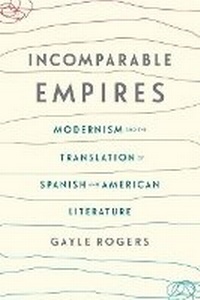
Incomparable Empires
Modernism and the Translation of Spanish and American Literature
Published on 1. November 2016
Book
Hardback
312 pages
978-0-231-17856-3 (ISBN)
Description
The Spanish-American War of 1898 seems to mark a turning point in both geopolitical and literary histories. The victorious American empire ascended and began its cultural domination of the globe in the twentieth century, while the once-mighty Spanish empire declined and became a minor state in the world republic of letters. But what if this narrative relies on several faulty assumptions, and what if key modernist figures in both America and Spain radically rewrote these histories at a foundational moment of modern literary studies? Following networks of American and Spanish writers, translators, and movements, Gayle Rogers uncovers the arguments that forged the politics and aesthetics of modernism. He revisits the role of empire-from its institutions to its cognitive effects-in shaping a nation's literature and culture. Ranging from universities to comparative practices, from Ezra Pound's failed ambitions as a Hispanist to Juan Ramon Jimenez's multilingual maps of modernismo, Rogers illuminates modernists' profound engagements with the formative dynamics of exceptionalist American and Spanish literary studies.
He reads the provocative, often counterintuitive arguments of John Dos Passos, who held that "American literature" could only flourish if the expanding U.S. empire collapsed like Spain's did. And he also details both a controversial theorization of a Harlem-Havana-Madrid nexus for black modernist writing and Ernest Hemingway's unorthodox development of a version of cubist Spanglish in For Whom the Bell Tolls. Bringing together revisionary literary historiography and rich textual analyses, Rogers offers a striking account of why foreign literatures mattered so much to two dramatically changing countries at a pivotal moment in history.
He reads the provocative, often counterintuitive arguments of John Dos Passos, who held that "American literature" could only flourish if the expanding U.S. empire collapsed like Spain's did. And he also details both a controversial theorization of a Harlem-Havana-Madrid nexus for black modernist writing and Ernest Hemingway's unorthodox development of a version of cubist Spanglish in For Whom the Bell Tolls. Bringing together revisionary literary historiography and rich textual analyses, Rogers offers a striking account of why foreign literatures mattered so much to two dramatically changing countries at a pivotal moment in history.
Reviews / Votes
Gayle Rogers develops a complex and nuanced literary history of political, institutional, and aesthetic transformations through translation across two empires. Incomparable Empires is an immense achievement for global and comparative modernist studies. -- Joshua L. Miller, author of Accented America: The Cultural Politics of Multilingual Modernism By de-coupling their translational practices from the national literary traditions and imperial teleologies they were supposed to express and reflect, the writers analyzed in Incomparable Empires carved out creative spaces that radically reconfigured U.S. and Spanish literatures. Rogers's brilliantly contextualized recovery of their alternative stratagems of translation promises to foster a grand scale re-thinking of the formation, structure, and purposes of our extant comparative literary histories of the early twentieth century. -- Donald E. Pease, author of The New American Exceptionalism Taking the Jamesonian view of imperialism in unexpected and original directions, Rogers explores the rivalry of the Spanish and U.S. empires at the intersection of modernism and translation. This volume achieves what one would have thought possible only from several books, namely writing a new history of two fields traditionally considered to be unrelated: Hispanism and American studies. -- Cesar Dominguez, coauthor of Introducing Comparative Literature: New Trends and Applications A groundbreaking contribution to such transnational fields as global modernism and world literature studies. -- Alejandro Mejias-Lopez, author of The Inverted Conquest: The Myth of Modernity and the Transatlantic Onset of Modernism Rogers has written a superlative examination of modernismo's cultural and literary production... Essential. CHOICEMore details
Series
Language
English
Place of publication
New York
United States
Product notice
Trade binding
Dimensions
Height: 229 mm
Width: 152 mm
Weight
553 gr
ISBN-13
978-0-231-17856-3 (9780231178563)
Copyright in bibliographic data and cover images is held by Nielsen Book Services Limited or by the publishers or by their respective licensors: all rights reserved.
Schweitzer Classification
Other editions
Additional editions
Book
12/2018
Columbia University Press
€27.24
Article not available at the moment
E-Book
12/2016
1st Edition
Columbia University Press
from
€24.95
Available for download
Person
Gayle Rogers is associate professor of English at the University of Pittsburgh. He is the author of Modernism and the New Spain: Britain, Cosmopolitan Europe, and Literary History (2012) and coauthor, with Sean Latham, of Modernism: Evolution of an Idea (2015).
Content
Acknowledgments Introduction: Modernism, Translation, and the Fields of Literary History Part I. American Modernism's Hispanists 1. "Splintered Staves": Pound, Comparative Literature, and the Translation of Spanish Literary History 2. Restaging the Disaster: Dos Passos, Empire, and Literature After the Spanish-American War Part II. Spain's American Translations 3. Jimenez, Modernism/o, and the Languages of Comparative Modernist Studies 4. Unamuno, Nativism, and the Politics of the Vernacular; or, On the Authenticity of Translation Part III. New Genealogies 5. Negro and Negro: Translating American Blackness in the Shadows of the Spanish Empire 6. "Spanish Is a Language Tu": Hemingway's Cubist Spanglish and Its Legacies Conclusion: Worlds Between Languages-the Spanglish Quixote Notes Index