

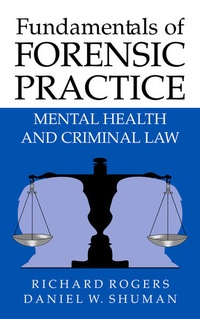
Fundamentals of Forensic Practice
Mental Health and Criminal Law
Published on 30. August 2005
Book
Hardback
VIII, 446 pages
978-0-387-25226-1 (ISBN)
Description
Forensic psychologists and psychiatrists are increasingly asked to provide expertise to courts and attorneys in the criminal justice system. To do so effectively, they must stay abreast of important advances in the understanding of legal standards as well as new developments in sophisticated measures and the methods for their assessment. Fundamentals of Forensic Practice is designed to address the critical issues that are faced by mental health experts in their role of conducting assessments, presenting findings, and preparing for challenges to admissibility and credibility.
Uniquely practical and comprehensive, this volume operationalizes legal standards and describes empirically validated methods for their evaluation. Not only is this essential for mental health professionals, but it is equally valuable to criminal attorneys. Lawyers require both clinical knowledge and understanding of legal standards in order to prepare their own experts and to challenge those on the opposing side. For both clinical and legal experts Fundamentals of Forensic Practice offers a full view of all phases of criminal proceedings:
- Pretrial-diversion, determinations of bail, waivers of Miranda rights, and the capacity to consent to searches.
- Trial-competency to stand trial and criminal responsibility. Beyond insanity, the latter addresses mens rea, automatism, and psychological context evidence, such as battered-woman syndrome.
- Post-trial-sentencing, capital sentencing, competency to be executed, and other post-conviction issues.
Other key features include:
- Chapters on specific criminal issues in a consistent format, with comprehensive coverage of legal standards and relevant clinical methods
- Guidelines for conducting more effective forensic evaluations
- In-depth coverage of specialized assessments, eg. malingering, sexual predator cases, and the insanity defense.
- A detailed overview of direct and cross-examination strategies
This book is the second collaboration between Rogers and Shuman. As individual authors, each received the American Psychiatric Association's prestigious Guttmacher Award for their outstanding contributions to forensic psychiatry.
Reviews / Votes
This is likely to be "the" book for frequent experts who want to better understand their roles in this complex environment, as well as the lawyers who utilize them. Well organized, easy to use, scholarly and practical, Fundamental of Forensic Practice is an important foundational text for training programs in forensic psychology, psychiatry, and metal health law.
- William H. Reid, M.D., M.P.H., Clinical and Adjunct Professor of Psychiatry, University of Texas Health Science Center, Texas A&M College of Medicine, and Texas Tech Health Science Center
More details
Edition
2005 ed.
Language
English
Place of publication
New York
United States
Target group
Professional and scholarly
Professional/practitioner
Illustrations
VIII, 446 p.
Dimensions
Height: 241 mm
Width: 160 mm
Thickness: 30 mm
Weight
846 gr
ISBN-13
978-0-387-25226-1 (9780387252261)
DOI
10.1007/b106925
Schweitzer Classification
Other editions
Additional editions
Book
10/2010
Springer
€106.99
Shipment within 15-20 days
E-Book
04/2006
1st Edition
Springer
€96.29
Available for download
Persons
Richard Rogers, Ph.D., ABPP, ist Regents Professor für Psychologie an der University of North Texas. Im Jahr 2014 erhielt er den Eminent Faculty Award, eine der höchsten Auszeichnungen der Universität, die jährlich an einen herausragenden Professor verliehen wird. Zuvor bekleidete er wichtige Positionen in der Abteilung für Psychiatrie und Recht an der Rush University und in der Abteilung für forensische Psychiatrie an der University of Toronto.Dr. Rogers ist auf nationaler Ebene für seine Beiträge zur forensischen Psychologie und Psychiatrie anerkannt. Zu den nationalen Auszeichnungen gehören (1) der Manfred S. Guttmacher Award der American Psychiatric Association, (2) der Distinguished Contributions to Forensic Psychology Award der American Academy of Forensic Psychologists und (3) der Amicus Award der American Academy of Psychiatry and Law.
Seine Beiträge zur klinischen Psychologie und zum Fachgebiet der Psychologie wurden ebenfalls gewürdigt. Im Jahr 2007 zeichnetedie Society of Clinical Psychology Dr. Rogers mit dem Distinguished Professional Contributions to Clinical Psychology aus. Im Jahr 2008 verlieh die American Psychological Association (APA) den prestigeträchtigen Distinguished Professional Contributions to Applied Research Award. Im Jahr 2011 ehrte die APA Dr. Rogers erneut mit ihrem Distinguished Professional Contributions to Public Policy Award. Im Jahr 2011 war er einer von nur drei Wissenschaftlern in der Geschichte der APA, die beide nationalen Auszeichnungen erhielten.Eric Y. Drogin ist Fellow der American Academy of Forensic Psychology, Diplomate und ehemaliger Präsident des American Board of Forensic Psychology und Diplomate des American Board of Professional Psychology. Dr. Drogin ist derzeit Dozent an der Harvard Medical School (als Mitglied des Programms für Psychiatrie und Recht und als Mitarbeiter des forensischen Psychiatriedienstes in der Abteilung für Psychiatrie am Beth Israel Deaconess Medical Center) und am Harvard Longwood Psychiatry Residency Training Program. Darüber hinaus war er Vorsitzender des American Psychological Association's Committee on Professional Practice and Standards, Vorsitzender des APA's Committee on Legal Issues, Vorsitzender der APA's Joint Task Force with the American Bar Association und Präsident der New Hampshire Psychological Association. Dr. Drogin erhielt seinen Doktor der Philosophie (Ph.D.) in Klinischer Psychologie von der Hahnemann University.
Content
Foundations of Practice.- Clinical and Legal Framework.- Malingering and Deception in Criminal Evaluations.- The Nature of Experts and Their Testimony.- Specific Criminal Issues.- Forensic Determinations of Diversion and Bail.- Miranda and Beyond: Competencies Related to Police Investigations.- Competency to Stand Trial.- The Insanity Defense.- Beyond Insanity: Other Issues of Criminal Responsibility.- Sentencing Recommendations and Capital Issues.- Competency to be Executed and Other Post-Conviction Relief Issues.- Sexual Predator Determinations.- Integration: Themes in Criminal Forensic Practice.