

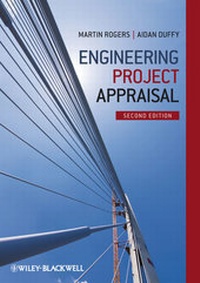
Engineering Project Appraisal
2nd Edition
Published on 21. September 2012
Book
Paperback/Softback
398 pages
978-0-470-67299-0 (ISBN)
Description
In most cases of civil engineering development, a range of alternative schemes meeting project goals are feasible, so some form of evaluation must be carried out to select the most appropriate to take forward. Evaluation criteria usually include the economic, environmental and social contexts of a project as well as the engineering challenges, so engineers must be familiar with the processes and tools used.
The second edition of Engineering Project Appraisal equips students with the understanding and analytical tools to carry out effective appraisals of alternative development schemes, using both economic and non-economic criteria. The building blocks of economic appraisal are covered early, leading to techniques such as net present worth, internal rate of return and annual worth. Cost Benefit Analysis is dealt with in detail, together with related methods such as Cost Effectiveness and the Goal Achievement Matrix. The text also details three multi-criteria models which have proved useful in the evaluation of proposals in the transportation, solid waste, energy and water resources fields: the Simple Additive Weighting (SAW) Model, the Analytic Hierarchy Process (AHP) technique and Concordance Analysis. There is a full discussion dealing with risk and uncertainty in these models.
With many worked examples and case studies, Engineering Project Appraisal is an essential text for both undergraduate and postgraduate students on professional civil engineering courses, and it is expected that students on planning and construction management courses will find it a valuable addition to their reading.
More details
Product info
Paperback
Edition
2. Auflage
Language
English
Place of publication
Hoboken
United Kingdom
Publishing group
John Wiley and Sons Ltd
Target group
Professional and scholarly
Product notice
Paperback (trade)
Dimensions
Height: 244 mm
Width: 174 mm
Thickness: 20 mm
Weight
761 gr
ISBN-13
978-0-470-67299-0 (9780470672990)
Schweitzer Classification
Other editions
Additional editions
Martin Rogers | Aidan Duffy
Engineering Project Appraisal
E-Book
07/2012
2nd Edition
Wiley-Blackwell
€56.99
Available for download
Martin Rogers | Aidan Duffy
Engineering Project Appraisal
E-Book
06/2012
2nd Edition
Wiley-Blackwell
€56.99
Available for download
Persons
Martin Rogers BE, MEngSc, PhD, BA(Public Ad), CEng, MICE, MRTPI, Chartered Engineer and Chartered Town Planner is currently an Assistant Head of School in the School of Civil and Building Services Engineering.
Aidan Duffy BA, BAI, MBA, PhD is a lecturer at the Dublin Institute of Technology where he specialises in the financial, economic and policy assessment of renewable energy technologies and energy efficient systems.
Content
Preface, xiii
Introduction, xv
PART 1 ECONOMICS-BASED PROJECT APPRAISAL TECHNIQUES, 1
1 Decision Making and Project Appraisal, 3
1.1 Decision making context, 3
1.2 Techniques for decision making, 4
1.3 Primacy of the rational model, 13
1.4 Decision-making conditions, 14
1.5 Project planning process, 16
1.6 Example of a decision process, 22
1.7 Summary, 25
1.8 Review of succeeding chapters, 26
2 Basic Tools for Economic Appraisal 29
2.1 Introduction, 29
2.2 The time value of money, 29
2.3 The estimation of interest, 30
2.4 Simple and compound interest, 31
2.5 Nominal and effective interest rates, 33
2.6 Continuous compounding, 34
2.7 Time equivalence, 35
2.8 Economic computation, 37
2.9 Summary, 50
3 Present Worth Evaluation 51
3.1 Introduction, 51
3.2 Present worth - the comparison process, 52
3.3 Summary, 65
4 Equivalent Annual Worth Computations 67
4.1 Introduction, 67
4.2 The pattern of capital recovery, 67
4.3 Modifying annual payments to include salvage value, 69
4.4 Evaluating a single project, 71
4.5 The comparison process, 72
4.6 Summary, 77
5 Rate of Return Computation 79
5.1 Introduction, 79
5.2 Minimum Acceptable Rate of Return (MARR), 79
5.3 Internal Rate of Return (IRR), 80
5.4 IRR for a single project, 80
5.5 Incremental analysis, 87
5.6 Summary, 94
6 Benefit/Cost Ratio, Depreciation and Taxation 96
6.1 Introduction, 96
6.2 Costs, benefits and disbenefits, 96
6.3 Estimating the benefit/cost ratio for a single project, 97
6.4 Comparing mutually exclusive options using incremental benefit/cost ratios, 98
6.5 Depreciation, 99
6.6 Taxation, 102
6.7 Summary, 104
7 Cost-Benefit Analysis of Public Projects 107
7.1 Introduction, 107
7.2 Historical background to cost-benefit analysis, 108
7.3 Theoretical basis for cost-benefit analysis, 110
7.4 The procedure of cost-benefit analysis, 111
7.5 Identifying the main project options, 111
7.6 Identifying costs and benefits, 111
7.7 Placing valuations on all costs and benefits/disbenefits, 112
7.8 Assessing and comparing the cost-benefit performance of options, 115
7.9 Sensitivity analysis, 117
7.10 Final decision, 119
7.11 Case study: the cost-benefit analysis of a highway improvement project, 119
7.12 Case study: water supply scheme in a developing country, 128
7.13 Case study: cost-benefit analysis of sewer flooding alleviation, 135
7.14 Advantages and disadvantages of traditional cost-benefit analysis, 137
7.15 Techniques for valuing non-economic impacts, 138
7.16 Using cost-benefit analysis within different areas of engineering, 148
7.17 Summary, 151
8 Economic Analysis of Renewable Energy Supply and Energy Efficient Projects 154
8.1 Introduction, 154
8.2 Policy context, 154
8.3 Renewable energy supply and energy efficient technologies, 157
8.4 Economic measures for renewable energy and energy efficient projects, 163
8.5 Estimating GHG emissions, 179
8.6 Uncertainty, 183
8.7 Case studies, 186
9 Value for Money in Construction 193
9.1 Definition of Value for Money, 193
9.2 Defining Value for Money in the context of a construction project, 194
9.3 Achieving Value for Money during construction, 194
9.4 Whole-life costing, 195
9.5 The concept of 'milestones', 196
9.6 Detailed description of the Value for Money framework, 197
9.7 Value for Money and design, 206
9.8 Is there a conflict between Sustainability and Value for Money, 211
9.9 The role of better managed construction in delivering projects on time and within budget, 213
10 Other Economic Analysis Techniques 216
10.1 Introduction, 216
10.2 Cost effectiveness, 216
10.3 The Planned Balance Sheet, 220
10.4 Hill's Goal Achievement Matrix, 227
10.5 Summary, 239
PART 2 NON-ECONOMIC-BASED PROJECT APPRAISAL TECHNIQUES 241
11 Multicriteria Analysis 243
11.1 Introduction, 243
11.2 Multicriteria evaluation models, 244
11.3 Simple non-compensatory methods, 246
11.4 Summary, 255
12 The Simple Additive Model 257
12.1 Background, 257
12.2 Introduction to the Simple Additive Weighting (SAW) Method, 259
12.3 Sensitivity testing, 261
12.4 Probabilistic Additive Weighting, 264
12.5 Assigning weights to the decision criteria, 270
12.6 Checklists, 282
12.7 Case Study: Using the Simple Additive Weighting Model to choose the best transport strategy for a major urban centre, 292
12.8 Summary, 298
13 Analytic Hierarchy Process (AHP) 300
13.1 Introduction, 300
13.2 Hierarchies, 301
13.3 Establishing priorities within hierarchies, 301
13.4 Establishing and calculating priorities, 303
13.5 Relationship between AHP and the Simple Additive Weighting (SAW) model, 316
13.6 Summary, 316
14 Concordance Techniques 318
14.1 Introduction, 318
14.2 Concordance Analysis, 319
14.3 PROMETHEE I and II, 321
14.4 ELECTRE I, 328
14.5 Other Concordance Models, 331
14.6 Summary, 339
15 Concluding Comments 343
15.1 Introduction, 343
15.2 Which project appraisal technique should one use? 343
15.3 Future challenges, 344
References, 345
Interest Factor Tables, 346
Index, 368