

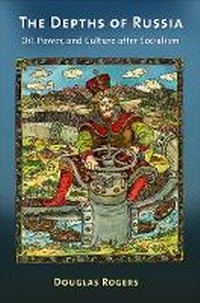
The Depths of Russia
Oil, Power, and Culture After Socialism
Published on 23. November 2015
Book
Paperback/Softback
394 pages
978-0-8014-5658-9 (ISBN)
Description
Russia is among the world's leading oil producers, sitting atop the planet's eighth largest reserves. Like other oil-producing nations, it has been profoundly transformed by the oil industry. In The Depths of Russia, Douglas Rogers offers a nuanced and multifaceted analysis of oil's place in Soviet and Russian life, based on ethnographic fieldwork and archival research in the Perm region of the Urals. Moving beyond models of oil calibrated to capitalist centers and postcolonial "petrostates," Rogers traces the distinctive contours of the socialist-and then postsocialist-oil complex, showing how oil has figured in the making and remaking of space and time, state and corporation, exchange and money, and past and present. He pays special attention to the material properties and transformations of oil (from depth in subsoil deposits to toxicity in refining) and to the ways oil has echoed through a range of cultural registers.
The Depths of Russia challenges the common focus on high politics and Kremlin intrigue by considering the role of oil in barter exchanges and surrogate currencies, industry-sponsored social and cultural development initiatives, and the city of Perm's campaign to become a European Capital of Culture. Rogers also situates Soviet and post-Soviet oil in global contexts, showing that many of the forms of state and corporate power that emerged in Russia after socialism are not outliers but very much part of a global family of state-corporate alliances gathered at the intersection of corporate social responsibility, cultural sponsorship, and the energy and extractive industries.
The Depths of Russia challenges the common focus on high politics and Kremlin intrigue by considering the role of oil in barter exchanges and surrogate currencies, industry-sponsored social and cultural development initiatives, and the city of Perm's campaign to become a European Capital of Culture. Rogers also situates Soviet and post-Soviet oil in global contexts, showing that many of the forms of state and corporate power that emerged in Russia after socialism are not outliers but very much part of a global family of state-corporate alliances gathered at the intersection of corporate social responsibility, cultural sponsorship, and the energy and extractive industries.
Reviews / Votes
Rogers focuses on how things work within oil corporations: how the new oil giants evolved out of Soviet carcasses; how they operate in symbiosis with the state; and, in particular, how they directly shape social and cultural institutions. The intersection of oil, money, and power might be a sexier topic. But the ways in which politicians and corporate bosses redefine and blend roles on the ground-indeed, to the point that Lukoil-Perm assumed the lead in a grand campaign to make the city of Perm a capital of culture, competing with St. Petersburg-provide more insight into the real texture of everyday.(Foreign Affairs) In general, many of the books trying to explain contemporary Russia are awkwardly similar in their approaches.... Douglas Rogers' book on the role of oil as a source for both state-building and a re-invention of culture in the Perm region is an innovative and enriching... exception to this trend.
(Transitions Online) [The Depths of Russia]... shows how a detailed anthropological study of a region far from Moscow and St. Petersburg can reveal new and unexpected information about developments in Russia. These results make this a book well worth reading and pondering over. It is an important contribution to anthropology/ethnography, business studies, and the understanding of postsocialist Russia.
(Slavic Review)
More details
Language
English
Place of publication
Ithaca
United States
Target group
College/higher education
Professional and scholarly
Product notice
Paperback (trade)
Illustrations
13 halftones, 3 maps - 13 Halftones, black and white
Dimensions
Height: 235 mm
Width: 155 mm
Thickness: 22 mm
Weight
907 gr
ISBN-13
978-0-8014-5658-9 (9780801456589)
Copyright in bibliographic data and cover images is held by Nielsen Book Services Limited or by the publishers or by their respective licensors: all rights reserved.
Schweitzer Classification
Other editions
Additional editions
E-Book
11/2015
Cornell University Press
€27.49
Available for download
Person
Douglas Rogers is Associate Professor of Anthropology at Yale University. He is the author of The Old Faith and the Russian Land: A Historical Ethnography of Ethics in the Urals, also from Cornell.
Content
Introduction: Oil, States and Corporations, and the Politics of Culture
Part 1. From Socialist to Postsocialist Oil
1. The Socialist Oil Complex: Scarcity and Hierarchies of Prestige in the Second Baku
2. Circulation before Privatization: Petrobarter and New Corporate Forms
3. The Lukoilization of Production: Space, Capital, and Surrogate Currencies
Part 2. The Book Years
4. State/Corporation: The Social and Cultural Project Movement
5. Corporation/State: Lukoil as General Partner of the Perm Region
Part 3. The Cultural Front
6. Oil and Culture: The Depths of Postsocialism
7. Alternative Energies: Lukoil-Perm in Corporate and Cultural Fields
8. "Bilbao on the Kama"?: The Perm Cultural Project and Its Critics
Appendix: Governors of the Perm Region in the Post-Soviet Period
Glossary
References
Index
Part 1. From Socialist to Postsocialist Oil
1. The Socialist Oil Complex: Scarcity and Hierarchies of Prestige in the Second Baku
2. Circulation before Privatization: Petrobarter and New Corporate Forms
3. The Lukoilization of Production: Space, Capital, and Surrogate Currencies
Part 2. The Book Years
4. State/Corporation: The Social and Cultural Project Movement
5. Corporation/State: Lukoil as General Partner of the Perm Region
Part 3. The Cultural Front
6. Oil and Culture: The Depths of Postsocialism
7. Alternative Energies: Lukoil-Perm in Corporate and Cultural Fields
8. "Bilbao on the Kama"?: The Perm Cultural Project and Its Critics
Appendix: Governors of the Perm Region in the Post-Soviet Period
Glossary
References
Index