

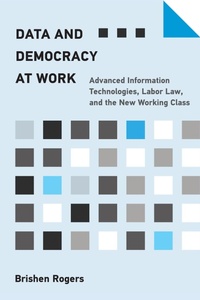
Data and Democracy at Work
Advanced Information Technologies, Labor Law, and the New Working Class
Published on 21. March 2023
Book
Paperback/Softback
304 pages
978-0-262-54513-6 (ISBN)
Description
"An exploration of how labor law has protected companies' rights to surveil their employees and limit worker power, and how it might be reformed"--
More details
Language
English
Place of publication
Cambridge (Massachusetts)
United States
Publishing group
MIT Press Ltd
Dimensions
Height: 226 mm
Width: 151 mm
Thickness: 21 mm
Weight
330 gr
ISBN-13
978-0-262-54513-6 (9780262545136)
Copyright in bibliographic data and cover images is held by Nielsen Book Services Limited or by the publishers or by their respective licensors: all rights reserved.
Schweitzer Classification
Other editions
Additional editions
Brishen Rogers
Data and Democracy at Work
Advanced Information Technologies, Labor Law, and the New Working Class
E-Book
03/2023
MIT Press
€48.99
Available for download
Person
Brishen Rogers is a Professor of Law at Georgetown University Law Center. His recent scholarship has been published in leading law reviews including the Yale Law Journal, Harvard Civil Rights-Civil Liberties Law Review, and the Texas Law Review. He has also written for the Boston Review, the New York Times, Onlabor.org, and the Law & Political Economy Blog, or lpeblog.org. Professor Rogers' scholarship has also been cited in landmark decisions by the California Supreme Court and the Court of Justice of the European Union.
Content
Acknowledgments ix
Introduction 1
1 Technology, the Service Transition, and the New Working Class 13
2 The Legal Construction of Workplace Neoliberalism 35
3 Inductive Knowledge and Digital Taylorism 57
4 Workplace Privacy and Associational Power 81
5 Data, Fissuring, and Consolidation 105
6 Data and Economic Democracy 131
Afterword: Law and the Technological Mundane 157
Notes 161
Selected Bibliography 239
Index 267
Introduction 1
1 Technology, the Service Transition, and the New Working Class 13
2 The Legal Construction of Workplace Neoliberalism 35
3 Inductive Knowledge and Digital Taylorism 57
4 Workplace Privacy and Associational Power 81
5 Data, Fissuring, and Consolidation 105
6 Data and Economic Democracy 131
Afterword: Law and the Technological Mundane 157
Notes 161
Selected Bibliography 239
Index 267