

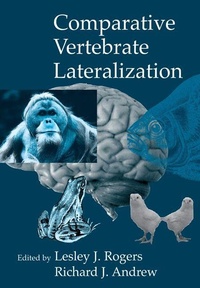
Comparative Vertebrate Lateralization
Published on 18. July 2008
Book
Paperback/Softback
672 pages
978-0-521-78700-0 (ISBN)
Description
No longer viewed as a characteristic unique to humans, brain lateralization is considered a key property of most, if not all, vertebrates. This field of study provides a firm basis from which to examine a number of important issues in the study of brain and behaviour. This book takes a comparative and integrative approach to lateralization in a wide range of vertebrate species, including humans. It highlights model systems that have proved invaluable in elucidating the function, causes, development, and evolution of lateralization. The book is arranged in four parts, beginning with the evolution of lateralization, moving to its development, to its cognitive dimensions, and finally to its role in memory. Experts in lateralization in lower vertebrates, birds, non-primate mammals, and primates have contributed chapters in which they discuss their own research and consider its implications to humans. The book is suitable for researchers, graduates and advanced undergraduates in psychology, neuroscience and the behavioral sciences.
Reviews / Votes
'Andrew & Roger perform an enormous service in bringing data from animal behaviour, neuroanatomy and electrophysiology into contact with traditional zoological concerns such as genetics, embryology and population biology.' Journal of Animal Behaviour 'Whatever the outcome of the war, this book will be a key starting point for those trying to understand it (or perhaps to fight in it).' Annals of Human BiologyMore details
Language
English
Place of publication
Cambridge
United Kingdom
Target group
Professional and scholarly
College/higher education
Product notice
Paperback (trade)
Illustrations
20 Tables, unspecified; 4 Halftones, unspecified; 66 Line drawings, unspecified
Dimensions
Height: 244 mm
Width: 170 mm
Thickness: 36 mm
Weight
1140 gr
ISBN-13
978-0-521-78700-0 (9780521787000)
Copyright in bibliographic data and cover images is held by Nielsen Book Services Limited or by the publishers or by their respective licensors: all rights reserved.
Schweitzer Classification
Other editions
Additional editions
Lesley J. Rogers | Richard Andrew
Comparative Vertebrate Lateralization
Book
03/2002
Cambridge University Press
€168.70
Shipment within 15-20 days
Persons
Lesley J. Rogers is Emeritus Professor at the Centre for Neuroscience and Animal Behaviour, University of New England, Armidale, Australia. A Fellow of the Australian Academy of Science, she has made outstanding contributions to understanding brain development and behaviour, including the discovery of lateralization in the chick forebrain at a time when lateralization was thought to be unique to humans. Her publications, numbering over 450, include 16 books and over 200 scientific papers and book chapters, mainly in the field of brain and behaviour with a focus on development and lateralization. She has received a number of awards for excellence in research, including a Special Investigator Award from the Australian Research Council, an Australian Centenary Medal, and the Clarke Medal from the Royal Society of New South Wales.
Content
Preface; Introduction; Part I. Evolution of Lateralization: 1. How ancient is lateralization? G. Vallortigara and A. Bisazza; 2. The earliest origins and subsequent evolution of lateralization R. J. Andrew; 3. The nature of lateralization in tetrapods R. J. Andrew and L. J. Rogers; 4. Advantages and disadvantages of lateralization L. J. Rogers; Part II. Development of Lateralization: 5. Behavioral development and lateralization R. J. Andrew; 6. Factors affecting the development of lateralization in chicks C. Deng and L. J. Rogers; 7. Ontogony of visual lateralization in pigeons O. Guentuerkuen; 8. Development of laterality and the role of the corpus callosum in rodents and humans P. E. Cowell and V. H. Denenberg; 9. Posture and laterality in human and nonhuman primates: asymmetries in maternal handling and the infant's early motor asymmetries E. Damerose and J. Vauclair; Part III. Cognition and Lateralization: 10. Evidence of cerebral lateralization from senses other than vision R. J. Andrew and J. A. S. Watkins; 11. Facing an obstacle: lateralization of object and spatial cognition G. Vallortigara and L. Regolin; 12. Laterality of communicative behaviors in nonhuman primates: a critical analysis W. D. Hopkins and S. F. Carriba; 13. Specialized processing of primate facial and vocal expressions: evidence for cerebral asymmetries D. J. Weiss, A. A. Ghazanfar, C. T. Miller and M. D. Hauser; Part IV. Lateralization and Memory: 14. Memory and lateralized recall A. N. B. Johnston and S. P. R. Rose; 15. Memory formation and brain lateralization R. J. Andrew; Epilogue; Appendix; Index.